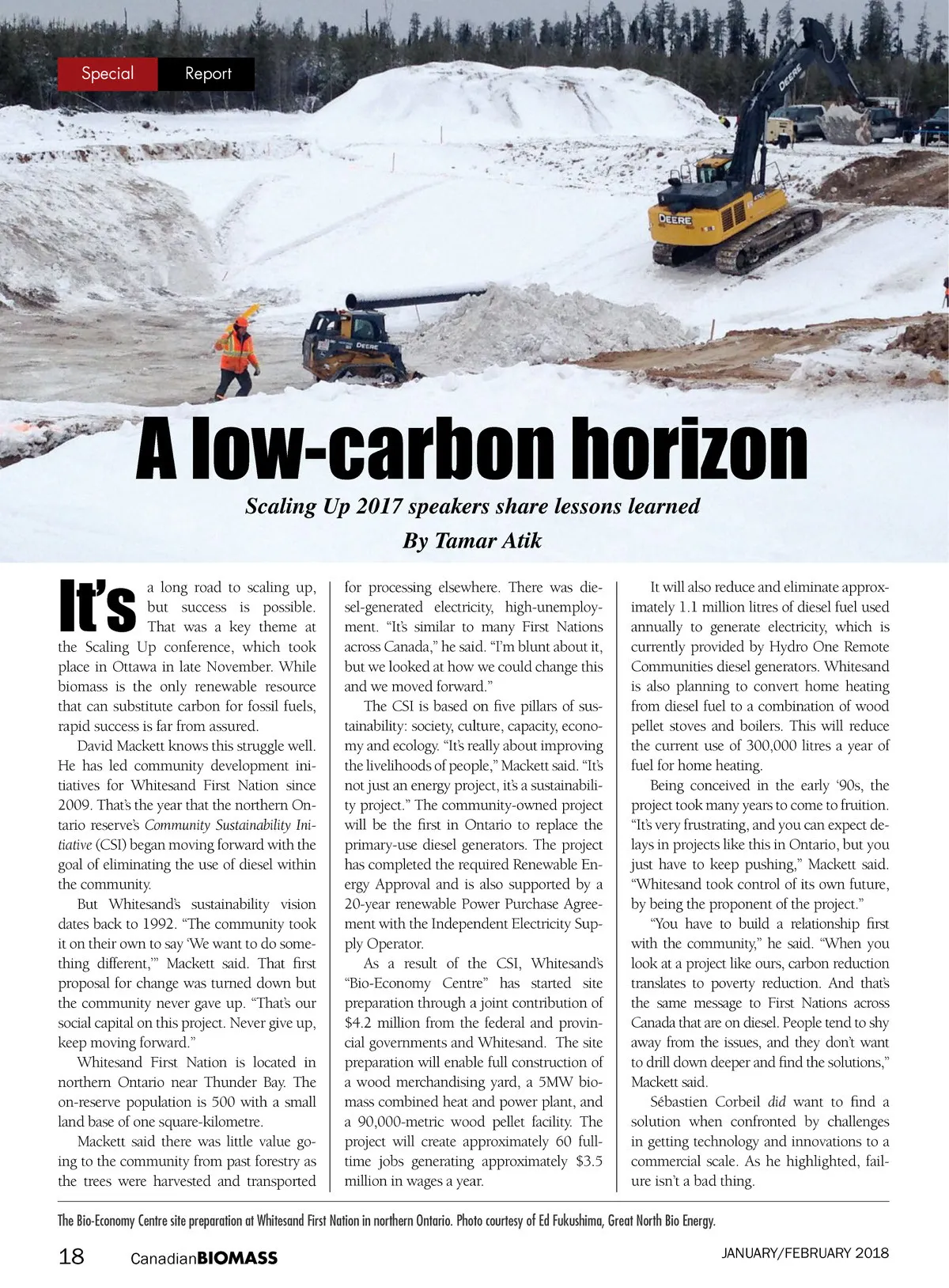
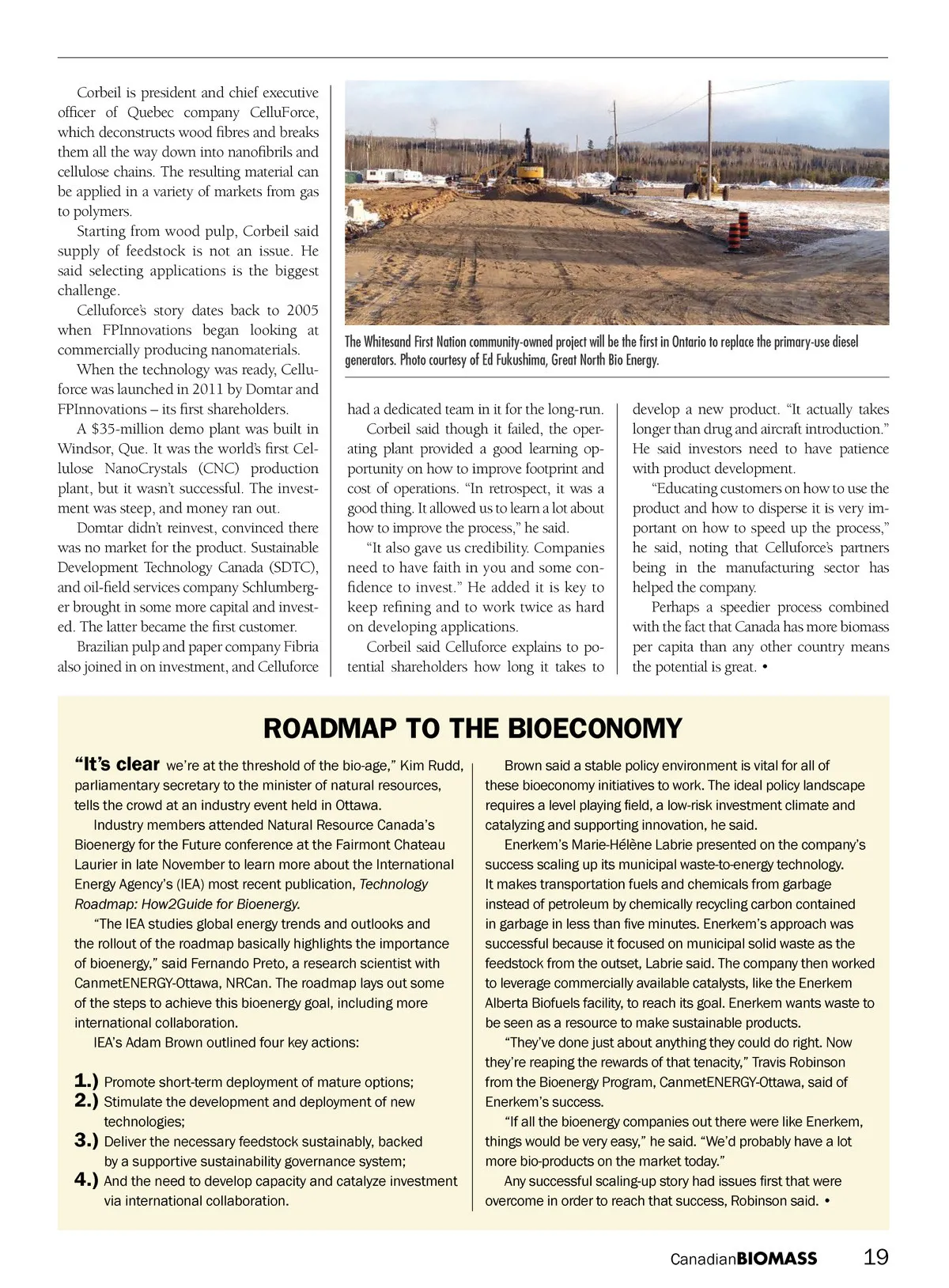
Corbeil is president and chief executive officer of Quebec company CelluForce, which deconstructs wood fibres and breaks them all the way down into nanofibrils and cellulose chains. The resulting material can be applied in a variety of markets from gas to polymers. Starting from wood pulp, Corbeil said supply of feedstock is not an issue. He said selecting applications is the biggest challenge. Celluforce’s story dates back to 2005 when FPInnovations began looking at commercially producing nanomaterials. When the technology was ready, Cellu-force was launched in 2011 by Domtar and FPInnovations – its first shareholders. A $35-million demo plant was built in Windsor, Que. It was the world’s first Cel-lulose NanoCrystals (CNC) production plant, but it wasn’t successful. The invest-ment was steep, and money ran out. Domtar didn’t reinvest, convinced there was no market for the product. Sustainable Development Technology Canada (SDTC), and oil-field services company Schlumberg-er brought in some more capital and invest-ed. The latter became the first customer. Brazilian pulp and paper company Fibria also joined in on investment, and Celluforce The Whitesand First Nation community-owned project will be the first in Ontario to replace the primary-use diesel generators. Photo courtesy of Ed Fukushima, Great North Bio Energy. had a dedicated team in it for the long-run. Corbeil said though it failed, the oper-ating plant provided a good learning op-portunity on how to improve footprint and cost of operations. “In retrospect, it was a good thing. It allowed us to learn a lot about how to improve the process,” he said. “It also gave us credibility. Companies need to have faith in you and some con-fidence to invest.” He added it is key to keep refining and to work twice as hard on developing applications. Corbeil said Celluforce explains to po-tential shareholders how long it takes to develop a new product. “It actually takes longer than drug and aircraft introduction.” He said investors need to have patience with product development. “Educating customers on how to use the product and how to disperse it is very im-portant on how to speed up the process,” he said, noting that Celluforce’s partners being in the manufacturing sector has helped the company. Perhaps a speedier process combined with the fact that Canada has more biomass per capita than any other country means the potential is great. • ROADMAP TO THE BIOECONOMY “It’s clear we’re at the threshold of the bio-age,” Kim Rudd, parliamentary secretary to the minister of natural resources, tells the crowd at an industry event held in Ottawa. Industry members attended Natural Resource Canada’s Bioenergy for the Future conference at the Fairmont Chateau Laurier in late November to learn more about the International Energy Agency’s (IEA) most recent publication, Technology Roadmap: How2Guide for Bioenergy. “The IEA studies global energy trends and outlooks and the rollout of the roadmap basically highlights the importance of bioenergy,” said Fernando Preto, a research scientist with CanmetENERGY-Ottawa, NRCan. The roadmap lays out some of the steps to achieve this bioenergy goal, including more international collaboration. IEA’s Adam Brown outlined four key actions: Brown said a stable policy environment is vital for all of these bioeconomy initiatives to work. The ideal policy landscape requires a level playing field, a low-risk investment climate and catalyzing and supporting innovation, he said. Enerkem’s Marie-Hélène Labrie presented on the company’s success scaling up its municipal waste-to-energy technology. It makes transportation fuels and chemicals from garbage instead of petroleum by chemically recycling carbon contained in garbage in less than five minutes. Enerkem’s approach was successful because it focused on municipal solid waste as the feedstock from the outset, Labrie said. The company then worked to leverage commercially available catalysts, like the Enerkem Alberta Biofuels facility, to reach its goal. Enerkem wants waste to be seen as a resource to make sustainable products. “They’ve done just about anything they could do right. Now they’re reaping the rewards of that tenacity,” Travis Robinson from the Bioenergy Program, CanmetENERGY-Ottawa, said of Enerkem’s success. “If all the bioenergy companies out there were like Enerkem, things would be very easy,” he said. “We’d probably have a lot more bio-products on the market today.” Any successful scaling-up story had issues first that were overcome in order to reach that success, Robinson said. • 1.) Promote short-term deployment of mature options; 2.) Stimulate the development and deployment of new 3.) Deliver the necessary feedstock sustainably, backed 4.) And the need to develop capacity and catalyze investment via international collaboration. by a supportive sustainability governance system; technologies; Canadian BIOMASS 19
Canadian Biomass January-February 2018: Page 19