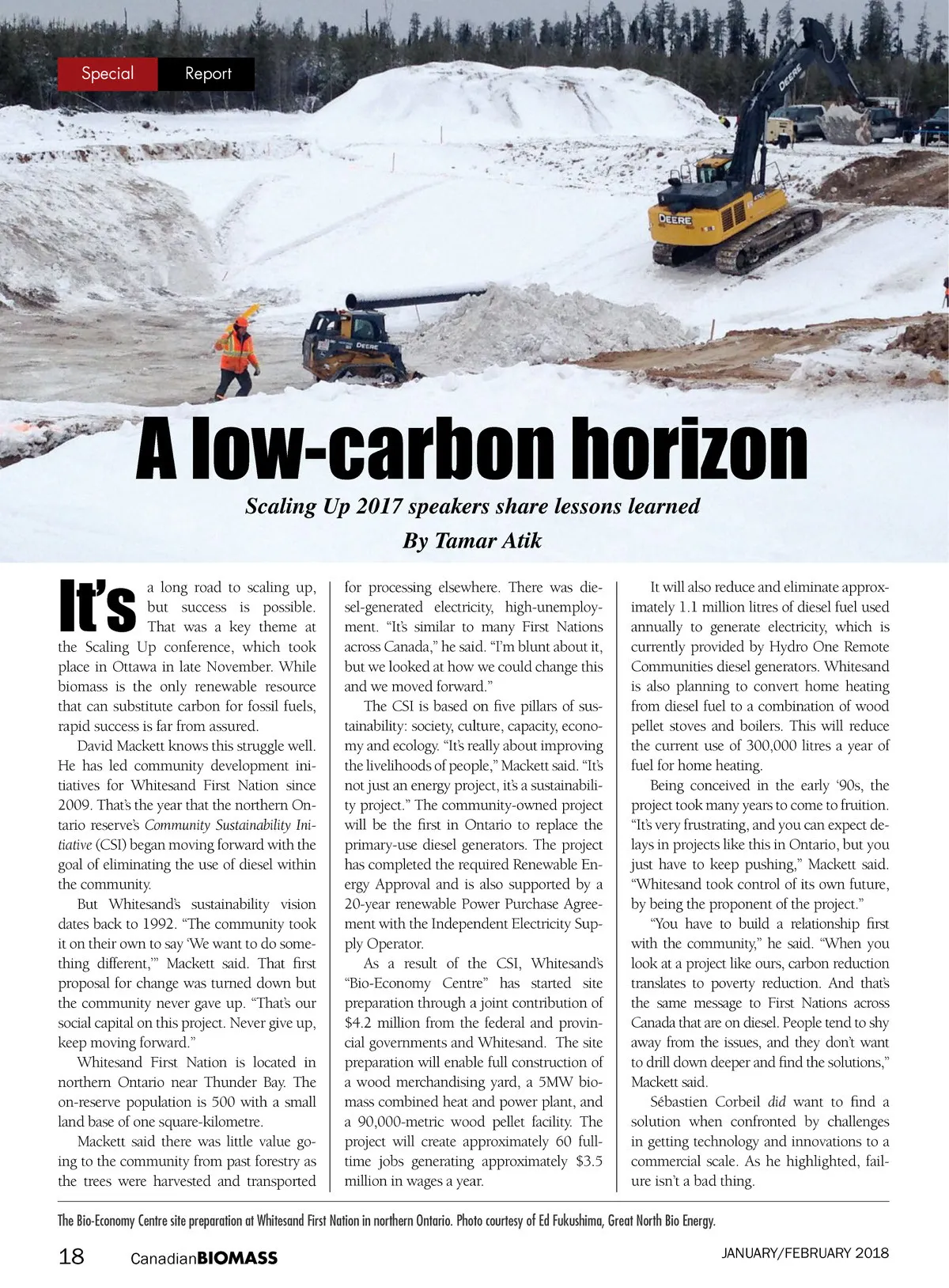
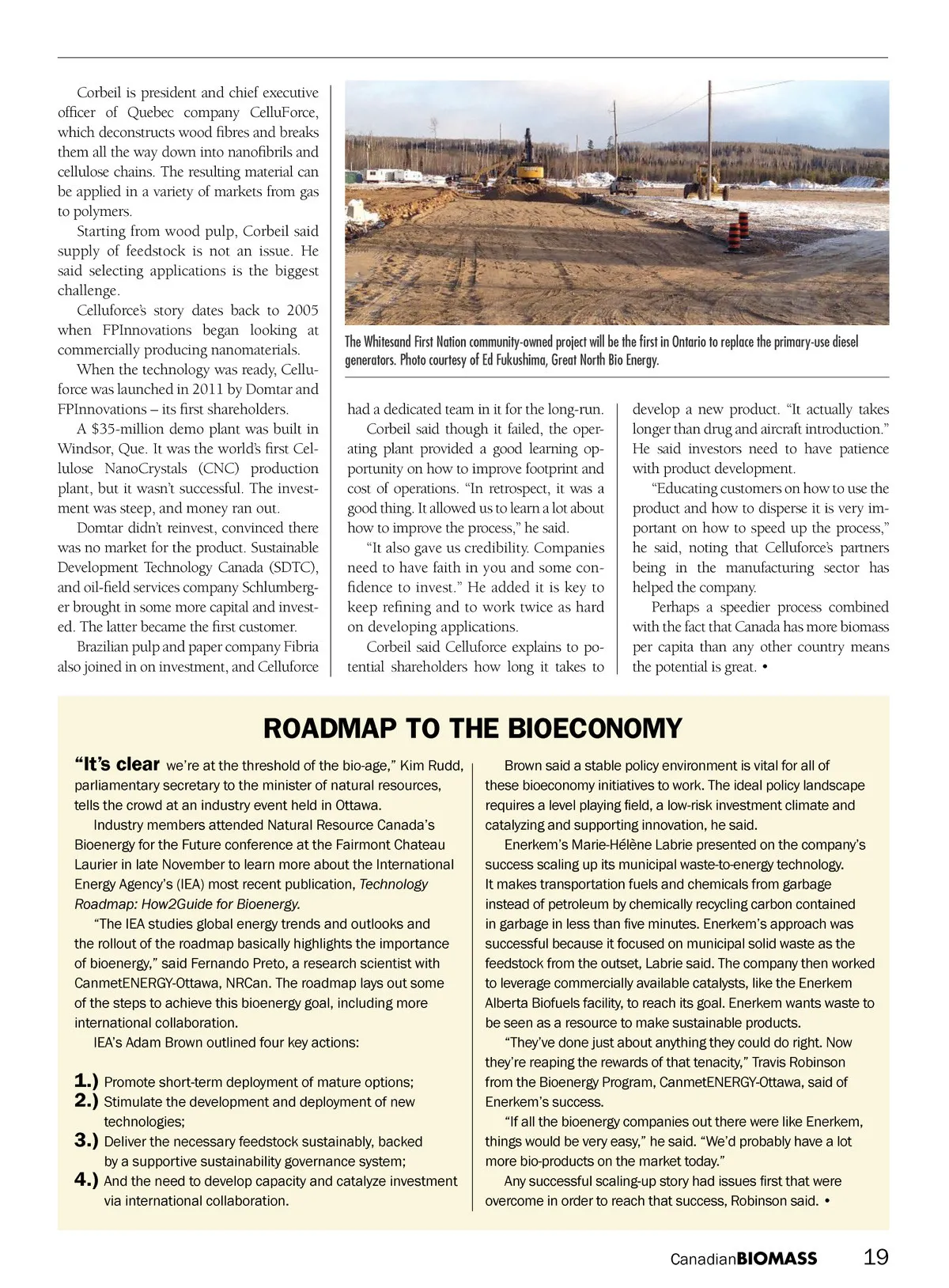
Special Report A low-carbon horizon Scaling Up 2017 speakers share lessons learned By Tamar Atik for processing elsewhere. There was die-sel-generated electricity, high-unemploy-ment. “It’s similar to many First Nations across Canada,” he said. “I’m blunt about it, but we looked at how we could change this and we moved forward.” The CSI is based on five pillars of sus-tainability: society, culture, capacity, econo-my and ecology. “It’s really about improving the livelihoods of people,” Mackett said. “It’s not just an energy project, it’s a sustainabili-ty project.” The community-owned project will be the first in Ontario to replace the primary-use diesel generators. The project has completed the required Renewable En-ergy Approval and is also supported by a 20-year renewable Power Purchase Agree-ment with the Independent Electricity Sup-ply Operator. As a result of the CSI, Whitesand’s “Bio-Economy Centre” has started site preparation through a joint contribution of $4.2 million from the federal and provin-cial governments and Whitesand. The site preparation will enable full construction of a wood merchandising yard, a 5MW bio-mass combined heat and power plant, and a 90,000-metric wood pellet facility. The project will create approximately 60 full-time jobs generating approximately $3.5 million in wages a year. It’s a long road to scaling up, but success is possible. That was a key theme at the Scaling Up conference, which took place in Ottawa in late November. While biomass is the only renewable resource that can substitute carbon for fossil fuels, rapid success is far from assured. David Mackett knows this struggle well. He has led community development ini-tiatives for Whitesand First Nation since 2009. That’s the year that the northern On-tario reserve’s Community Sustainability Ini-tiative (CSI) began moving forward with the goal of eliminating the use of diesel within the community. But Whitesand’s sustainability vision dates back to 1992. “The community took it on their own to say ‘We want to do some-thing different,’” Mackett said. That first proposal for change was turned down but the community never gave up. “That’s our social capital on this project. Never give up, keep moving forward.” Whitesand First Nation is located in northern Ontario near Thunder Bay. The on-reserve population is 500 with a small land base of one square-kilometre. Mackett said there was little value go-ing to the community from past forestry as the trees were harvested and transported It will also reduce and eliminate approx-imately 1.1 million litres of diesel fuel used annually to generate electricity, which is currently provided by Hydro One Remote Communities diesel generators. Whitesand is also planning to convert home heating from diesel fuel to a combination of wood pellet stoves and boilers. This will reduce the current use of 300,000 litres a year of fuel for home heating. Being conceived in the early ‘90s, the project took many years to come to fruition. “It’s very frustrating, and you can expect de-lays in projects like this in Ontario, but you just have to keep pushing,” Mackett said. “Whitesand took control of its own future, by being the proponent of the project.” “You have to build a relationship first with the community,” he said. “When you look at a project like ours, carbon reduction translates to poverty reduction. And that’s the same message to First Nations across Canada that are on diesel. People tend to shy away from the issues, and they don’t want to drill down deeper and find the solutions,” Mackett said. Sébastien Corbeil did want to find a solution when confronted by challenges in getting technology and innovations to a commercial scale. As he highlighted, fail-ure isn’t a bad thing. The Bio-Economy Centre site preparation at Whitesand First Nation in northern Ontario. Photo courtesy of Ed Fukushima, Great North Bio Energy. 18 Canadian BIOMASS JANUARY/FEBRUARY 2018
Canadian Biomass January-February 2018: Page 18