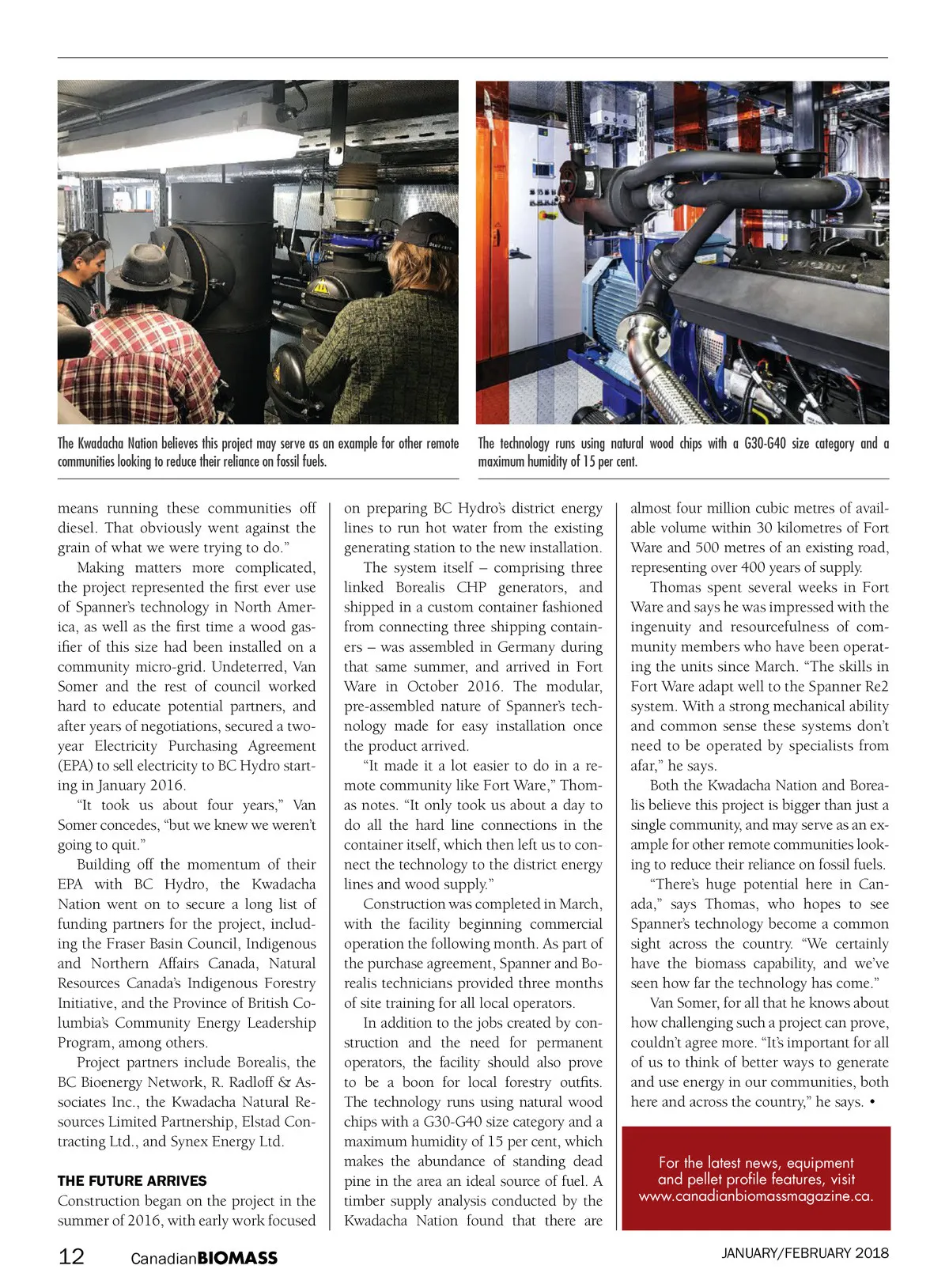
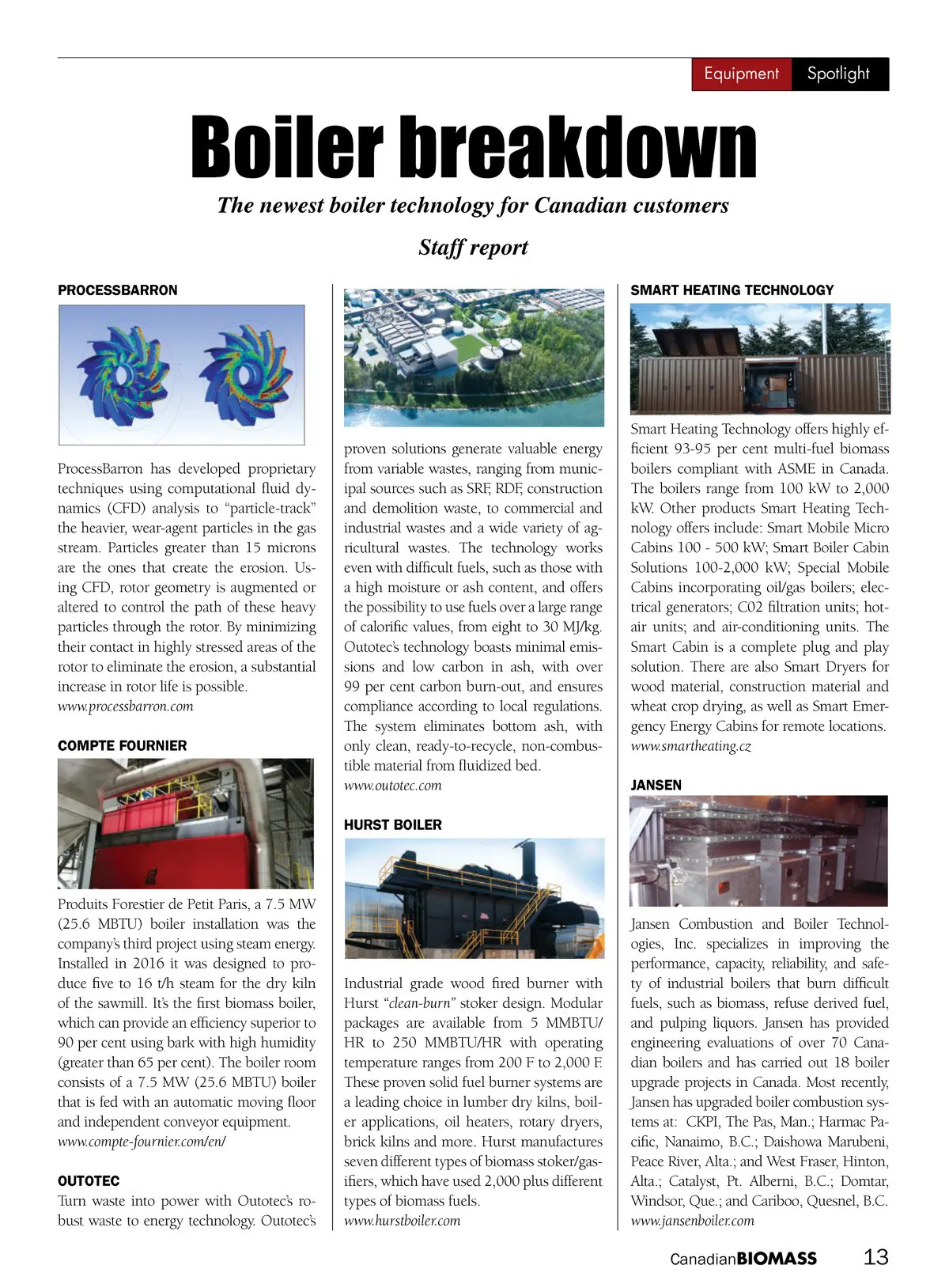
The Kwadacha Nation believes this project may serve as an example for other remote communities looking to reduce their reliance on fossil fuels. The technology runs using natural wood chips with a G30-G40 size category and a maximum humidity of 15 per cent. means running these communities off diesel. That obviously went against the grain of what we were trying to do.” Making matters more complicated, the project represented the first ever use of Spanner’s technology in North Amer-ica, as well as the first time a wood gas-ifier of this size had been installed on a community micro-grid. Undeterred, Van Somer and the rest of council worked hard to educate potential partners, and after years of negotiations, secured a two-year Electricity Purchasing Agreement (EPA) to sell electricity to BC Hydro start-ing in January 2016. “It took us about four years,” Van Somer concedes, “but we knew we weren’t going to quit.” Building off the momentum of their EPA with BC Hydro, the Kwadacha Nation went on to secure a long list of funding partners for the project, includ-ing the Fraser Basin Council, Indigenous and Northern Affairs Canada, Natural Resources Canada’s Indigenous Forestry Initiative, and the Province of British Co-lumbia’s Community Energy Leadership Program, among others. Project partners include Borealis, the BC Bioenergy Network, R. Radloff & As-sociates Inc., the Kwadacha Natural Re-sources Limited Partnership, Elstad Con-tracting Ltd., and Synex Energy Ltd. THE FUTURE ARRIVES Construction began on the project in the summer of 2016, with early work focused on preparing BC Hydro’s district energy lines to run hot water from the existing generating station to the new installation. The system itself – comprising three linked Borealis CHP generators, and shipped in a custom container fashioned from connecting three shipping contain-ers – was assembled in Germany during that same summer, and arrived in Fort Ware in October 2016. The modular, pre-assembled nature of Spanner’s tech-nology made for easy installation once the product arrived. “It made it a lot easier to do in a re-mote community like Fort Ware,” Thom-as notes. “It only took us about a day to do all the hard line connections in the container itself, which then left us to con-nect the technology to the district energy lines and wood supply.” Construction was completed in March, with the facility beginning commercial operation the following month. As part of the purchase agreement, Spanner and Bo-realis technicians provided three months of site training for all local operators. In addition to the jobs created by con-struction and the need for permanent operators, the facility should also prove to be a boon for local forestry outfits. The technology runs using natural wood chips with a G30-G40 size category and a maximum humidity of 15 per cent, which makes the abundance of standing dead pine in the area an ideal source of fuel. A timber supply analysis conducted by the Kwadacha Nation found that there are almost four million cubic metres of avail-able volume within 30 kilometres of Fort Ware and 500 metres of an existing road, representing over 400 years of supply. Thomas spent several weeks in Fort Ware and says he was impressed with the ingenuity and resourcefulness of com-munity members who have been operat-ing the units since March. “The skills in Fort Ware adapt well to the Spanner Re2 system. With a strong mechanical ability and common sense these systems don’t need to be operated by specialists from afar,” he says. Both the Kwadacha Nation and Borea-lis believe this project is bigger than just a single community, and may serve as an ex-ample for other remote communities look-ing to reduce their reliance on fossil fuels. “There’s huge potential here in Can-ada,” says Thomas, who hopes to see Spanner’s technology become a common sight across the country. “We certainly have the biomass capability, and we’ve seen how far the technology has come.” Van Somer, for all that he knows about how challenging such a project can prove, couldn’t agree more. “It’s important for all of us to think of better ways to generate and use energy in our communities, both here and across the country,” he says. • For the latest news, equipment and pellet profile features, visit www.canadianbiomassmagazine.ca. 12 Canadian BIOMASS JANUARY/FEBRUARY 2018
Canadian Biomass January-February 2018: Page 12