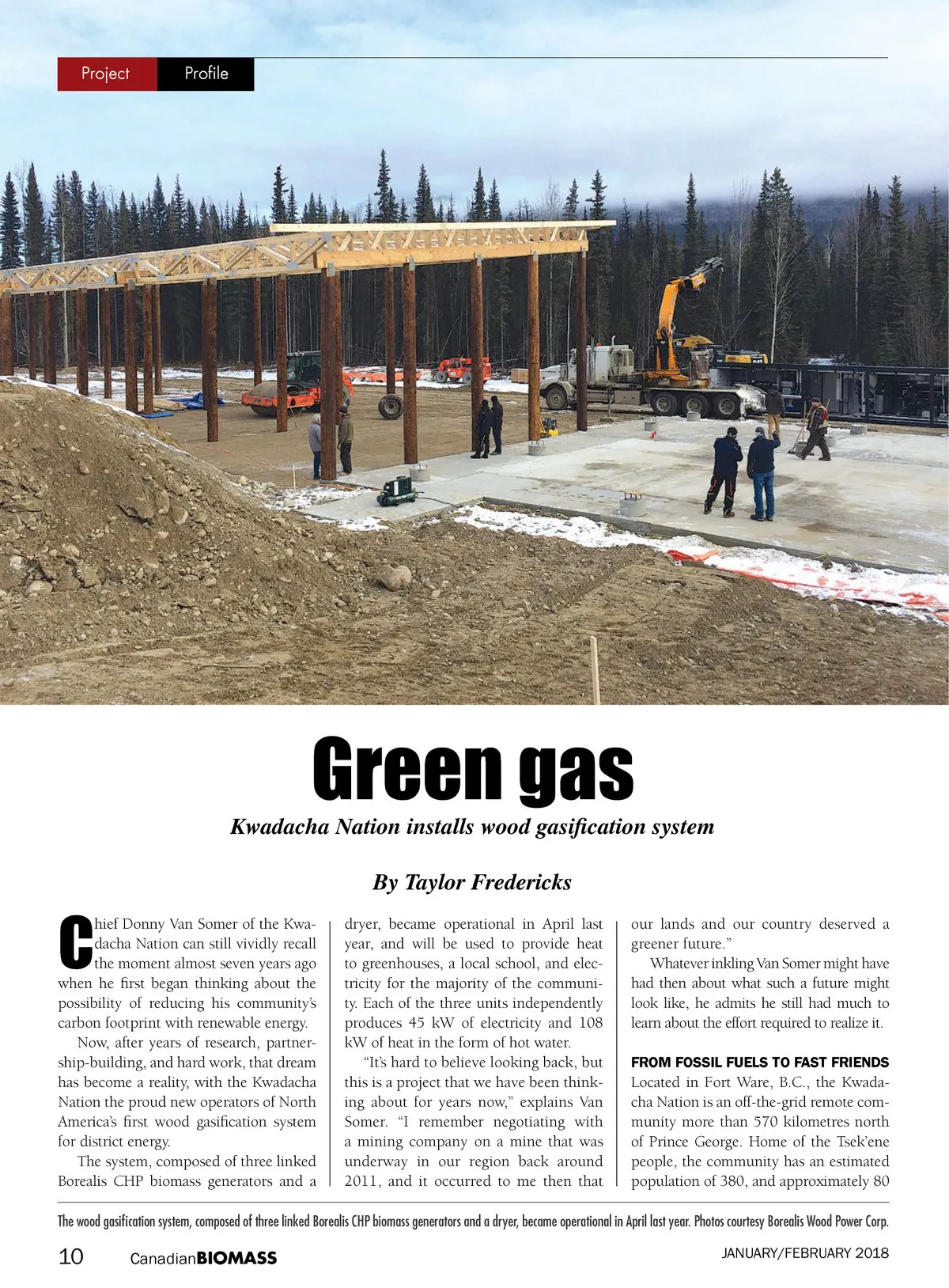
homes. Due to its remote location, the community has traditionally relied on costly diesel generators to provide elec-tricity, and propane for heat. Looking for sustainable, green initia-tives that might help to reduce their eco-logical footprint, the Kwadacha council quickly identified reduced reliance on greenhouse gas-producing diesel and propane as a priority. From there, the question became how an off-the-grid community might achieve such a goal. “We began consulting with some peo-ple associated with some of Canada’s green initiatives, and researching what it would take to make our community greener from an energy perspective,” ex-plains Van Somer. While Chief Van Somer and the Kwa-dacha council were looking for the kind of technology and innovation that could provide their community with reliable and sustainable energy at an affordable price, Dale Thomas, director of oper-ations, and the team at Borealis Wood Power Corp., were busy looking for their first major biomass project in Canada. Founded in 2012, Borealis is the ex-clusive distributor of the Borealis CHP generator, a 45kW combined heat and power (CHP) wood gasification system developed and manufactured by Ger-man-based Spanner Re2 GmbH, a long-time supplier of biomass heat and power systems in both Europe and Japan. With exclusive Canadian rights to Spanner’s technology – which utilizes modular, pre-assembled units that can be linked up to provide additional pow-er – Borealis caught the attention of Van Somer and the Kwadacha council. “It took us almost two years of re-search before we discovered Spanner and their technology,” says Van Somer, “and it was at that point that we linked up with Dale and Borealis. For us, the Borealis unit, which burns dry wood, made a lot of sense, especially after the big epidemic of pine beetle generated so much biomass in the region. We also liked Borealis because they’re smaller units, but you can go as big as you want by linking multiple units in tandem, which was appealing to us.” Following a visit in 2014 to a Borealis fa-cility in Burlington, Ont., where a running demonstration had been set up, it became clear to Van Somer and council that they had the technology they were looking for. “It really began with the Kwadacha Nation, and Fort Ware,” says Thomas, reflecting on the beginnings of their suc-cessful partnership. “They were actual-ly our first project, and one of the first groups that we talked with.” There are more than 650 installations using this technology around the world with more than 15 million operating hours. The Borealis units can be contain-erized or installed into an existing building and are flexible enough to meet a range of needs. There is also progress on using the gasification unit to supplement diesel in regular diesel systems, and even a small-er and more compact unit that produces 9kW of electricity and 22kW of heat. FIGHTING FOR FUNDING With the question of which technology to pursue now settled, the next challenge for the Kwadacha Nation was engaging like-minded stakeholders to secure funding and support for the project. As Van Somer soon found out, this was no easy process, particularly when it came to working with important provin-cial allies like BC Hydro. “It was initially a challenge for us get-ting BC Hydro to buy in,” he explains. “With their Remote Community Electri-fication Program, they’re mandated to provide off-the-grid communities like ours with BC power, which typically Canadian BIOMASS 11
Canadian Biomass January-February 2018: Page 11