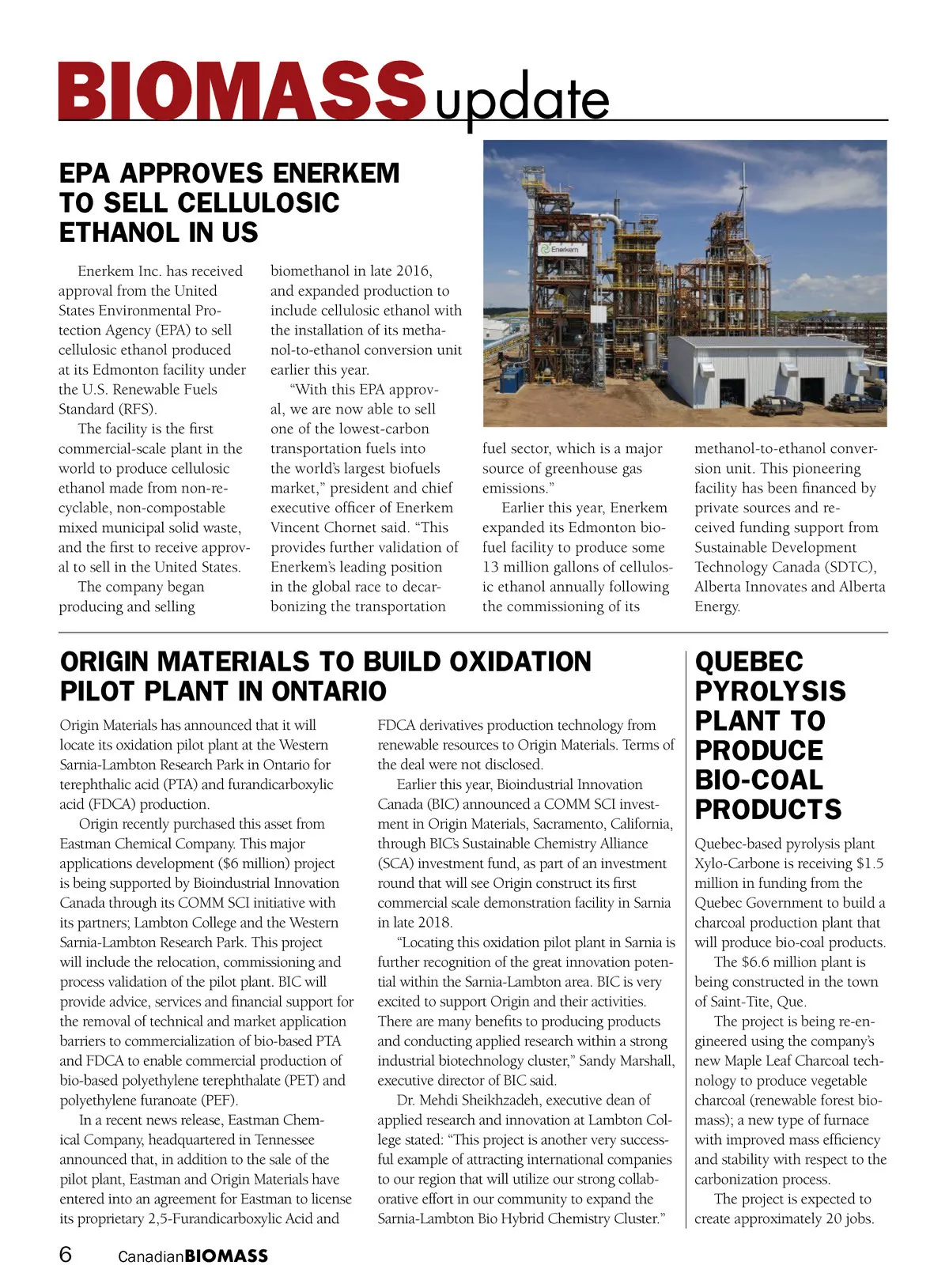
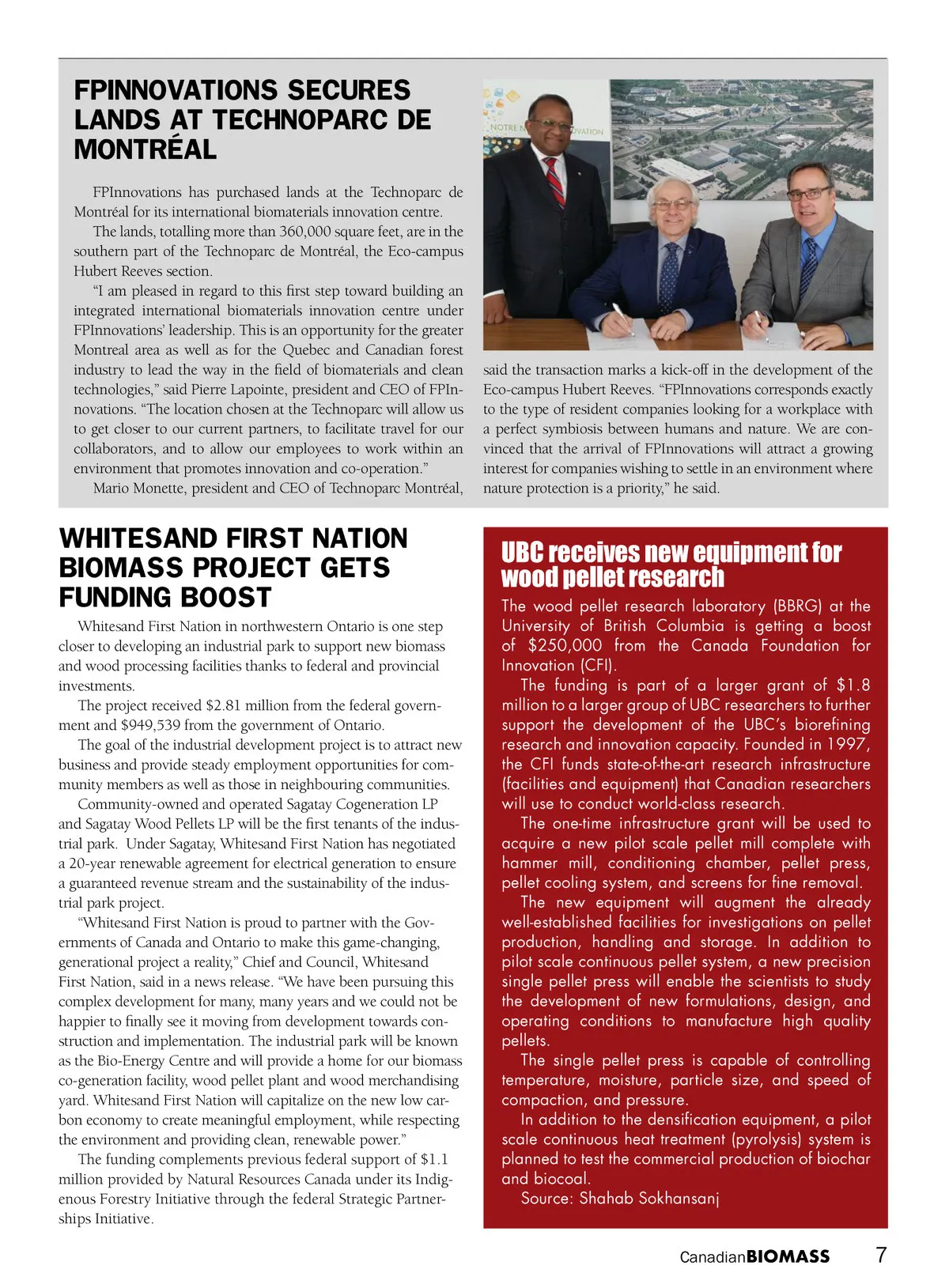
FPINNOVATIONS SECURES LANDS AT TECHNOPARC DE MONTRÉAL FPInnovations has purchased lands at the Technoparc de Montréal for its international biomaterials innovation centre. The lands, totalling more than 360,000 square feet, are in the southern part of the Technoparc de Montréal, the Eco-campus Hubert Reeves section. “I am pleased in regard to this first step toward building an integrated international biomaterials innovation centre under FPInnovations’ leadership. This is an opportunity for the greater Montreal area as well as for the Quebec and Canadian forest industry to lead the way in the field of biomaterials and clean technologies,” said Pierre Lapointe, president and CEO of FPIn-novations. “The location chosen at the Technoparc will allow us to get closer to our current partners, to facilitate travel for our collaborators, and to allow our employees to work within an environment that promotes innovation and co-operation.” Mario Monette, president and CEO of Technoparc Montréal, said the transaction marks a kick-off in the development of the Eco-campus Hubert Reeves. “FPInnovations corresponds exactly to the type of resident companies looking for a workplace with a perfect symbiosis between humans and nature. We are con-vinced that the arrival of FPInnovations will attract a growing interest for companies wishing to settle in an environment where nature protection is a priority,” he said. WHITESAND FIRST NATION BIOMASS PROJECT GETS FUNDING BOOST Whitesand First Nation in northwestern Ontario is one step closer to developing an industrial park to support new biomass and wood processing facilities thanks to federal and provincial investments. The project received $2.81 million from the federal govern-ment and $949,539 from the government of Ontario. The goal of the industrial development project is to attract new business and provide steady employment opportunities for com-munity members as well as those in neighbouring communities. Community-owned and operated Sagatay Cogeneration LP and Sagatay Wood Pellets LP will be the first tenants of the indus-trial park. Under Sagatay, Whitesand First Nation has negotiated a 20-year renewable agreement for electrical generation to ensure a guaranteed revenue stream and the sustainability of the indus-trial park project. “Whitesand First Nation is proud to partner with the Gov-ernments of Canada and Ontario to make this game-changing, generational project a reality,” Chief and Council, Whitesand First Nation, said in a news release. “We have been pursuing this complex development for many, many years and we could not be happier to finally see it moving from development towards con-struction and implementation. The industrial park will be known as the Bio-Energy Centre and will provide a home for our biomass co-generation facility, wood pellet plant and wood merchandising yard. Whitesand First Nation will capitalize on the new low car-bon economy to create meaningful employment, while respecting the environment and providing clean, renewable power.” The funding complements previous federal support of $1.1 million provided by Natural Resources Canada under its Indig-enous Forestry Initiative through the federal Strategic Partner-ships Initiative. UBC receives new equipment for wood pellet research The wood pellet research laboratory (BBRG) at the University of British Columbia is getting a boost of $250,000 from the Canada Foundation for Innovation (CFI). The funding is part of a larger grant of $1.8 million to a larger group of UBC researchers to further support the development of the UBC’s biorefining research and innovation capacity. Founded in 1997, the CFI funds state-of-the-art research infrastructure (facilities and equipment) that Canadian researchers will use to conduct world-class research. The one-time infrastructure grant will be used to acquire a new pilot scale pellet mill complete with hammer mill, conditioning chamber, pellet press, pellet cooling system, and screens for fine removal. The new equipment will augment the already well-established facilities for investigations on pellet production, handling and storage. In addition to pilot scale continuous pellet system, a new precision single pellet press will enable the scientists to study the development of new formulations, design, and operating conditions to manufacture high quality pellets. The single pellet press is capable of controlling temperature, moisture, particle size, and speed of compaction, and pressure. In addition to the densification equipment, a pilot scale continuous heat treatment (pyrolysis) system is planned to test the commercial production of biochar and biocoal. Source: Shahab Sokhansanj Canadian BIOMASS 7
Canadian Biomass November/December 2017: Page 7