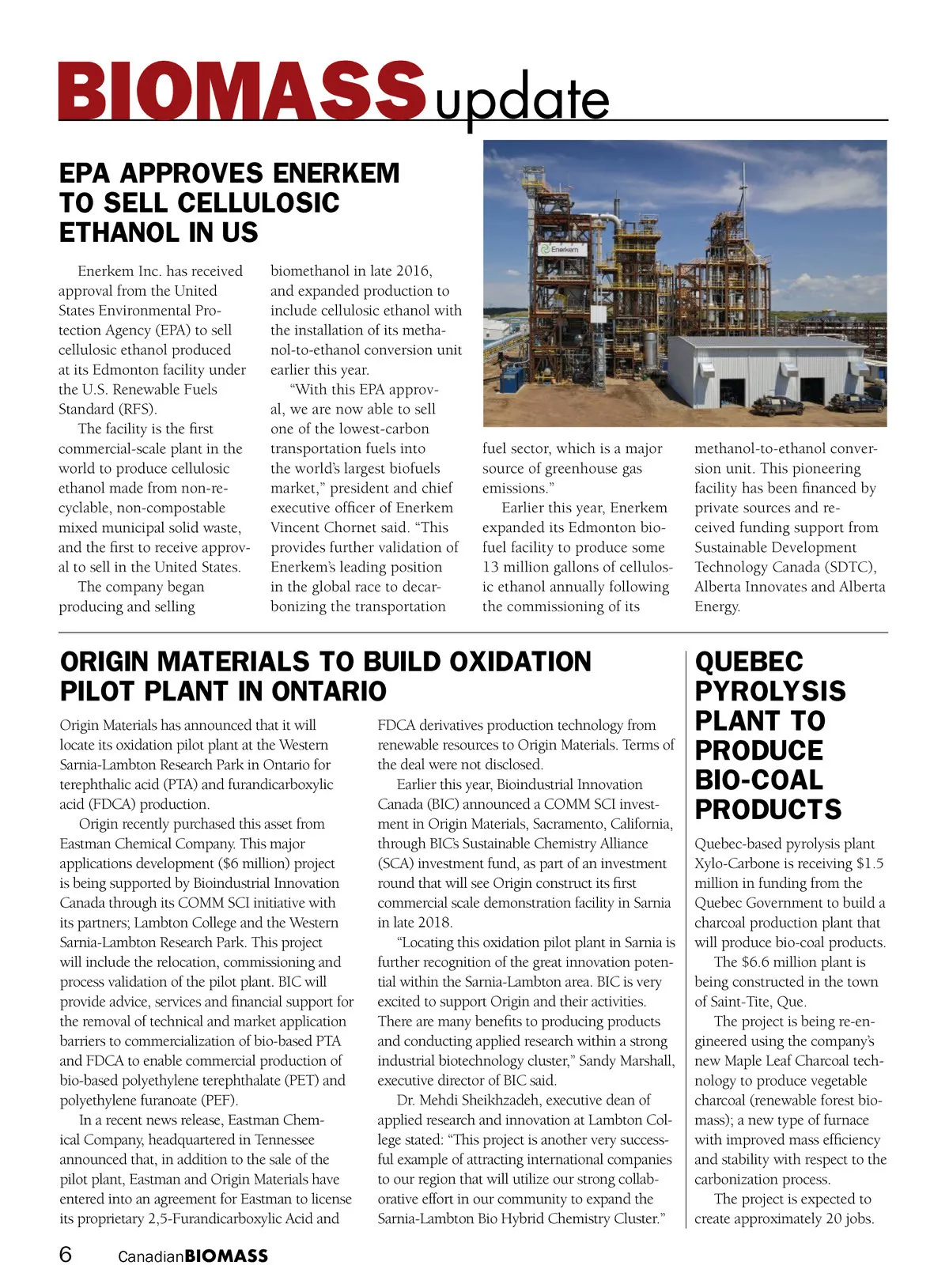
BIOMASS update EPA APPROVES ENERKEM TO SELL CELLULOSIC ETHANOL IN US Enerkem Inc. has received approval from the United States Environmental Pro-tection Agency (EPA) to sell cellulosic ethanol produced at its Edmonton facility under the U.S. Renewable Fuels Standard (RFS). The facility is the first commercial-scale plant in the world to produce cellulosic ethanol made from non-re-cyclable, non-compostable mixed municipal solid waste, and the first to receive approv-al to sell in the United States. The company began producing and selling biomethanol in late 2016, and expanded production to include cellulosic ethanol with the installation of its metha-nol-to-ethanol conversion unit earlier this year. “With this EPA approv-al, we are now able to sell one of the lowest-carbon transportation fuels into the world’s largest biofuels market,” president and chief executive officer of Enerkem Vincent Chornet said. “This provides further validation of Enerkem’s leading position in the global race to decar-bonizing the transportation fuel sector, which is a major source of greenhouse gas emissions.” Earlier this year, Enerkem expanded its Edmonton bio-fuel facility to produce some 13 million gallons of cellulos-ic ethanol annually following the commissioning of its methanol-to-ethanol conver-sion unit. This pioneering facility has been financed by private sources and re-ceived funding support from Sustainable Development Technology Canada (SDTC), Alberta Innovates and Alberta Energy. ORIGIN MATERIALS TO BUILD OXIDATION PILOT PLANT IN ONTARIO Origin Materials has announced that it will locate its oxidation pilot plant at the Western Sarnia-Lambton Research Park in Ontario for terephthalic acid (PTA) and furandicarboxylic acid (FDCA) production. Origin recently purchased this asset from Eastman Chemical Company. This major applications development ($6 million) project is being supported by Bioindustrial Innovation Canada through its COMM SCI initiative with its partners; Lambton College and the Western Sarnia-Lambton Research Park. This project will include the relocation, commissioning and process validation of the pilot plant. BIC will provide advice, services and financial support for the removal of technical and market application barriers to commercialization of bio-based PTA and FDCA to enable commercial production of bio-based polyethylene terephthalate (PET) and polyethylene furanoate (PEF). In a recent news release, Eastman Chem-ical Company, headquartered in Tennessee announced that, in addition to the sale of the pilot plant, Eastman and Origin Materials have entered into an agreement for Eastman to license its proprietary 2,5-Furandicarboxylic Acid and FDCA derivatives production technology from renewable resources to Origin Materials. Terms of the deal were not disclosed. Earlier this year, Bioindustrial Innovation Canada (BIC) announced a COMM SCI invest-ment in Origin Materials, Sacramento, California, through BIC’s Sustainable Chemistry Alliance (SCA) investment fund, as part of an investment round that will see Origin construct its first commercial scale demonstration facility in Sarnia in late 2018. “Locating this oxidation pilot plant in Sarnia is further recognition of the great innovation poten-tial within the Sarnia-Lambton area. BIC is very excited to support Origin and their activities. There are many benefits to producing products and conducting applied research within a strong industrial biotechnology cluster,” Sandy Marshall, executive director of BIC said. Dr. Mehdi Sheikhzadeh, executive dean of applied research and innovation at Lambton Col-lege stated: “This project is another very success-ful example of attracting international companies to our region that will utilize our strong collab-orative effort in our community to expand the Sarnia-Lambton Bio Hybrid Chemistry Cluster.” QUEBEC PYROLYSIS PLANT TO PRODUCE BIO-COAL PRODUCTS Quebec-based pyrolysis plant Xylo-Carbone is receiving $1.5 million in funding from the Quebec Government to build a charcoal production plant that will produce bio-coal products. The $6.6 million plant is being constructed in the town of Saint-Tite, Que. The project is being re-en-gineered using the company’s new Maple Leaf Charcoal tech-nology to produce vegetable charcoal (renewable forest bio-mass); a new type of furnace with improved mass efficiency and stability with respect to the carbonization process. The project is expected to create approximately 20 jobs. 6 Canadian BIOMASS
Canadian Biomass November/December 2017: Page 6