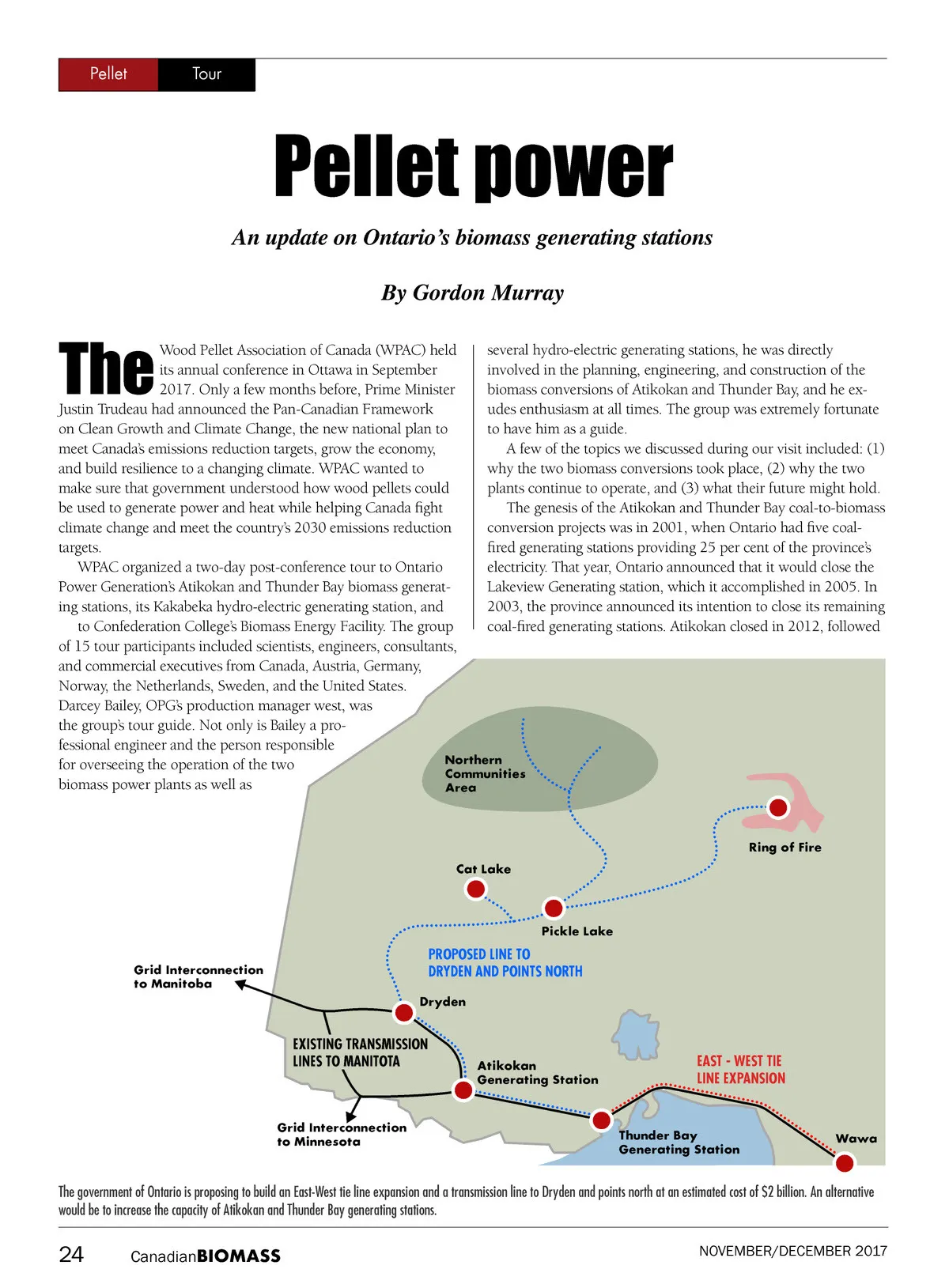
Pellet Tour Pellet power An update on Ontario’s biomass generating stations By Gordon Murray The several hydro-electric generating stations, he was directly Wood Pellet Association of Canada (WPAC) held involved in the planning, engineering, and construction of the its annual conference in Ottawa in September biomass conversions of Atikokan and Thunder Bay, and he ex-2017. Only a few months before, Prime Minister udes enthusiasm at all times. The group was extremely fortunate Justin Trudeau had announced the Pan-Canadian Framework to have him as a guide. on Clean Growth and Climate Change, the new national plan to A few of the topics we discussed during our visit included: (1) meet Canada’s emissions reduction targets, grow the economy, why the two biomass conversions took place, (2) why the two and build resilience to a changing climate. WPAC wanted to plants continue to operate, and (3) what their future might hold. make sure that government understood how wood pellets could The genesis of the Atikokan and Thunder Bay coal-to-biomass be used to generate power and heat while helping Canada fight conversion projects was in 2001, when Ontario had five coal-climate change and meet the country’s 2030 emissions reduction fired generating stations providing 25 per cent of the province’s targets. electricity. That year, Ontario announced that it would close the WPAC organized a two-day post-conference tour to Ontario Lakeview Generating station, which it accomplished in 2005. In Power Generation’s Atikokan and Thunder Bay biomass generat-2003, the province announced its intention to close its remaining ing stations, its Kakabeka hydro-electric generating station, and coal-fired generating stations. Atikokan closed in 2012, followed to Confederation College’s Biomass Energy Facility. The group of 15 tour participants included scientists, engineers, consultants, and commercial executives from Canada, Austria, Germany, Norway, the Netherlands, Sweden, and the United States. Darcey Bailey, OPG’s production manager west, was the group’s tour guide. Not only is Bailey a pro-fessional engineer and the person responsible Northern for overseeing the operation of the two Communities biomass power plants as well as Area Ring of Fire Cat Lake Pickle Lake Grid Interconnection to Manitoba PROPOSED LINE TO DRYDEN AND POINTS NORTH Dryden EXISTING TRANSMISSION LINES TO MANITOTA Atikokan Generating Station EAST -WEST TIE LINE EXPANSION Grid Interconnection to Minnesota Thunder Bay Generating Station Wawa The government of Ontario is proposing to build an East-West tie line expansion and a transmission line to Dryden and points north at an estimated cost of $2 billion. An alternative would be to increase the capacity of Atikokan and Thunder Bay generating stations. 24 Canadian BIOMASS NOVEMBER/DECEMBER 2017
Canadian Biomass November/December 2017: Page 24