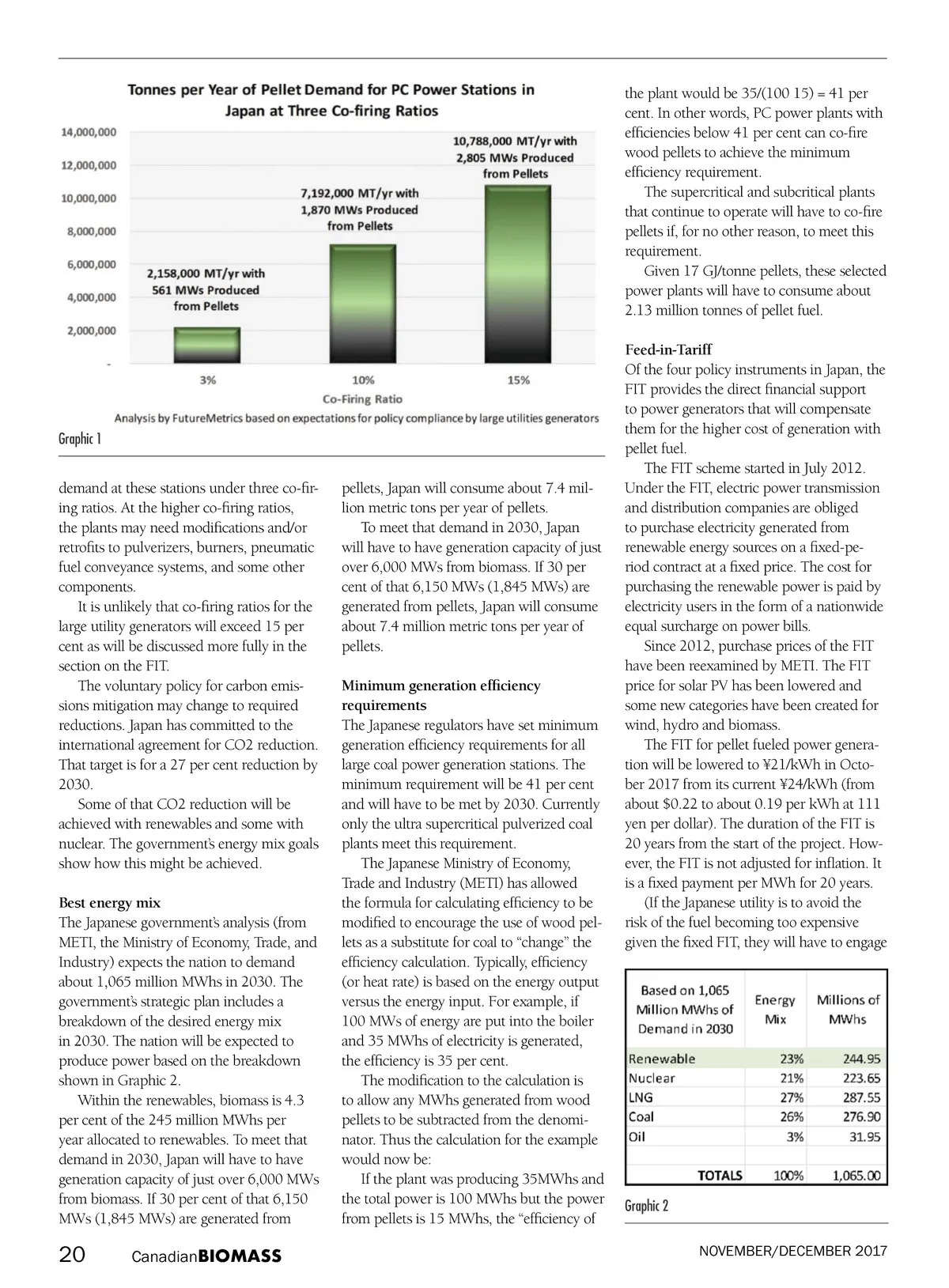
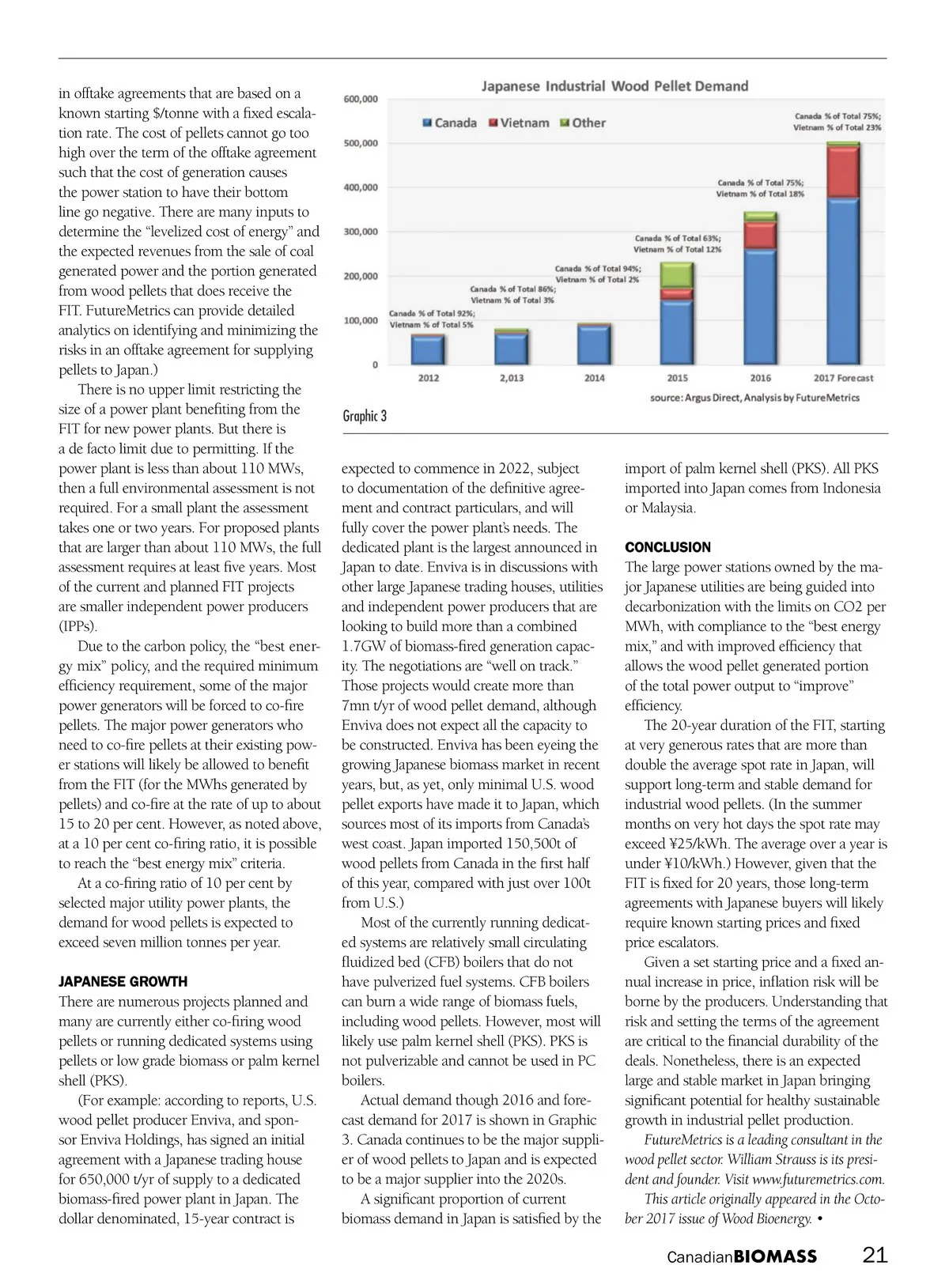
the plant would be 35/(100‐15) = 41 per cent. In other words, PC power plants with efficiencies below 41 per cent can co-fire wood pellets to achieve the minimum efficiency requirement. The supercritical and subcritical plants that continue to operate will have to co-fire pellets if, for no other reason, to meet this requirement. Given 17 GJ/tonne pellets, these selected power plants will have to consume about 2.13 million tonnes of pellet fuel. Feed-in-Tariff Of the four policy instruments in Japan, the FIT provides the direct financial support to power generators that will compensate them for the higher cost of generation with pellet fuel. The FIT scheme started in July 2012. Under the FIT, electric power transmission and distribution companies are obliged to purchase electricity generated from renewable energy sources on a fixed-pe-riod contract at a fixed price. The cost for purchasing the renewable power is paid by electricity users in the form of a nationwide equal surcharge on power bills. Since 2012, purchase prices of the FIT have been reexamined by METI. The FIT price for solar PV has been lowered and some new categories have been created for wind, hydro and biomass. The FIT for pellet fueled power genera-tion will be lowered to ¥21/kWh in Octo-ber 2017 from its current ¥24/kWh (from about $0.22 to about 0.19 per kWh at 111 yen per dollar). The duration of the FIT is 20 years from the start of the project. How-ever, the FIT is not adjusted for inflation. It is a fixed payment per MWh for 20 years. (If the Japanese utility is to avoid the risk of the fuel becoming too expensive given the fixed FIT, they will have to engage Graphic 1 demand at these stations under three co-fir-ing ratios. At the higher co-firing ratios, the plants may need modifications and/or retrofits to pulverizers, burners, pneumatic fuel conveyance systems, and some other components. It is unlikely that co-firing ratios for the large utility generators will exceed 15 per cent as will be discussed more fully in the section on the FIT. The voluntary policy for carbon emis-sions mitigation may change to required reductions. Japan has committed to the international agreement for CO2 reduction. That target is for a 27 per cent reduction by 2030. Some of that CO2 reduction will be achieved with renewables and some with nuclear. The government’s energy mix goals show how this might be achieved. Best energy mix The Japanese government’s analysis (from METI, the Ministry of Economy, Trade, and Industry) expects the nation to demand about 1,065 million MWhs in 2030. The government’s strategic plan includes a breakdown of the desired energy mix in 2030. The nation will be expected to produce power based on the breakdown shown in Graphic 2. Within the renewables, biomass is 4.3 per cent of the 245 million MWhs per year allocated to renewables. To meet that demand in 2030, Japan will have to have generation capacity of just over 6,000 MWs from biomass. If 30 per cent of that 6,150 MWs (1,845 MWs) are generated from pellets, Japan will consume about 7.4 mil-lion metric tons per year of pellets. To meet that demand in 2030, Japan will have to have generation capacity of just over 6,000 MWs from biomass. If 30 per cent of that 6,150 MWs (1,845 MWs) are generated from pellets, Japan will consume about 7.4 million metric tons per year of pellets. Minimum generation efficiency requirements The Japanese regulators have set minimum generation efficiency requirements for all large coal power generation stations. The minimum requirement will be 41 per cent and will have to be met by 2030. Currently only the ultra‐supercritical pulverized coal plants meet this requirement. The Japanese Ministry of Economy, Trade and Industry (METI) has allowed the formula for calculating efficiency to be modified to encourage the use of wood pel-lets as a substitute for coal to “change” the efficiency calculation. Typically, efficiency (or heat rate) is based on the energy output versus the energy input. For example, if 100 MWs of energy are put into the boiler and 35 MWhs of electricity is generated, the efficiency is 35 per cent. The modification to the calculation is to allow any MWhs generated from wood pellets to be subtracted from the denomi-nator. Thus the calculation for the example would now be: If the plant was producing 35MWhs and the total power is 100 MWhs but the power from pellets is 15 MWhs, the “efficiency of Graphic 2 NOVEMBER/DECEMBER 2017 20 Canadian BIOMASS
Canadian Biomass November/December 2017: Page 20