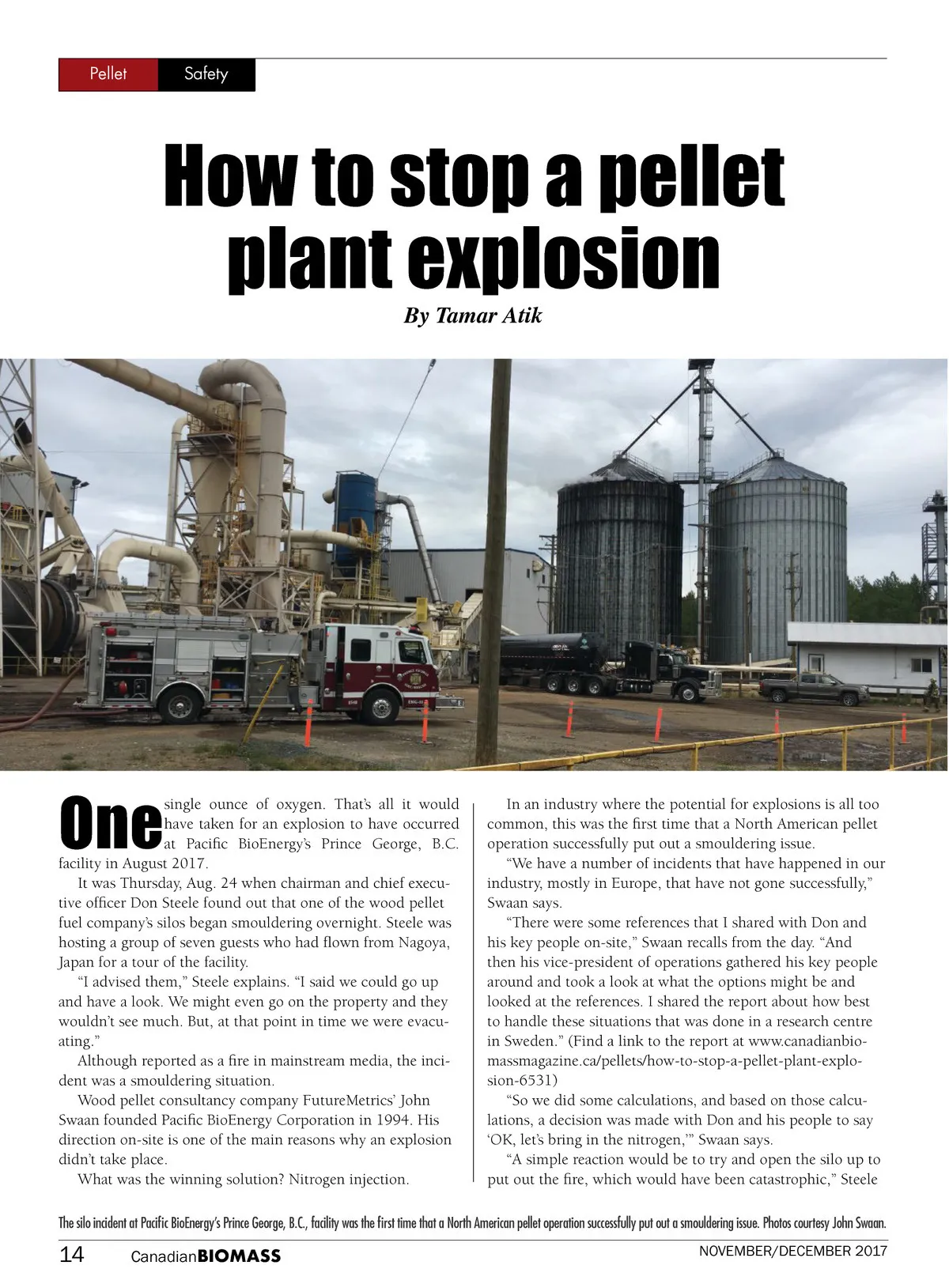
says. “Any oxygen entering would have been disastrous. It was a tremendously risky proposition.” The silo holds 3,500 tonnes of pellets – the energy equivalent of about 10,000 barrels of oil. The incident had the potential to evacuate the entire surrounding city. Nitrogen injection equipment was brought to the facility from neighbouring Alberta within eight to 10 hours. Alberta’s oil fields have prompted the province’s first responders to be prepared for fire suppression missions to prevent explosions. The smouldering material in the silo was injected with nitrogen for a few days until it was safe enough to remove in small amounts. Nitrogen arrives as a liquid and needs to be turned into a vapour. “I think the first principle of it is, liquid nitrogen is an inert gas,” Steele says. “In other words, it can’t explode or burn. So you use it to push the oxygen out of the container and then try and seal it off. We tried with foam and various things, but once you’ve got the oxygen content below a certain level, about 10 per cent, you’ve minimized the risk of an explosion. So then you can start pulling the material out. “We basically wetted it down, and over a course of seven days eliminated the risk, moved the material out, quenched the fire risk and then stockpiled it over in another part of our property,” he says. “I think the key thing is nobody overreacted… I don’t even think there was a Band-Aid.” Swaan and Steele say co-operation between industry and first responders is what ensured a safe outcome. “This kind of incident has the potential for major, major injury. Our people knew how to safely handle the material and the first responders and fire department knew how to look after our people to keep them out of harm’s way,” Steele says. “They had the respiration equipment, they had the fire hoses, they had the ability and the technique for putting out a fire. Our people knew how to move the material through and safely evacuate the silo.” Half a million dollars-worth of material and product was destroyed and a lot of equipment was damaged, but Steele says everybody’s safety makes the situation a success. “It’s a happy beginning actually, because we’re beginning now to refit and add to our knowledge of our product and how to handle it,” he says. “And I think the whole industry is going to learn something from it too.” “I say anything that can be fixed with money is not a problem. You can’t fix people with money, particularly if they’re severely injured or killed.” “It’s not a matter of ‘if’ a silo fire could happen, it’s ‘when,’” Swaan says. “But the good news is that we now as an industry have a lot of new learnings. We have experience that we can now share with the industry so that we can make it a safer industry for these types of situations.” Steele says, “The key thing is, think before you act, use other information, use your judgement, move deliberately, keep everybody safe.” • 563.264.8066 airoflex.com Canadian BIOMASS CBM_timberprod_BEL_septoct17_CSA.indd 1 2017-09-21 CBM_Airoflex_MayJune17_CSA.indd 2:04 PM 1 15 2017-05-17 7:25 AM
Canadian Biomass November/December 2017: Page 15