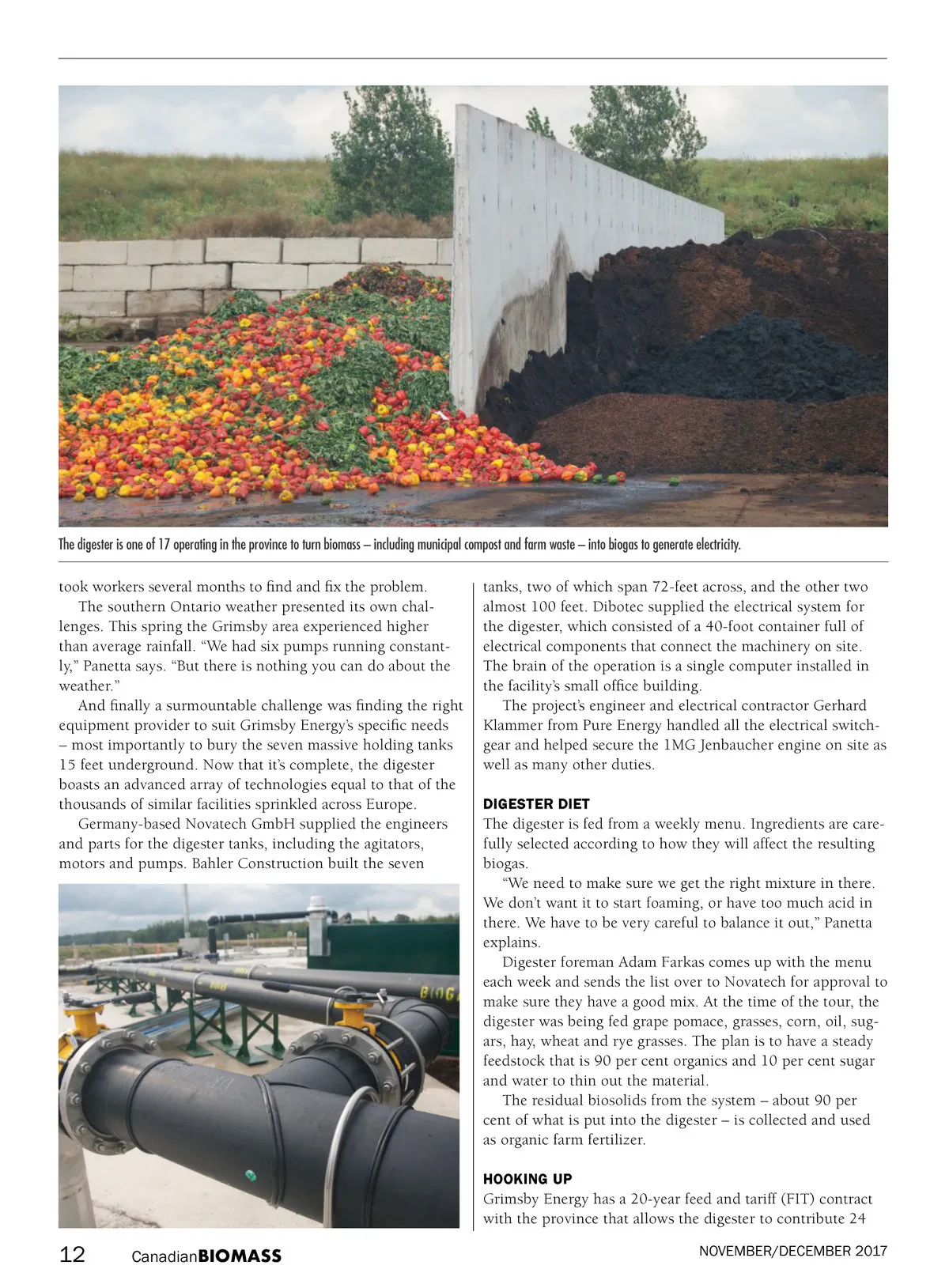
MW of electricity a day, but with its current capacity it will be producing excess biogas. Panetta hopes to sell the excess as renewable natural gas that can be added to nearby natural gas pipelines. “We have so much capability of producing so much more renewable natural gas. We definitely have that as another product, and we have a third product, which is heat. We could probably supply enough heat for three municipal buildings,” Panetta says. “It’s another revenue for generating profits.” In Germany, he says, it’s common for digesters to be locat-ed next to schools, government buildings or apartments to supply heat. In the future, Grimsby Energy would also consider tech-nologies that maximize the efficiency of anaerobic digesters, such as that being tested by GE Water and Process Technol-ogies and new food products grown from the University of Guelph in Ontario, Panetta says. The technology on trial, called biological hydrolysis, moves one stage of the anaerobic digestion upstream from the main tank in order to increase the production of biogas. But for now, as Grimsby Energy’s anaerobic digester con-tinues to grow its supply chain and ramp up biogas produc-tion, the facility will continue to supply its 1MW per hour of electricity fed by 60 tonnes of organic, farming waste, and other biomass. “We’ve been approached by other interested Excavation for the project began in late 2015 and involved digging a 300-foot by 275-foot hole 18 feet deep. Construction of actual tanks started in May 2016 and finished on Dec. 20, 2016. Photo courtesy Grimsby Energy. municipalities and we will give assistance,” Panetta says. “We have the experience, the knowledge, expertise and know where to not make the same mistakes, and yes we would make a second one. “We are keeping organics out of the landfill, making elec-tricity to sell to the grid, making a profit for our municipality and giving the end result digestate back to the farmers to spread on their lands – 100 per cent nutrient organic fertiliz-er. It just makes sense,” he says. • Low temperature belt dryer INDUSTRIES SERVED Biomass Biofuels Waste-to-Energy Resource Recovery Power Generation Pulp and Paper RECEIVING PROCESSING CONVEYING RECLAIM DELIVERY Advantages of a STELA belt dryer: • due to indirect heating reduced explosion and fire risk • no filter or WESP for exhaust air needed • easy operation and low maintenance • low electrical consumption 763.576.9040 wolfmhs.com Stela Laxhuber GmbH Laxhuperlatz 1 D-84323 Massing Tel. +49 8724/899-0 E-Mail: [email protected] www.stela.de Canadian BIOMASS 13
Canadian Biomass November/December 2017: Page 13