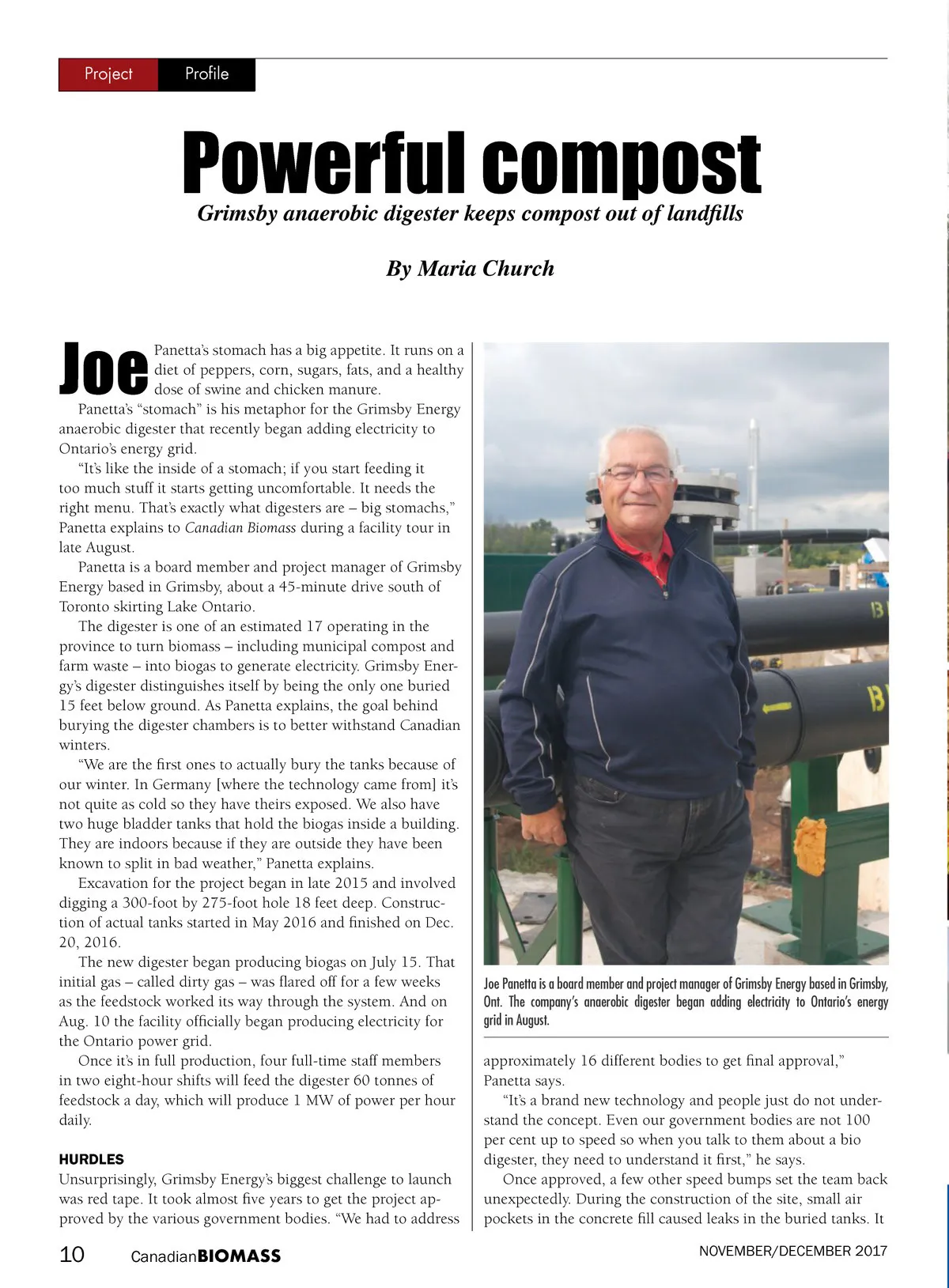
Project Profile Powerful compost Grimsby anaerobic digester keeps compost out of landfills By Maria Church Panetta’s stomach has a big appetite. It runs on a diet of peppers, corn, sugars, fats, and a healthy dose of swine and chicken manure. Panetta’s “stomach” is his metaphor for the Grimsby Energy anaerobic digester that recently began adding electricity to Ontario’s energy grid. “It’s like the inside of a stomach; if you start feeding it too much stuff it starts getting uncomfortable. It needs the right menu. That’s exactly what digesters are – big stomachs,” Panetta explains to Canadian Biomass during a facility tour in late August. Panetta is a board member and project manager of Grimsby Energy based in Grimsby, about a 45-minute drive south of Toronto skirting Lake Ontario. The digester is one of an estimated 17 operating in the province to turn biomass – including municipal compost and farm waste – into biogas to generate electricity. Grimsby Ener-gy’s digester distinguishes itself by being the only one buried 15 feet below ground. As Panetta explains, the goal behind burying the digester chambers is to better withstand Canadian winters. “We are the first ones to actually bury the tanks because of our winter. In Germany [where the technology came from] it’s not quite as cold so they have theirs exposed. We also have two huge bladder tanks that hold the biogas inside a building. They are indoors because if they are outside they have been known to split in bad weather,” Panetta explains. Excavation for the project began in late 2015 and involved digging a 300-foot by 275-foot hole 18 feet deep. Construc-tion of actual tanks started in May 2016 and finished on Dec. 20, 2016. The new digester began producing biogas on July 15. That initial gas – called dirty gas – was flared off for a few weeks as the feedstock worked its way through the system. And on Aug. 10 the facility officially began producing electricity for the Ontario power grid. Once it’s in full production, four full-time staff members in two eight-hour shifts will feed the digester 60 tonnes of feedstock a day, which will produce 1 MW of power per hour daily. HURDLES Joe Joe Panetta is a board member and project manager of Grimsby Energy based in Grimsby, Ont. The company’s anaerobic digester began adding electricity to Ontario’s energy grid in August. Unsurprisingly, Grimsby Energy’s biggest challenge to launch was red tape. It took almost five years to get the project ap-proved by the various government bodies. “We had to address approximately 16 different bodies to get final approval,” Panetta says. “It’s a brand new technology and people just do not under-stand the concept. Even our government bodies are not 100 per cent up to speed so when you talk to them about a bio digester, they need to understand it first,” he says. Once approved, a few other speed bumps set the team back unexpectedly. During the construction of the site, small air pockets in the concrete fill caused leaks in the buried tanks. It NOVEMBER/DECEMBER 2017 10 Canadian BIOMASS
Canadian Biomass November/December 2017: Page 10