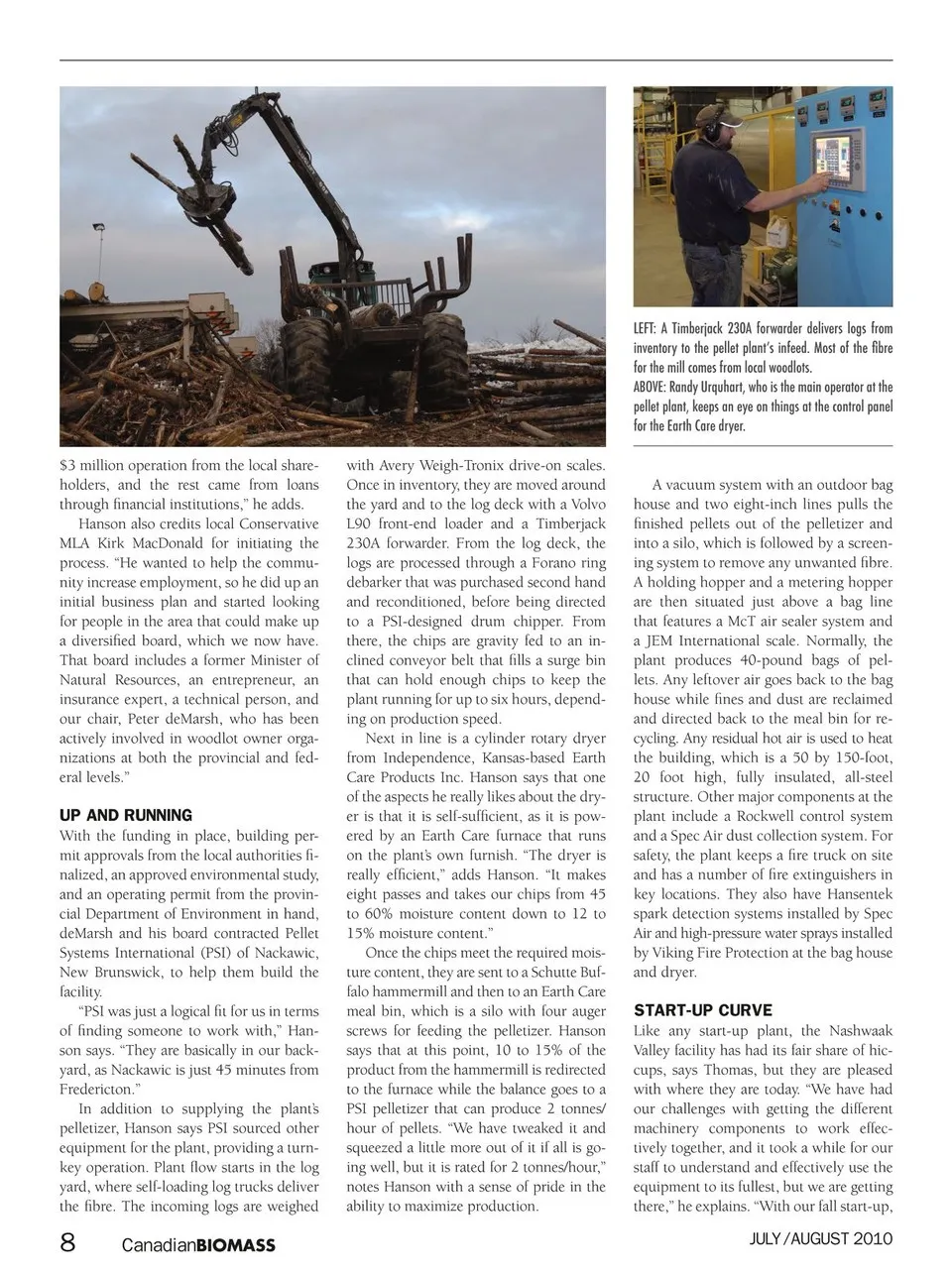
$3 million operation from the local share-holders, and the rest came from loans through financial institutions,” he adds. Hanson also credits local Conservative MLA Kirk MacDonald for initiating the process. “He wanted to help the commu-nity increase employment, so he did up an initial business plan and started looking for people in the area that could make up a diversified board, which we now have. That board includes a former Minister of Natural Resources, an entrepreneur, an insurance expert, a technical person, and our chair, Peter deMarsh, who has been actively involved in woodlot owner orga-nizations at both the provincial and fed-eral levels.” UP AND RUNNING With the funding in place, building per-mit approvals from the local authorities fi-nalized, an approved environmental study, and an operating permit from the provin-cial Department of Environment in hand, deMarsh and his board contracted Pellet Systems International (PSI) of Nackawic, New Brunswick, to help them build the facility. “PSI was just a logical fit for us in terms of finding someone to work with,” Han-son says. “They are basically in our back-yard, as Nackawic is just 45 minutes from Fredericton.” In addition to supplying the plant’s pelletizer, Hanson says PSI sourced other equipment for the plant, providing a turn-key operation. Plant flow starts in the log yard, where self-loading log trucks deliver the fibre. The incoming logs are weighed 8 CanadianBIOMASS with Avery Weigh-Tronix drive-on scales. Once in inventory, they are moved around the yard and to the log deck with a Volvo L90 front-end loader and a Timberjack 230A forwarder. From the log deck, the logs are processed through a Forano ring debarker that was purchased second hand and reconditioned, before being directed to a PSI-designed drum chipper. From there, the chips are gravity fed to an in-clined conveyor belt that fills a surge bin that can hold enough chips to keep the plant running for up to six hours, depend-ing on production speed. Next in line is a cylinder rotary dryer from Independence, Kansas-based Earth Care Products Inc. Hanson says that one of the aspects he really likes about the dry-er is that it is self-sufficient, as it is pow-ered by an Earth Care furnace that runs on the plant’s own furnish. “The dryer is really efficient,” adds Hanson. “It makes eight passes and takes our chips from 45 to 60% moisture content down to 12 to 15% moisture content.” Once the chips meet the required mois-ture content, they are sent to a Schutte Buf-falo hammermill and then to an Earth Care meal bin, which is a silo with four auger screws for feeding the pelletizer. Hanson says that at this point, 10 to 15% of the product from the hammermill is redirected to the furnace while the balance goes to a PSI pelletizer that can produce 2 tonnes/ hour of pellets. “We have tweaked it and squeezed a little more out of it if all is go-ing well, but it is rated for 2 tonnes/hour,” notes Hanson with a sense of pride in the ability to maximize production. A vacuum system with an outdoor bag house and two eight-inch lines pulls the finished pellets out of the pelletizer and into a silo, which is followed by a screen-ing system to remove any unwanted fibre. A holding hopper and a metering hopper are then situated just above a bag line that features a McT air sealer system and a JEM International scale. Normally, the plant produces 40-pound bags of pel-lets. Any leftover air goes back to the bag house while fines and dust are reclaimed and directed back to the meal bin for re-cycling. Any residual hot air is used to heat the building, which is a 50 by 150-foot, 20 foot high, fully insulated, all-steel structure. Other major components at the plant include a Rockwell control system and a Spec Air dust collection system. For safety, the plant keeps a fire truck on site and has a number of fire extinguishers in key locations. They also have Hansentek spark detection systems installed by Spec Air and high-pressure water sprays installed by Viking Fire Protection at the bag house and dryer. START-UP CURVE Like any start-up plant, the Nashwaak Valley facility has had its fair share of hic-cups, says Thomas, but they are pleased with where they are today. “We have had our challenges with getting the different machinery components to work effec-tively together, and it took a while for our staff to understand and effectively use the equipment to its fullest, but we are getting there,” he explains. “With our fall start-up, JULY/AUGUST 2010
Canadian Biomass July/August 2010: Page 8