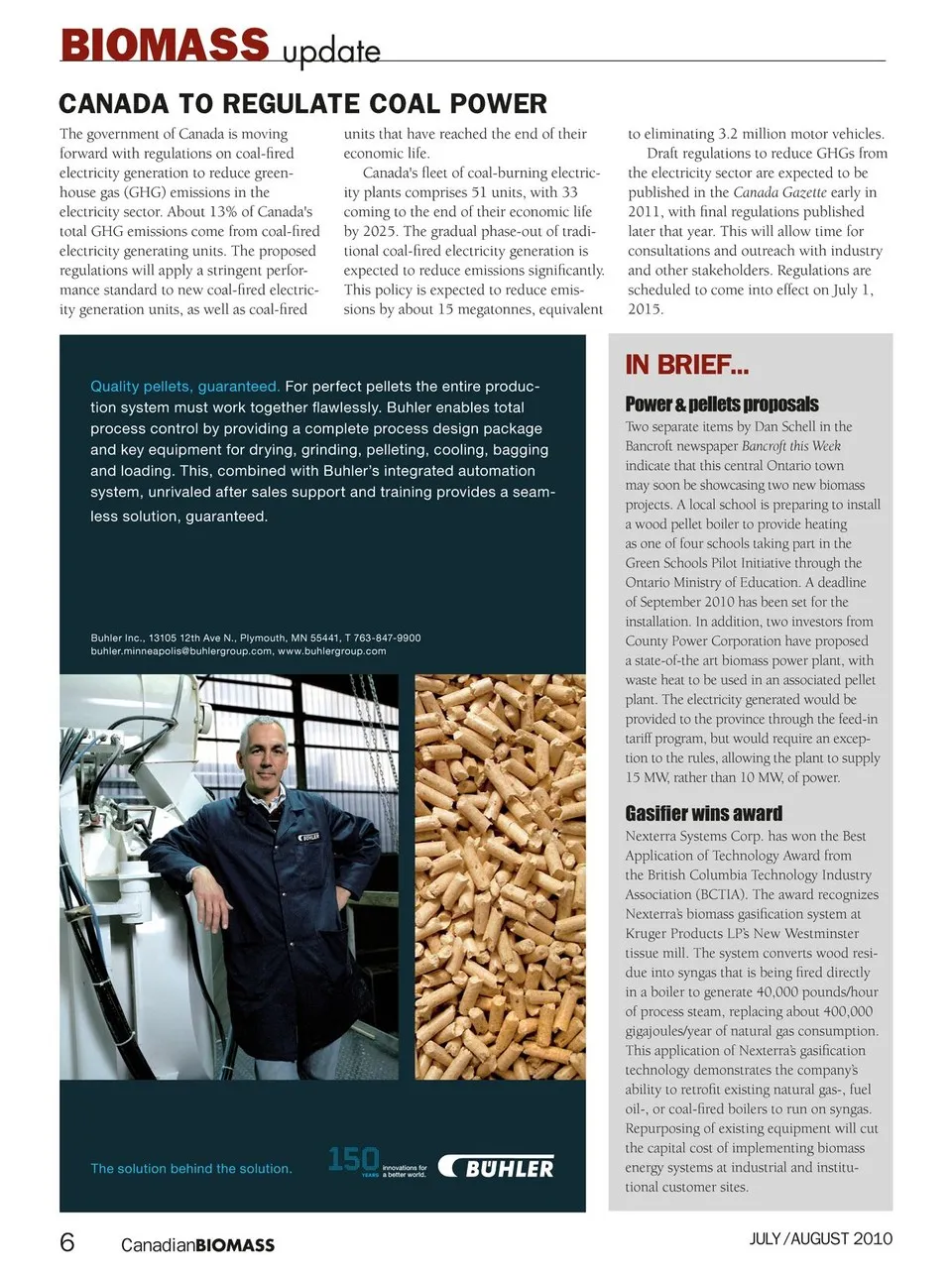
Pellet The old saying of “when one door closes, another one opens” could prove true for some woodlot owners in a rural area near Fredericton, New Brunswick. By Bill Tice the challenge of a collapsing kraft pulp industry in the Atlantic region and the resulting lim-ited market for low-grade logs, an entre-preneurial group of woodlot owners has joined forces with other community resi-dents to build a pellet plant. The plant is located in the Nashwaak Valley in central New Brunswick, a pleasant 35-minute drive out of Fredericton on country roads. The enterprise, called Nashwaak Valley Wood Energy, hums along 24 hours/day, six days/week. It’s housed in an unassum-ing building that is situated in a forest clearing at the end of a long driveway near the community of Nashwaak Bridge. Production Ken Thomas, who is the manager of the 2 tonne/hour pellet plant, says that many of the investors and owners of the facility are local woodlot owners. “Hav-ing reached the conclusion that the loss of markets for lower grade wood was likely to be permanent, pellet manufacturing seemed to be an emerging alternative for their fibre,” he explains. “We provide an outlet for low-quality softwood pulpwood and also a market for species that tradi-tionally did not have a home in our prov-ince, such as hemlock, tamarack, and pine pulpwood.” LOCAL INVESTMENT But Thomas says it’s not just the woodlot owners who have embraced the plant, which produced its first pellets in the fall of 2009 following a construction process that took more than a year. “The com-munity support for this project was very evident from the first meetings to discuss the project,” he says. “We had over 100 community members turn out during the early weeks of discussion, and most of them purchased some shares based on the plans that were presented. We now have 130 shareholders who have invested some capital in the project. Although some have a relatively small investment of a few hun-dred dollars, others have made a signifi-cant investment in the operation.” Bill Hanson, who is a local woodlot owner and one of nine directors for the company, concurs with Thomas. “This is a local company that hires local people and puts money back into the local com-munity,” says the retired Irving pulp mill maintenance foreman. Hanson is the self-professed troubleshooter at the plant, as he likes to solve the day-to-day technical issues that can occur in upstart operations like this one. “We raised about one-third of the funds needed to finance the almost CanadianBIOMASS 7
Canadian Biomass July/August 2010: Page 7