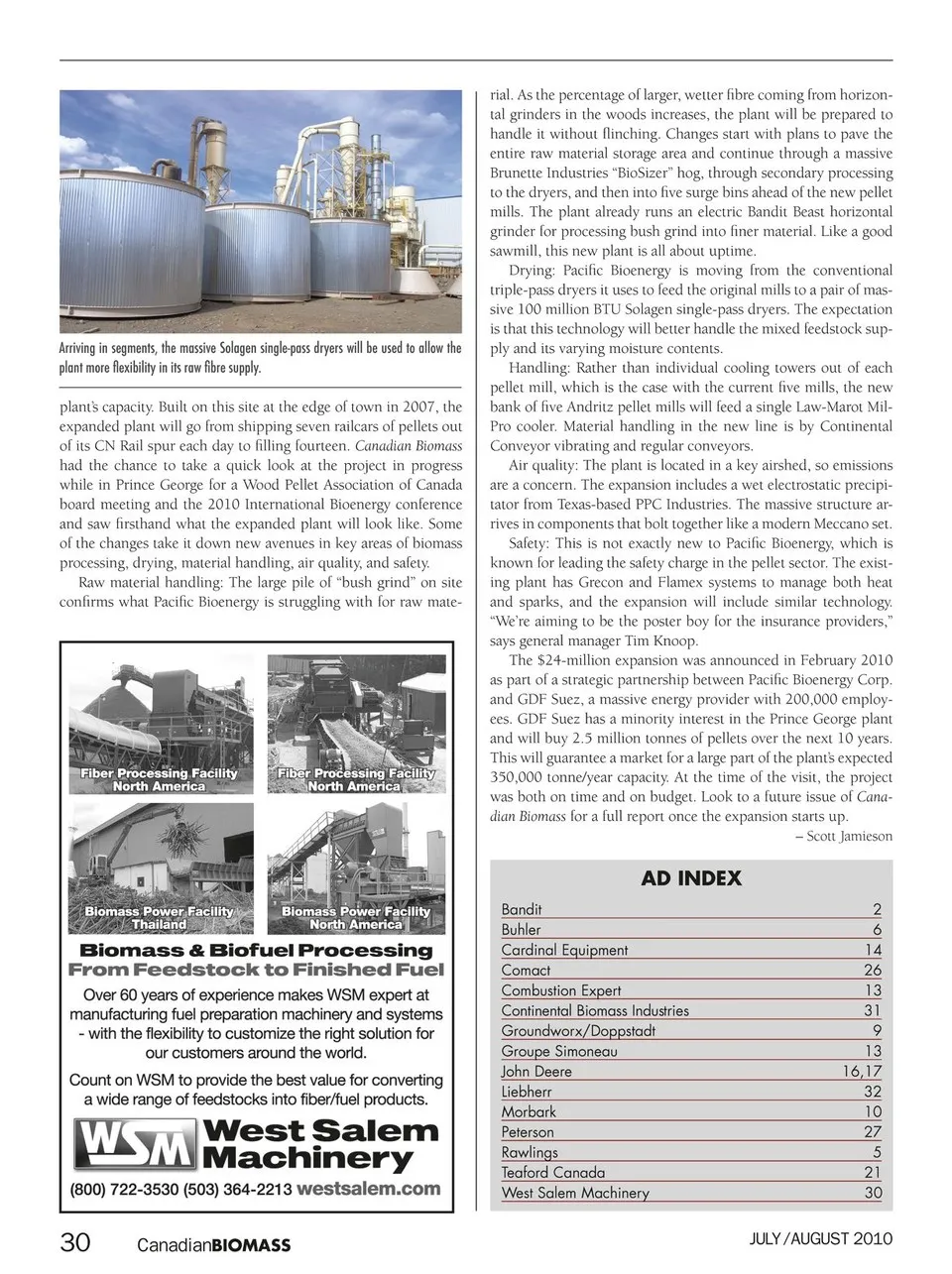
plant’s capacity. Built on this site at the edge of town in 2007, the expanded plant will go from shipping seven railcars of pellets out of its CN Rail spur each day to filling fourteen. Canadian Biomass had the chance to take a quick look at the project in progress while in Prince George for a Wood Pellet Association of Canada board meeting and the 2010 International Bioenergy conference and saw firsthand what the expanded plant will look like. Some of the changes take it down new avenues in key areas of biomass processing, drying, material handling, air quality, and safety. Raw material handling: The large pile of “bush grind” on site confirms what Pacific Bioenergy is struggling with for raw mate-rial. As the percentage of larger, wetter fibre coming from horizon-tal grinders in the woods increases, the plant will be prepared to handle it without flinching. Changes start with plans to pave the entire raw material storage area and continue through a massive Brunette Industries “BioSizer” hog, through secondary processing to the dryers, and then into five surge bins ahead of the new pellet mills. The plant already runs an electric Bandit Beast horizontal grinder for processing bush grind into finer material. Like a good sawmill, this new plant is all about uptime. Drying: Pacific Bioenergy is moving from the conventional triple-pass dryers it uses to feed the original mills to a pair of mas-sive 100 million BTU Solagen single-pass dryers. The expectation is that this technology will better handle the mixed feedstock sup-ply and its varying moisture contents. Handling: Rather than individual cooling towers out of each pellet mill, which is the case with the current five mills, the new bank of five Andritz pellet mills will feed a single Law-Marot Mil-Pro cooler. Material handling in the new line is by Continental Conveyor vibrating and regular conveyors. Air quality: The plant is located in a key airshed, so emissions are a concern. The expansion includes a wet electrostatic precipi-tator from Texas-based PPC Industries. The massive structure ar-rives in components that bolt together like a modern Meccano set. Safety: This is not exactly new to Pacific Bioenergy, which is known for leading the safety charge in the pellet sector. The exist-ing plant has Grecon and Flamex systems to manage both heat and sparks, and the expansion will include similar technology. “We’re aiming to be the poster boy for the insurance providers,” says general manager Tim Knoop. The $24-million expansion was announced in February 2010 as part of a strategic partnership between Pacific Bioenergy Corp. and GDF Suez, a massive energy provider with 200,000 employ-ees. GDF Suez has a minority interest in the Prince George plant and will buy 2.5 million tonnes of pellets over the next 10 years. This will guarantee a market for a large part of the plant’s expected 350,000 tonne/year capacity. At the time of the visit, the project was both on time and on budget. Look to a future issue of Cana-dian Biomass for a full report once the expansion starts up. – Scott Jamieson AD INDEX Bandit 2 Buhler 6 Cardinal Equipment 14 Comact 26 Combustion Expert 13 Continental Biomass Industries 31 Groundworx/Doppstadt 9 Groupe Simoneau John Deere 13 16,17 Liebherr 32 Morbark 10 Peterson 27 Rawlings 5 Teaford Canada West Salem Machinery 30 CanadianBIOMASS 21 30 JULY/AUGUST 2010
Canadian Biomass July/August 2010: Page 30