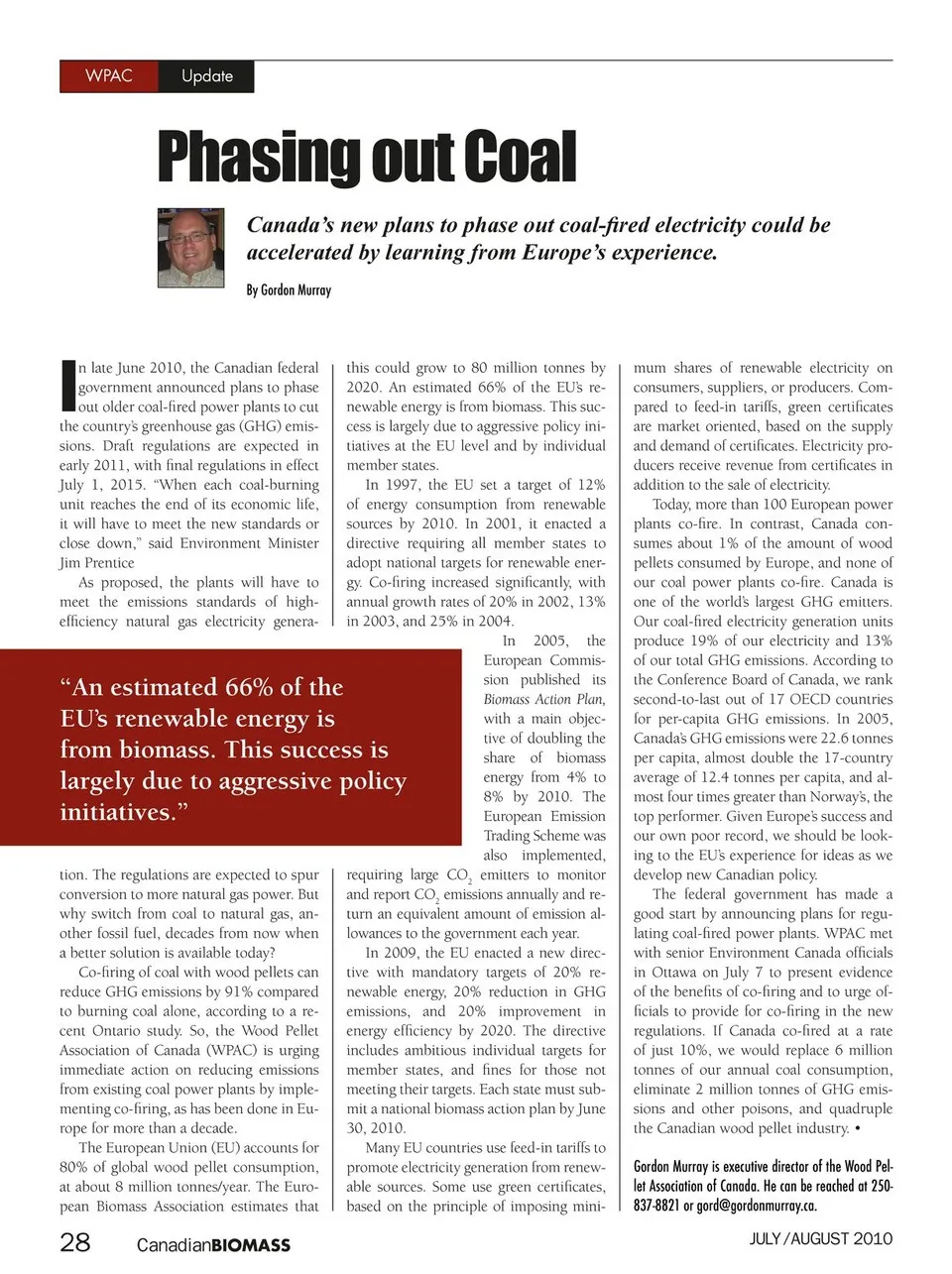
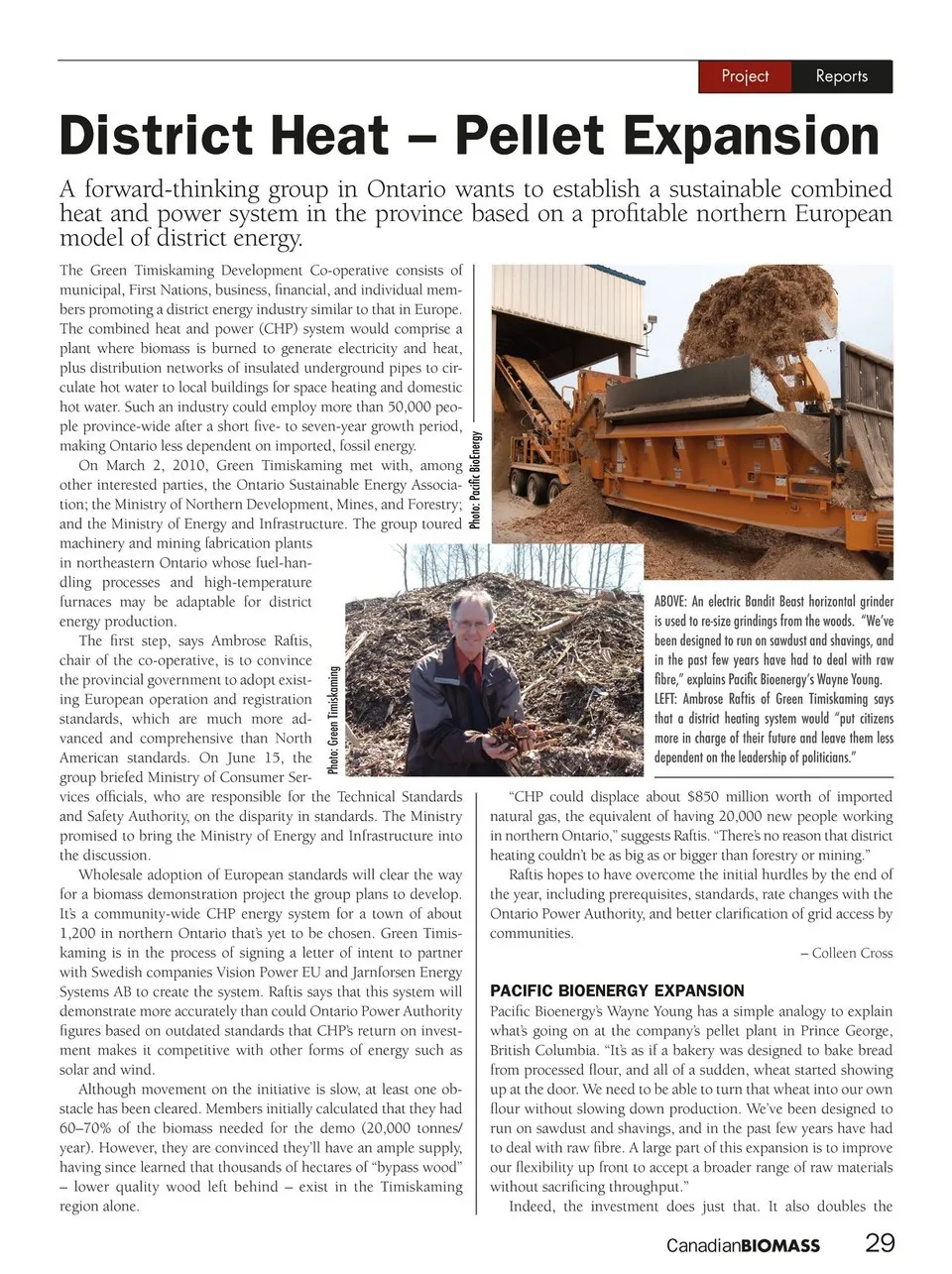
Project Reports District Heat – Pellet Expansion A forward-thinking group in Ontario wants to establish a sustainable combined heat and power system in the province based on a profitable northern European model of district energy. The Green Timiskaming Development Co-operative consists of municipal, First Nations, business, financial, and individual mem-bers promoting a district energy industry similar to that in Europe. The combined heat and power (CHP) system would comprise a plant where biomass is burned to generate electricity and heat, plus distribution networks of insulated underground pipes to cir-culate hot water to local buildings for space heating and domestic hot water. Such an industry could employ more than 50,000 peo-ple province-wide after a short five-to seven-year growth period, making Ontario less dependent on imported, fossil energy. On March 2, 2010, Green Timiskaming met with, among other interested parties, the Ontario Sustainable Energy Associa-tion; the Ministry of Northern Development, Mines, and Forestry; and the Ministry of Energy and Infrastructure. The group toured machinery and mining fabrication plants in northeastern Ontario whose fuel-han-dling processes and high-temperature furnaces may be adaptable for district energy production. The first step, says Ambrose Raftis, chair of the co-operative, is to convince the provincial government to adopt exist-ing European operation and registration standards, which are much more ad-vanced and comprehensive than North American standards. On June 15, the group briefed Ministry of Consumer Ser-vices officials, who are responsible for the Technical Standards and Safety Authority, on the disparity in standards. The Ministry promised to bring the Ministry of Energy and Infrastructure into the discussion. Wholesale adoption of European standards will clear the way for a biomass demonstration project the group plans to develop. It’s a community-wide CHP energy system for a town of about 1,200 in northern Ontario that’s yet to be chosen. Green Timis-kaming is in the process of signing a letter of intent to partner with Swedish companies Vision Power EU and Jarnforsen Energy Systems AB to create the system. Raftis says that this system will demonstrate more accurately than could Ontario Power Authority figures based on outdated standards that CHP’s return on invest-ment makes it competitive with other forms of energy such as solar and wind. Although movement on the initiative is slow, at least one ob-stacle has been cleared. Members initially calculated that they had 60–70% of the biomass needed for the demo (20,000 tonnes/ year). However, they are convinced they’ll have an ample supply, having since learned that thousands of hectares of “bypass wood” – lower quality wood left behind – exist in the Timiskaming region alone. “CHP could displace about $850 million worth of imported natural gas, the equivalent of having 20,000 new people working in northern Ontario,” suggests Raftis. “There’s no reason that district heating couldn’t be as big as or bigger than forestry or mining.” Raftis hopes to have overcome the initial hurdles by the end of the year, including prerequisites, standards, rate changes with the Ontario Power Authority, and better clarification of grid access by communities. – Colleen Cross PACIFIC BIOENERGY EXPANSION Pacific Bioenergy’s Wayne Young has a simple analogy to explain what’s going on at the company’s pellet plant in Prince George, British Columbia. “It’s as if a bakery was designed to bake bread from processed flour, and all of a sudden, wheat started showing up at the door. We need to be able to turn that wheat into our own flour without slowing down production. We’ve been designed to run on sawdust and shavings, and in the past few years have had to deal with raw fibre. A large part of this expansion is to improve our flexibility up front to accept a broader range of raw materials without sacrificing throughput.” Indeed, the investment does just that. It also doubles the CanadianBIOMASS 29
Canadian Biomass July/August 2010: Page 29