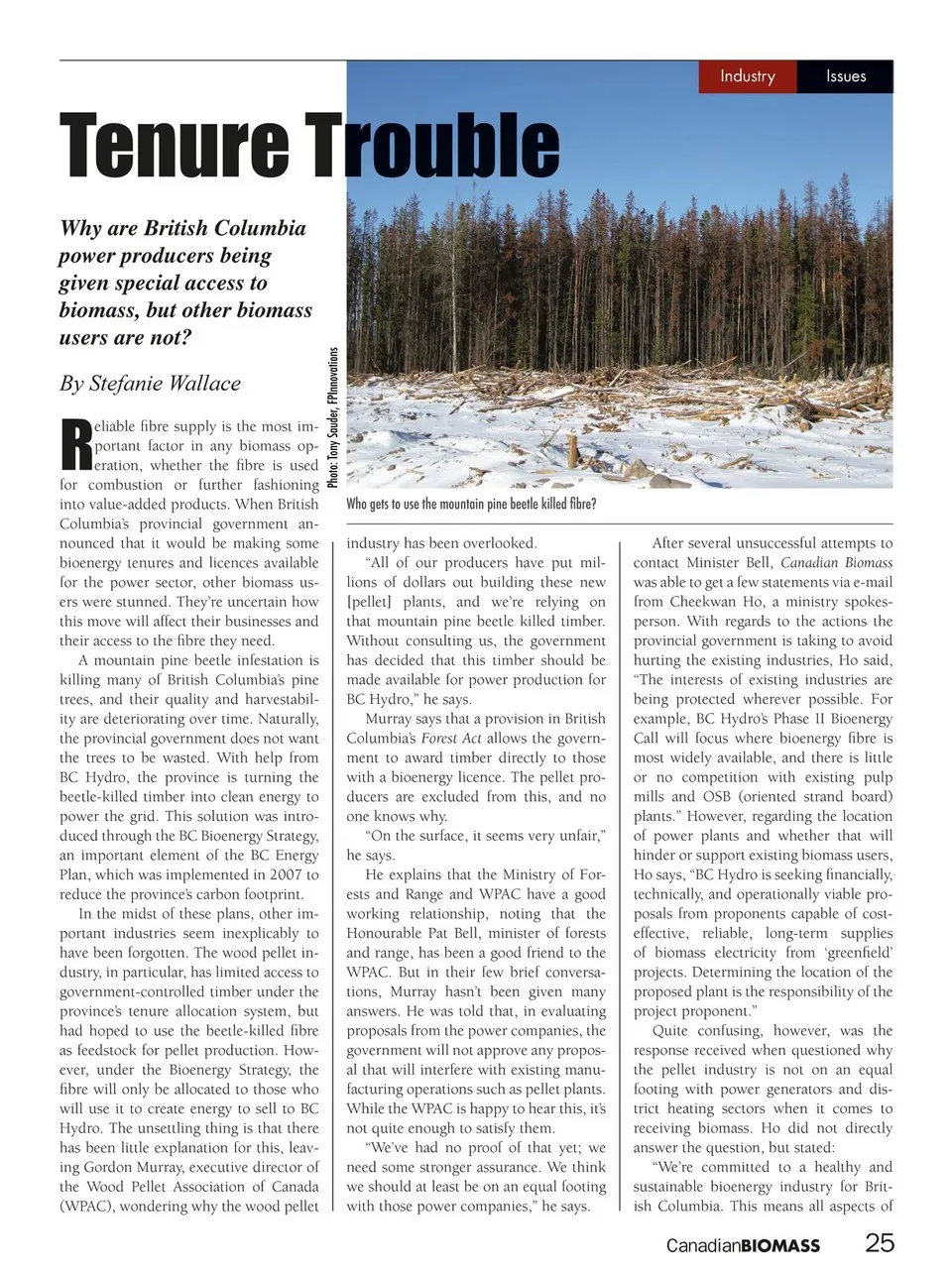
Industry Why are British Columbia power producers being given special access to biomass, but other biomass users are not? eliable fibre supply is the most im-portant factor in any biomass op-eration, whether the fibre is used for combustion or further fashioning into value-added products. When British Columbia’s provincial government an-nounced that it would be making some bioenergy tenures and licences available for the power sector, other biomass us-ers were stunned. They’re uncertain how this move will affect their businesses and their access to the fibre they need. A mountain pine beetle infestation is killing many of British Columbia’s pine trees, and their quality and harvestabil-ity are deteriorating over time. Naturally, the provincial government does not want the trees to be wasted. With help from BC Hydro, the province is turning the beetle-killed timber into clean energy to power the grid. This solution was intro-duced through the BC Bioenergy Strategy, an important element of the BC Energy Plan, which was implemented in 2007 to reduce the province’s carbon footprint. In the midst of these plans, other im-portant industries seem inexplicably to have been forgotten. The wood pellet in-dustry, in particular, has limited access to government-controlled timber under the province’s tenure allocation system, but had hoped to use the beetle-killed fibre as feedstock for pellet production. How-ever, under the Bioenergy Strategy, the fibre will only be allocated to those who will use it to create energy to sell to BC Hydro. The unsettling thing is that there has been little explanation for this, leav-ing Gordon Murray, executive director of the Wood Pellet Association of Canada (WPAC), wondering why the wood pellet industry has been overlooked. “All of our producers have put mil-lions of dollars out building these new [pellet] plants, and we’re relying on that mountain pine beetle killed timber. Without consulting us, the government has decided that this timber should be made available for power production for BC Hydro,” he says. Murray says that a provision in British Columbia’s Forest Act allows the govern-ment to award timber directly to those with a bioenergy licence. The pellet pro-ducers are excluded from this, and no one knows why. “On the surface, it seems very unfair,” he says. He explains that the Ministry of For-ests and Range and WPAC have a good working relationship, noting that the Honourable Pat Bell, minister of forests and range, has been a good friend to the WPAC. But in their few brief conversa-tions, Murray hasn’t been given many answers. He was told that, in evaluating proposals from the power companies, the government will not approve any propos-al that will interfere with existing manu-facturing operations such as pellet plants. While the WPAC is happy to hear this, it’s not quite enough to satisfy them. “We’ve had no proof of that yet; we need some stronger assurance. We think we should at least be on an equal footing with those power companies,” he says. After several unsuccessful attempts to contact Minister Bell, Canadian Biomass was able to get a few statements via e-mail from Cheekwan Ho, a ministry spokes-person. With regards to the actions the provincial government is taking to avoid hurting the existing industries, Ho said, “The interests of existing industries are being protected wherever possible. For example, BC Hydro’s Phase II Bioenergy Call will focus where bioenergy fibre is most widely available, and there is little or no competition with existing pulp mills and OSB (oriented strand board) plants.” However, regarding the location of power plants and whether that will hinder or support existing biomass users, Ho says, “BC Hydro is seeking financially, technically, and operationally viable pro-posals from proponents capable of cost-effective, reliable, long-term supplies of biomass electricity from ‘greenfield’ projects. Determining the location of the proposed plant is the responsibility of the project proponent.” Quite confusing, however, was the response received when questioned why the pellet industry is not on an equal footing with power generators and dis-trict heating sectors when it comes to receiving biomass. Ho did not directly answer the question, but stated: “We’re committed to a healthy and sustainable bioenergy industry for Brit-ish Columbia. This means all aspects of CanadianBIOMASS 25 Issues
Canadian Biomass July/August 2010: Page 25