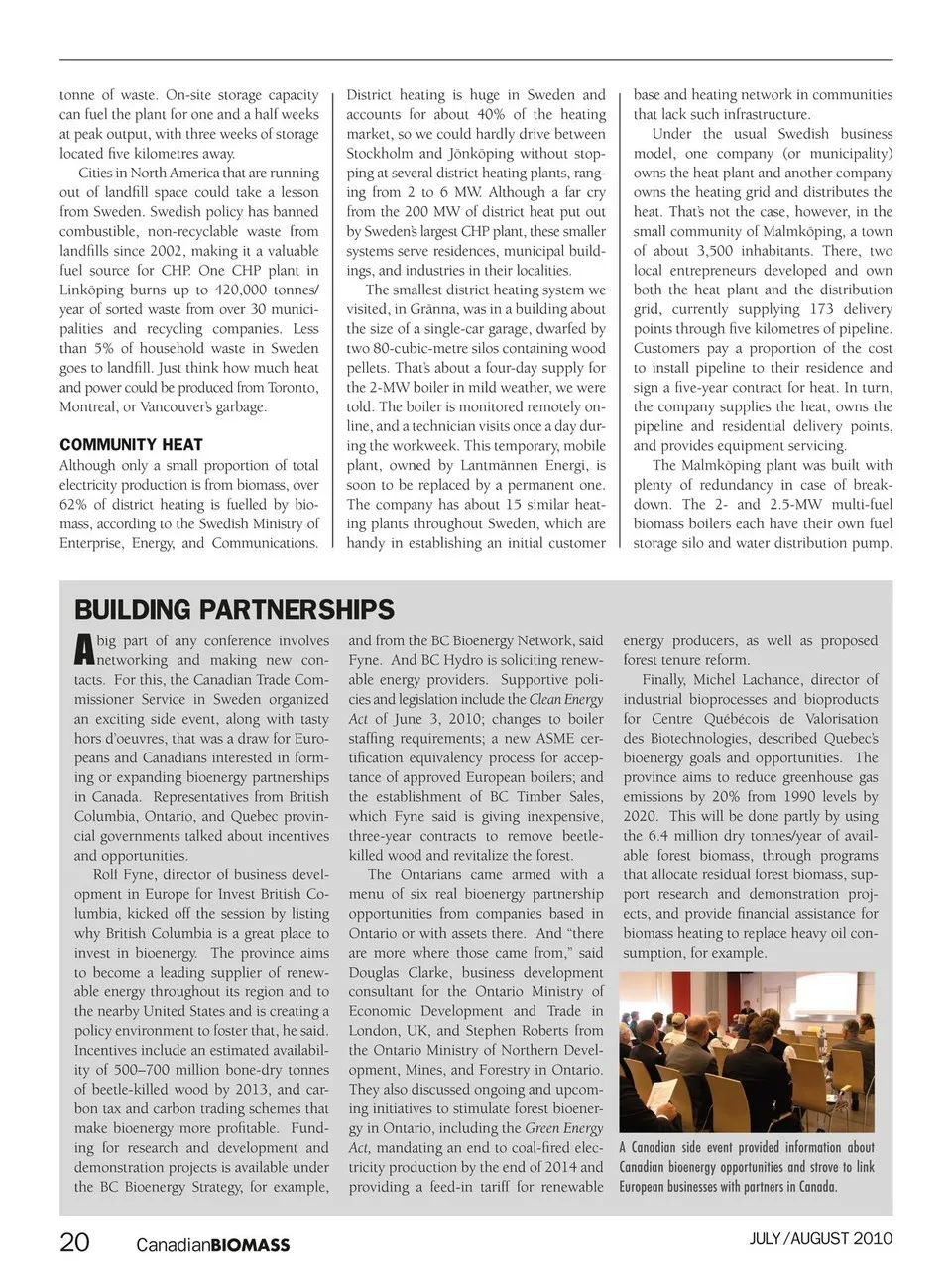
tonne of waste. On-site storage capacity can fuel the plant for one and a half weeks at peak output, with three weeks of storage located five kilometres away. Cities in North America that are running out of landfill space could take a lesson from Sweden. Swedish policy has banned combustible, non-recyclable waste from landfills since 2002, making it a valuable fuel source for CHP. One CHP plant in Linköping burns up to 420,000 tonnes/ year of sorted waste from over 30 munici-palities and recycling companies. Less than 5% of household waste in Sweden goes to landfill. Just think how much heat and power could be produced from Toronto, Montreal, or Vancouver’s garbage. COMMUNITY HEAT Although only a small proportion of total electricity production is from biomass, over 62% of district heating is fuelled by bio-mass, according to the Swedish Ministry of Enterprise, Energy, and Communications. District heating is huge in Sweden and accounts for about 40% of the heating market, so we could hardly drive between Stockholm and Jönköping without stop-ping at several district heating plants, rang-ing from 2 to 6 MW. Although a far cry from the 200 MW of district heat put out by Sweden’s largest CHP plant, these smaller systems serve residences, municipal build-ings, and industries in their localities. The smallest district heating system we visited, in Gränna, was in a building about the size of a single-car garage, dwarfed by two 80-cubic-metre silos containing wood pellets. That’s about a four-day supply for the 2-MW boiler in mild weather, we were told. The boiler is monitored remotely on-line, and a technician visits once a day dur-ing the workweek. This temporary, mobile plant, owned by Lantmännen Energi, is soon to be replaced by a permanent one. The company has about 15 similar heat-ing plants throughout Sweden, which are handy in establishing an initial customer BUILDING PARTNERSHIPS big part of any conference involves networking and making new con-tacts. For this, the Canadian Trade Com-missioner Service in Sweden organized an exciting side event, along with tasty hors d’oeuvres, that was a draw for Euro-peans and Canadians interested in form-ing or expanding bioenergy partnerships in Canada. Representatives from British Columbia, Ontario, and Quebec provin-cial governments talked about incentives and opportunities. Rolf Fyne, director of business devel-opment in Europe for Invest British Co-lumbia, kicked off the session by listing why British Columbia is a great place to invest in bioenergy. The province aims to become a leading supplier of renew-able energy throughout its region and to the nearby United States and is creating a policy environment to foster that, he said. Incentives include an estimated availabil-ity of 500–700 million bone-dry tonnes of beetle-killed wood by 2013, and car-bon tax and carbon trading schemes that make bioenergy more profitable. Fund-ing for research and development and demonstration projects is available under the BC Bioenergy Strategy, for example, 20 CanadianBIOMASS and from the BC Bioenergy Network, said Fyne. And BC Hydro is soliciting renew-able energy providers. Supportive poli-cies and legislation include the Clean Energy Act of June 3, 2010; changes to boiler staffing requirements; a new ASME cer-tification equivalency process for accep-tance of approved European boilers; and the establishment of BC Timber Sales, which Fyne said is giving inexpensive, three-year contracts to remove beetle-killed wood and revitalize the forest. The Ontarians came armed with a menu of six real bioenergy partnership opportunities from companies based in Ontario or with assets there. And “there are more where those came from,” said Douglas Clarke, business development consultant for the Ontario Ministry of Economic Development and Trade in London, UK, and Stephen Roberts from the Ontario Ministry of Northern Devel-opment, Mines, and Forestry in Ontario. They also discussed ongoing and upcom-ing initiatives to stimulate forest bioener-gy in Ontario, including the Green Energy Act, mandating an end to coal-fired elec-tricity production by the end of 2014 and providing a feed-in tariff for renewable energy producers, as well as proposed forest tenure reform. Finally, Michel Lachance, director of industrial bioprocesses and bioproducts for Centre Québécois de Valorisation des Biotechnologies, described Quebec’s bioenergy goals and opportunities. The province aims to reduce greenhouse gas emissions by 20% from 1990 levels by 2020. This will be done partly by using the 6.4 million dry tonnes/year of avail-able forest biomass, through programs that allocate residual forest biomass, sup-port research and demonstration proj-ects, and provide financial assistance for biomass heating to replace heavy oil con-sumption, for example. base and heating network in communities that lack such infrastructure. Under the usual Swedish business model, one company (or municipality) owns the heat plant and another company owns the heating grid and distributes the heat. That’s not the case, however, in the small community of Malmköping, a town of about 3,500 inhabitants. There, two local entrepreneurs developed and own both the heat plant and the distribution grid, currently supplying 173 delivery points through five kilometres of pipeline. Customers pay a proportion of the cost to install pipeline to their residence and sign a five-year contract for heat. In turn, the company supplies the heat, owns the pipeline and residential delivery points, and provides equipment servicing. The Malmköping plant was built with plenty of redundancy in case of break-down. The 2-and 2.5-MW multi-fuel biomass boilers each have their own fuel storage silo and water distribution pump. JULY/AUGUST 2010
Canadian Biomass July/August 2010: Page 20