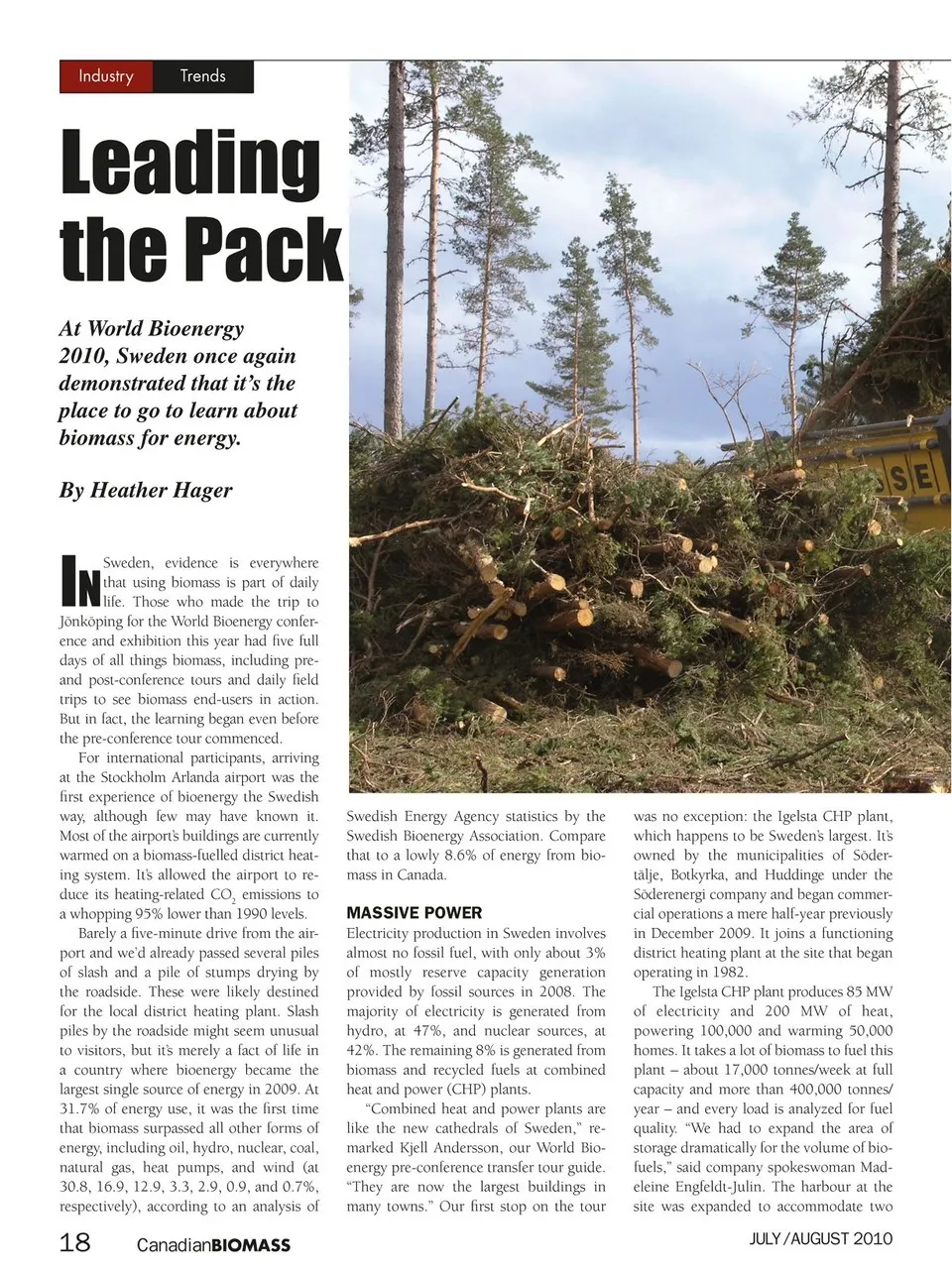
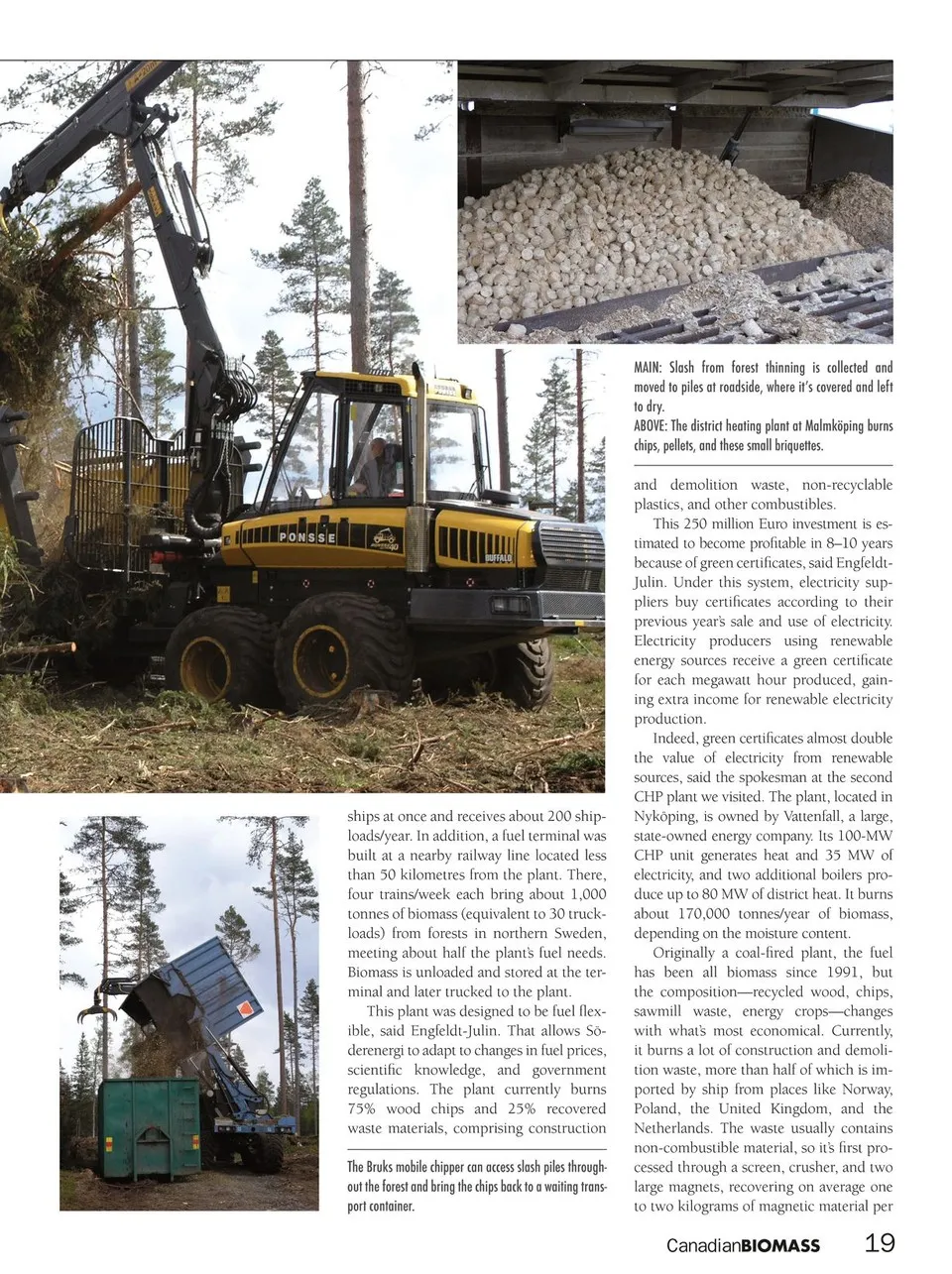
ships at once and receives about 200 ship-loads/year. In addition, a fuel terminal was built at a nearby railway line located less than 50 kilometres from the plant. There, four trains/week each bring about 1,000 tonnes of biomass (equivalent to 30 truck-loads) from forests in northern Sweden, meeting about half the plant’s fuel needs. Biomass is unloaded and stored at the ter-minal and later trucked to the plant. This plant was designed to be fuel flex-ible, said Engfeldt-Julin. That allows Sö-derenergi to adapt to changes in fuel prices, scientific knowledge, and government regulations. The plant currently burns 75% wood chips and 25% recovered waste materials, comprising construction and demolition waste, non-recyclable plastics, and other combustibles. This 250 million Euro investment is es-timated to become profitable in 8–10 years because of green certificates, said Engfeldt-Julin. Under this system, electricity sup-pliers buy certificates according to their previous year’s sale and use of electricity. Electricity producers using renewable energy sources receive a green certificate for each megawatt hour produced, gain-ing extra income for renewable electricity production. Indeed, green certificates almost double the value of electricity from renewable sources, said the spokesman at the second CHP plant we visited. The plant, located in Nyköping, is owned by Vattenfall, a large, state-owned energy company. Its 100-MW CHP unit generates heat and 35 MW of electricity, and two additional boilers pro-duce up to 80 MW of district heat. It burns about 170,000 tonnes/year of biomass, depending on the moisture content. Originally a coal-fired plant, the fuel has been all biomass since 1991, but the composition—recycled wood, chips, sawmill waste, energy crops—changes with what’s most economical. Currently, it burns a lot of construction and demoli-tion waste, more than half of which is im-ported by ship from places like Norway, Poland, the United Kingdom, and the Netherlands. The waste usually contains non-combustible material, so it’s first pro-cessed through a screen, crusher, and two large magnets, recovering on average one to two kilograms of magnetic material per CanadianBIOMASS 19
Canadian Biomass July/August 2010: Page 19