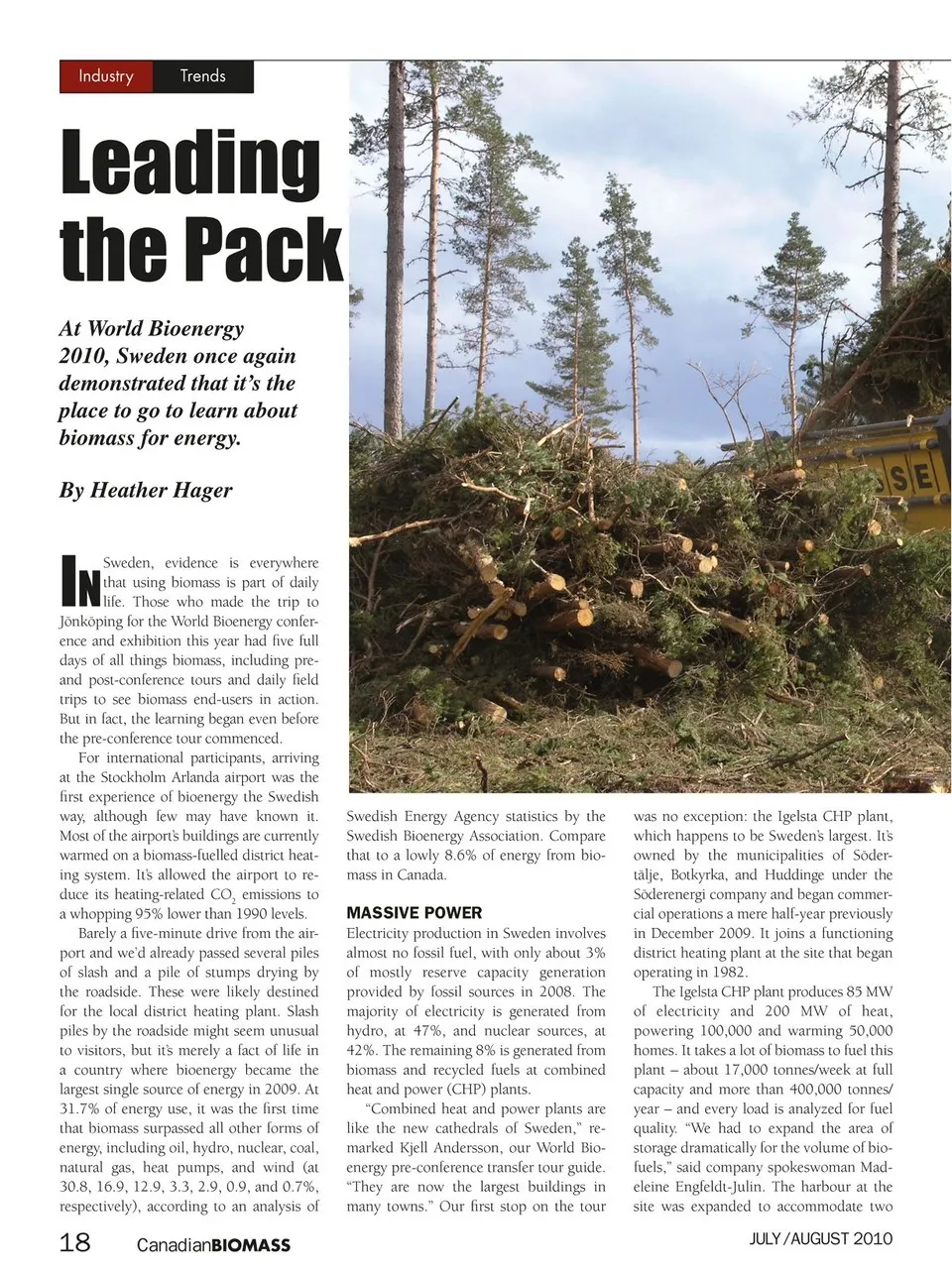
Industry Trends At World Bioenergy 2010, Sweden once again demonstrated that it’s the place to go to learn about biomass for energy. By Heather Hager Sweden, evidence is everywhere that using biomass is part of daily life. Those who made the trip to Jönköping for the World Bioenergy confer-ence and exhibition this year had five full days of all things biomass, including pre-and post-conference tours and daily field trips to see biomass end-users in action. But in fact, the learning began even before the pre-conference tour commenced. For international participants, arriving at the Stockholm Arlanda airport was the first experience of bioenergy the Swedish way, although few may have known it. Most of the airport’s buildings are currently warmed on a biomass-fuelled district heat-ing system. It’s allowed the airport to re-duce its heating-related CO2 emissions to a whopping 95% lower than 1990 levels. Barely a five-minute drive from the air-port and we’d already passed several piles of slash and a pile of stumps drying by the roadside. These were likely destined for the local district heating plant. Slash piles by the roadside might seem unusual to visitors, but it’s merely a fact of life in a country where bioenergy became the largest single source of energy in 2009. At 31.7% of energy use, it was the first time that biomass surpassed all other forms of energy, including oil, hydro, nuclear, coal, natural gas, heat pumps, and wind (at 30.8, 16.9, 12.9, 3.3, 2.9, 0.9, and 0.7%, respectively), according to an analysis of 18 CanadianBIOMASS MASSIVE POWER Electricity production in Sweden involves almost no fossil fuel, with only about 3% of mostly reserve capacity generation provided by fossil sources in 2008. The majority of electricity is generated from hydro, at 47%, and nuclear sources, at 42%. The remaining 8% is generated from biomass and recycled fuels at combined heat and power (CHP) plants. “Combined heat and power plants are like the new cathedrals of Sweden,” re-marked Kjell Andersson, our World Bio-energy pre-conference transfer tour guide. “They are now the largest buildings in many towns.” Our first stop on the tour Swedish Energy Agency statistics by the Swedish Bioenergy Association. Compare that to a lowly 8.6% of energy from bio-mass in Canada. was no exception: the Igelsta CHP plant, which happens to be Sweden’s largest. It’s owned by the municipalities of Söder-tälje, Botkyrka, and Huddinge under the Söderenergi company and began commer-cial operations a mere half-year previously in December 2009. It joins a functioning district heating plant at the site that began operating in 1982. The Igelsta CHP plant produces 85 MW of electricity and 200 MW of heat, powering 100,000 and warming 50,000 homes. It takes a lot of biomass to fuel this plant – about 17,000 tonnes/week at full capacity and more than 400,000 tonnes/ year – and every load is analyzed for fuel quality. “We had to expand the area of storage dramatically for the volume of bio-fuels,” said company spokeswoman Mad-eleine Engfeldt-Julin. The harbour at the site was expanded to accommodate two JULY/AUGUST 2010
Canadian Biomass July/August 2010: Page 18