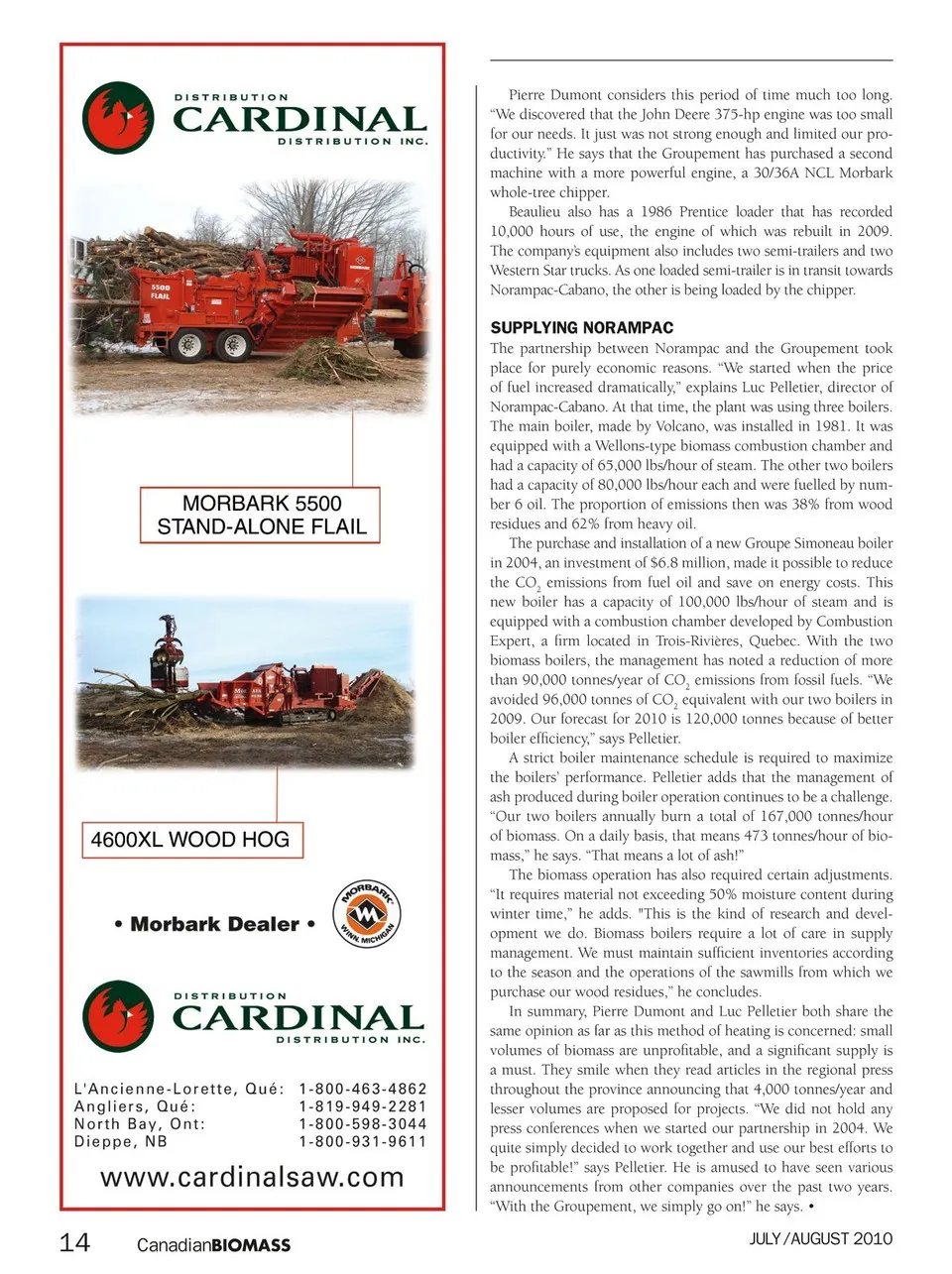
Pierre Dumont considers this period of time much too long. “We discovered that the John Deere 375-hp engine was too small for our needs. It just was not strong enough and limited our pro-ductivity.” He says that the Groupement has purchased a second machine with a more powerful engine, a 30/36A NCL Morbark whole-tree chipper. Beaulieu also has a 1986 Prentice loader that has recorded 10,000 hours of use, the engine of which was rebuilt in 2009. The company’s equipment also includes two semi-trailers and two Western Star trucks. As one loaded semi-trailer is in transit towards Norampac-Cabano, the other is being loaded by the chipper. SUPPLYING NORAMPAC emissions from fuel oil and save on energy costs. This new boiler has a capacity of 100,000 lbs/hour of steam and is equipped with a combustion chamber developed by Combustion Expert, a firm located in Trois-Rivières, Quebec. With the two biomass boilers, the management has noted a reduction of more than 90,000 tonnes/year of CO2 avoided 96,000 tonnes of CO2 The partnership between Norampac and the Groupement took place for purely economic reasons. “We started when the price of fuel increased dramatically,” explains Luc Pelletier, director of Norampac-Cabano. At that time, the plant was using three boilers. The main boiler, made by Volcano, was installed in 1981. It was equipped with a Wellons-type biomass combustion chamber and had a capacity of 65,000 lbs/hour of steam. The other two boilers had a capacity of 80,000 lbs/hour each and were fuelled by num-ber 6 oil. The proportion of emissions then was 38% from wood residues and 62% from heavy oil. The purchase and installation of a new Groupe Simoneau boiler in 2004, an investment of $6.8 million, made it possible to reduce the CO2 emissions from fossil fuels. “We equivalent with our two boilers in 2009. Our forecast for 2010 is 120,000 tonnes because of better boiler efficiency,” says Pelletier. A strict boiler maintenance schedule is required to maximize the boilers’ performance. Pelletier adds that the management of ash produced during boiler operation continues to be a challenge. “Our two boilers annually burn a total of 167,000 tonnes/hour of biomass. On a daily basis, that means 473 tonnes/hour of bio-mass,” he says. “That means a lot of ash!” The biomass operation has also required certain adjustments. “It requires material not exceeding 50% moisture content during winter time,” he adds. "This is the kind of research and devel-opment we do. Biomass boilers require a lot of care in supply management. We must maintain sufficient inventories according to the season and the operations of the sawmills from which we purchase our wood residues,” he concludes. In summary, Pierre Dumont and Luc Pelletier both share the same opinion as far as this method of heating is concerned: small volumes of biomass are unprofitable, and a significant supply is a must. They smile when they read articles in the regional press throughout the province announcing that 4,000 tonnes/year and lesser volumes are proposed for projects. “We did not hold any press conferences when we started our partnership in 2004. We quite simply decided to work together and use our best efforts to be profitable!” says Pelletier. He is amused to have seen various announcements from other companies over the past two years. “With the Groupement, we simply go on!” he says. • 14 CanadianBIOMASS JULY/AUGUST 2010
Canadian Biomass July/August 2010: Page 14