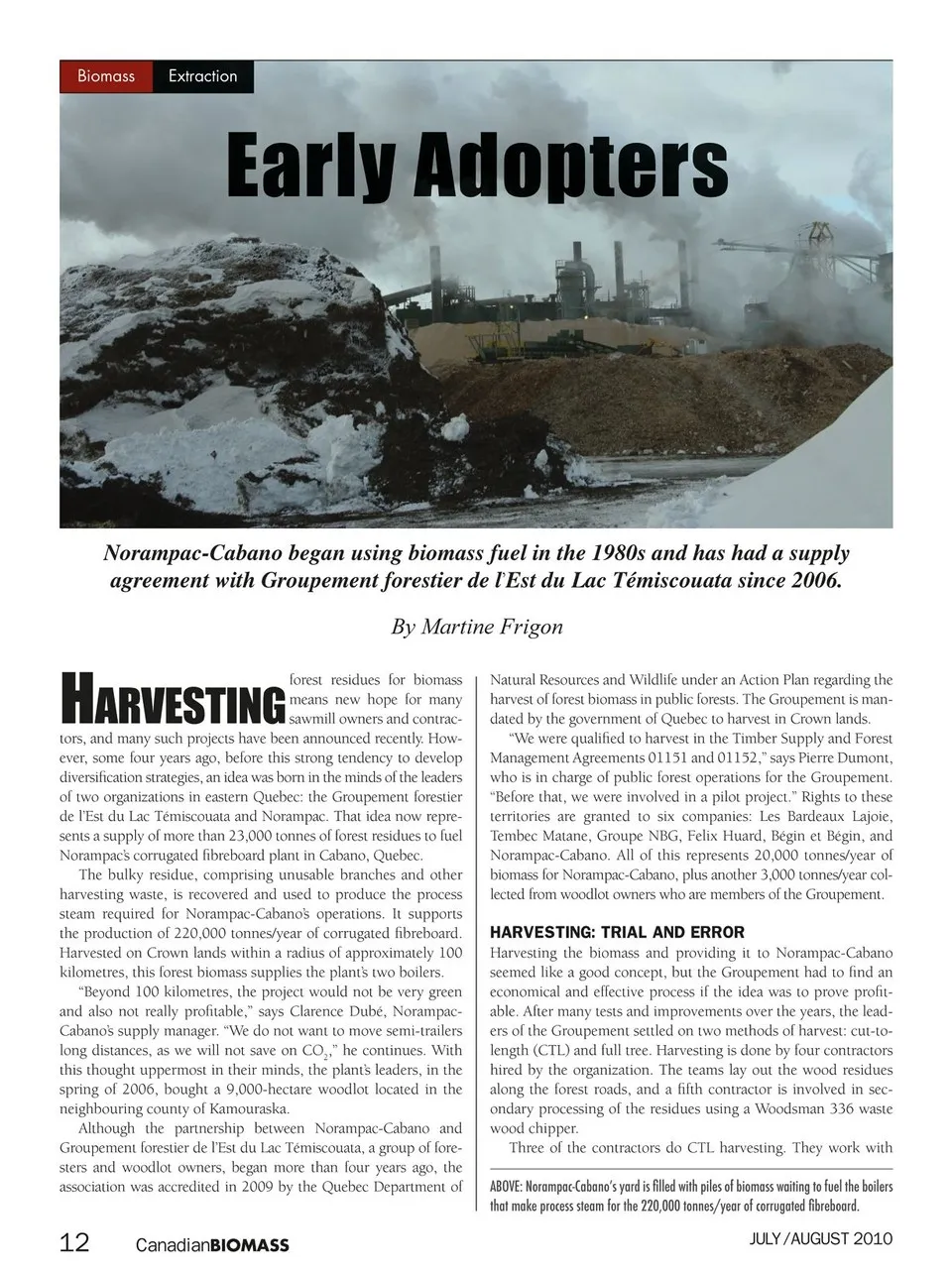
CTL harvesters and transport the wood residues by forwarder. This method requires care to avoid contamination, says Pierre Dumont, who is in charge of public forest operations for the Groupement. “With the forwarder, the operators must be careful not to collect too much rock and dust because such material would cause problems for the chipper. This is what we have learned from experimentation,” says Dumont. Born, raised, and living in Dégelis, Dumont graduated as a forest technician from Cégep of Sainte-Foy in 1981 and has worked for the Groupement since 1987. Rosaire Laplante is one of the three contractors who specialize in CTL harvesting. He owns two harvesters, a Tigercat 845D and an 845C, both fitted with Logmax 7000 harvesting heads. He also has a Rottne Rapid 16-tonne forwarder. Les Chantiers du lac, another company, operates with two Tiger-cat models 845B and 860B, also with Logmax 7000 harvesting heads, and a John Deere 1110D forwarder. Lionel Rousseau, the third CTL contractor, uses a Tigercat 822 harvester as well as a Valmet 425 harvester. Both of those machines are equipped with Logmax 7000 harvesting heads. Rousseau’s company also uses two Eco Log forwarders, models 547 and 564. In the full-tree operation, Berthier Beaulieu uses a Prentice 630 feller buncher and a Gilbert 1252 feller head, two John Deere 748G and 738G skidders, and two John Deere 790E and 2054 delimbers equipped with Propac delimber models 613 and 453. Meanwhile, Camille Beaulieu works along Highway 185, pro-cessing wood residues left after the construction of the road. Living in Packington, Quebec, he is the contractor in charge of the opera-tions, using a Woodsman 334 wood chipper. The Groupement purchased the chipper new in 2006. Having launched his own business 10 years ago, Beaulieu was formerly an operator. His team is made up of his brother Lucien, and Marc-Andre Picard, a young man who has just turned 20. “There are more restrictions when you use a chipper, compared to a grinder: We have to check carefully to be sure no rocks are introduced into the machine because that would slow down our production,” Beaulieu explains. “A full load made by this chipper weighs 34 tonnes in the semi-trailer and will take one and a half hours to process,” he adds. CanadianBIOMASS 13
Canadian Biomass July/August 2010: Page 13