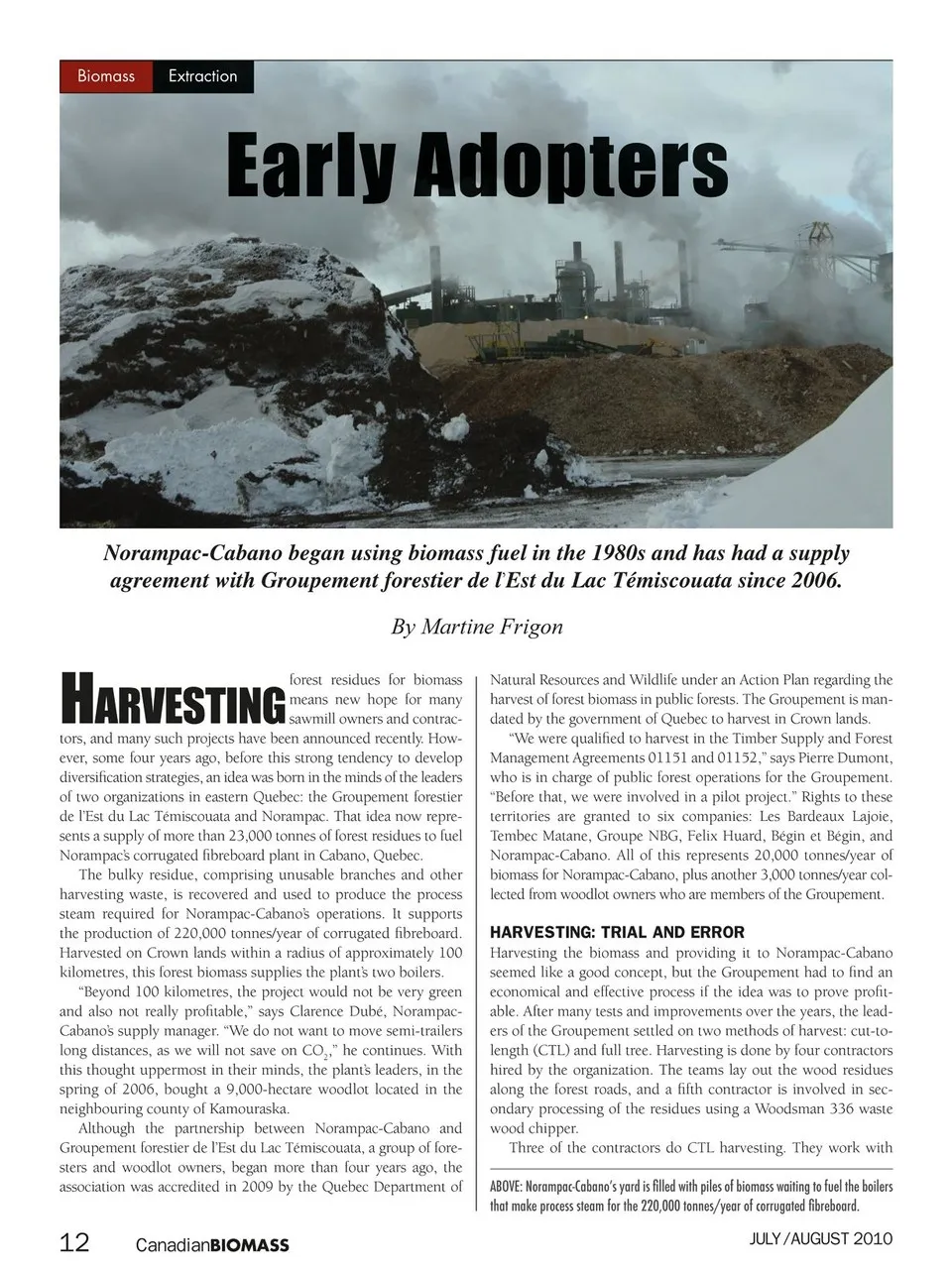
Biomass Extraction Norampac-Cabano began using biomass fuel in the 1980s and has had a supply agreement with Groupement forestier de l’Est du Lac Témiscouata since 2006. forest residues for biomass means new hope for many sawmill owners and contrac-tors, and many such projects have been announced recently. How-ever, some four years ago, before this strong tendency to develop diversification strategies, an idea was born in the minds of the leaders of two organizations in eastern Quebec: the Groupement forestier de l’Est du Lac Témiscouata and Norampac. That idea now repre-sents a supply of more than 23,000 tonnes of forest residues to fuel Norampac’s corrugated fibreboard plant in Cabano, Quebec. The bulky residue, comprising unusable branches and other harvesting waste, is recovered and used to produce the process steam required for Norampac-Cabano’s operations. It supports the production of 220,000 tonnes/year of corrugated fibreboard. Harvested on Crown lands within a radius of approximately 100 kilometres, this forest biomass supplies the plant’s two boilers. “Beyond 100 kilometres, the project would not be very green and also not really profitable,” says Clarence Dubé, Norampac-Cabano’s supply manager. “We do not want to move semi-trailers long distances, as we will not save on CO2 ,” he continues. With this thought uppermost in their minds, the plant’s leaders, in the spring of 2006, bought a 9,000-hectare woodlot located in the neighbouring county of Kamouraska. Although the partnership between Norampac-Cabano and Groupement forestier de l’Est du Lac Témiscouata, a group of fore-sters and woodlot owners, began more than four years ago, the association was accredited in 2009 by the Quebec Department of 12 CanadianBIOMASS Natural Resources and Wildlife under an Action Plan regarding the harvest of forest biomass in public forests. The Groupement is man-dated by the government of Quebec to harvest in Crown lands. “We were qualified to harvest in the Timber Supply and Forest Management Agreements 01151 and 01152,” says Pierre Dumont, who is in charge of public forest operations for the Groupement. “Before that, we were involved in a pilot project.” Rights to these territories are granted to six companies: Les Bardeaux Lajoie, Tembec Matane, Groupe NBG, Felix Huard, Bégin et Bégin, and Norampac-Cabano. All of this represents 20,000 tonnes/year of biomass for Norampac-Cabano, plus another 3,000 tonnes/year col-lected from woodlot owners who are members of the Groupement. HARVESTING: TRIAL AND ERROR Harvesting the biomass and providing it to Norampac-Cabano seemed like a good concept, but the Groupement had to find an economical and effective process if the idea was to prove profit-able. After many tests and improvements over the years, the lead-ers of the Groupement settled on two methods of harvest: cut-to-length (CTL) and full tree. Harvesting is done by four contractors hired by the organization. The teams lay out the wood residues along the forest roads, and a fifth contractor is involved in sec-ondary processing of the residues using a Woodsman 336 waste wood chipper. Three of the contractors do CTL harvesting. They work with JULY/AUGUST 2010
Canadian Biomass July/August 2010: Page 12