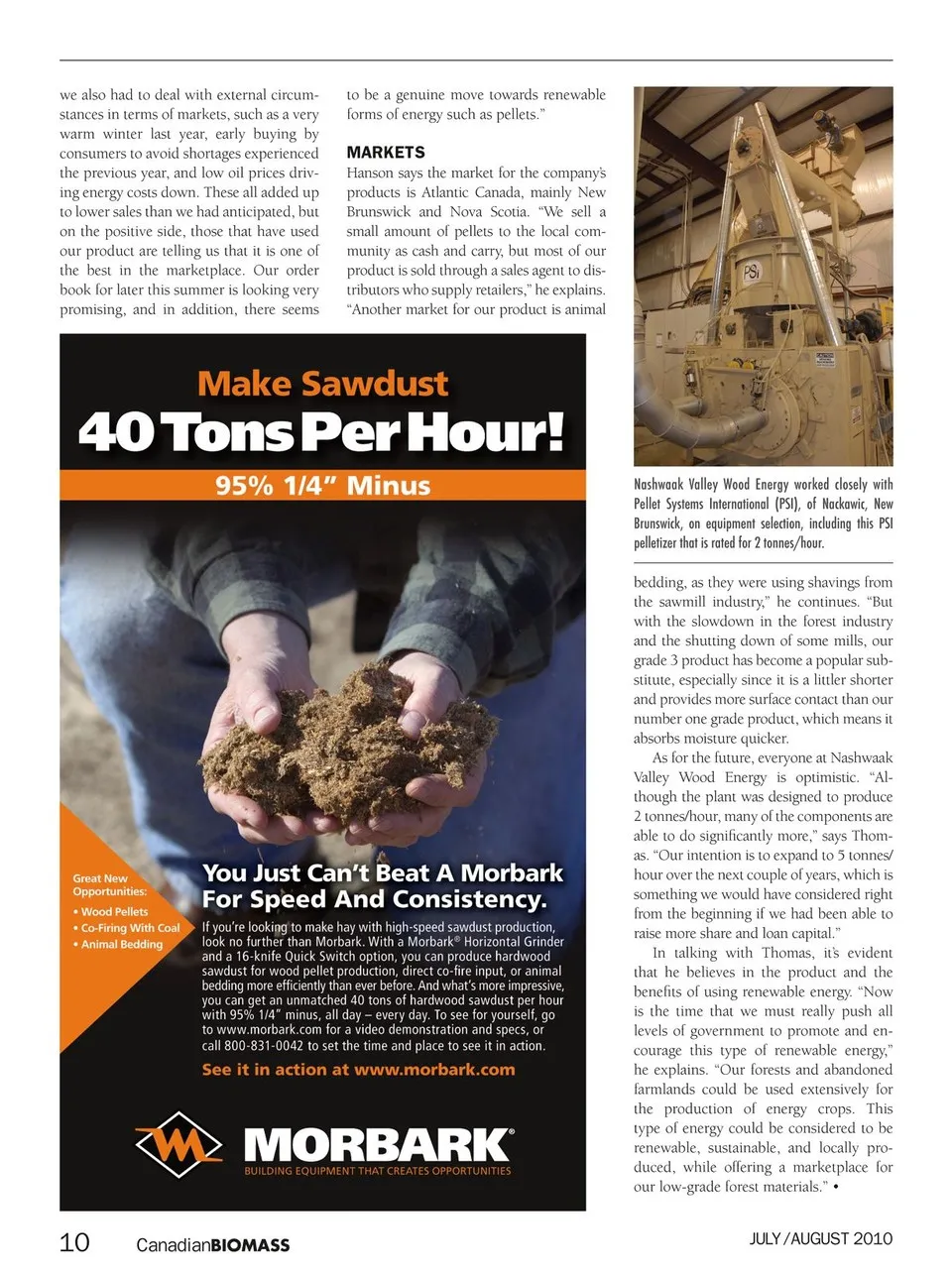
we also had to deal with external circum-stances in terms of markets, such as a very warm winter last year, early buying by consumers to avoid shortages experienced the previous year, and low oil prices driv-ing energy costs down. These all added up to lower sales than we had anticipated, but on the positive side, those that have used our product are telling us that it is one of the best in the marketplace. Our order book for later this summer is looking very promising, and in addition, there seems to be a genuine move towards renewable forms of energy such as pellets.” MARKETS Hanson says the market for the company’s products is Atlantic Canada, mainly New Brunswick and Nova Scotia. “We sell a small amount of pellets to the local com-munity as cash and carry, but most of our product is sold through a sales agent to dis-tributors who supply retailers,” he explains. “Another market for our product is animal bedding, as they were using shavings from the sawmill industry,” he continues. “But with the slowdown in the forest industry and the shutting down of some mills, our grade 3 product has become a popular sub-stitute, especially since it is a littler shorter and provides more surface contact than our number one grade product, which means it absorbs moisture quicker. As for the future, everyone at Nashwaak Valley Wood Energy is optimistic. “Al-though the plant was designed to produce 2 tonnes/hour, many of the components are able to do significantly more,” says Thom-as. “Our intention is to expand to 5 tonnes/ hour over the next couple of years, which is something we would have considered right from the beginning if we had been able to raise more share and loan capital.” In talking with Thomas, it’s evident that he believes in the product and the benefits of using renewable energy. “Now is the time that we must really push all levels of government to promote and en-courage this type of renewable energy,” he explains. “Our forests and abandoned farmlands could be used extensively for the production of energy crops. This type of energy could be considered to be renewable, sustainable, and locally pro-duced, while offering a marketplace for our low-grade forest materials.” • 10 CanadianBIOMASS JULY/AUGUST 2010
Canadian Biomass July/August 2010: Page 10