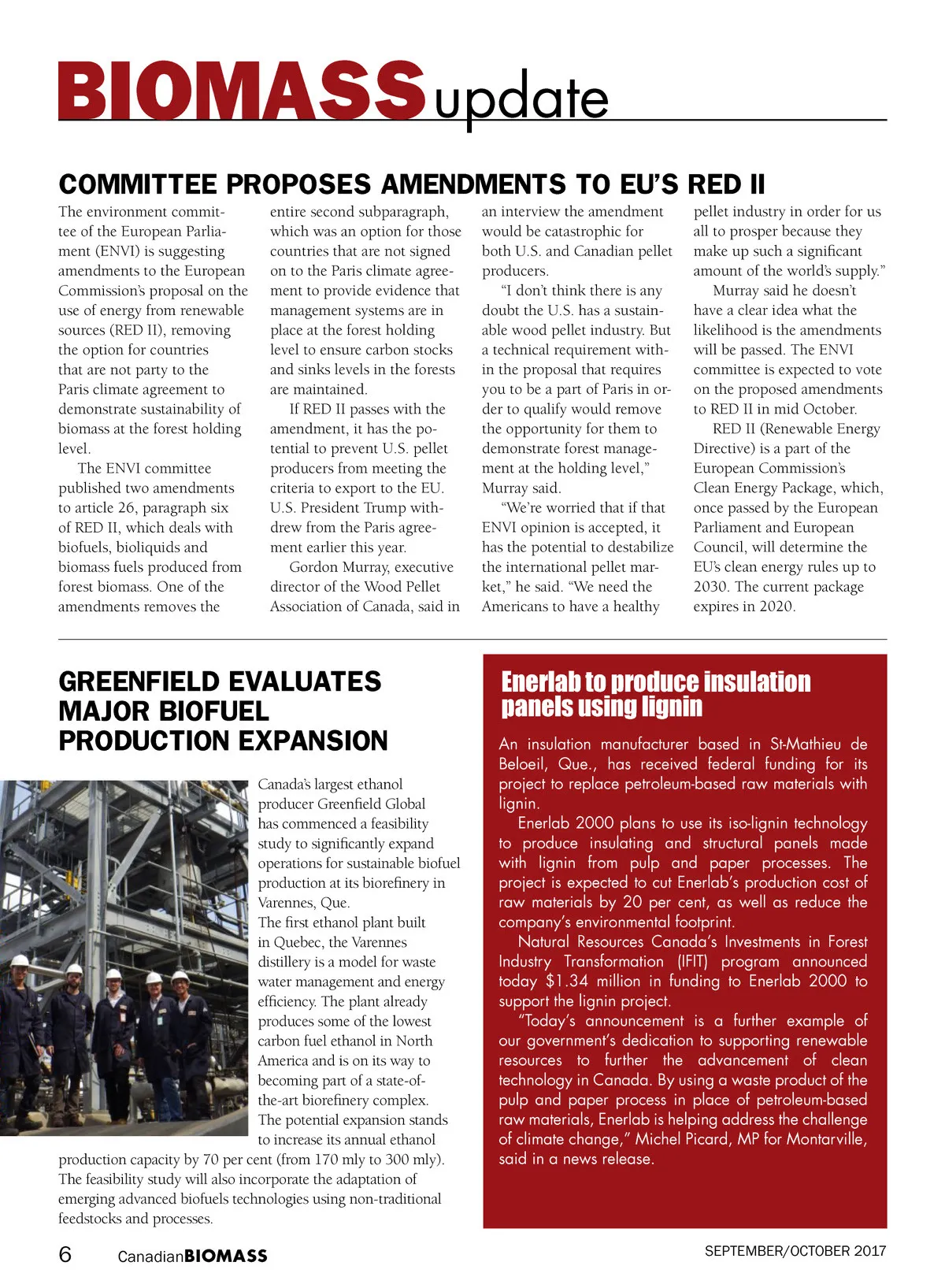
NEW NAME, NEW FOCUS FOR CANADA’S LONGEST-RUNNING BIOENERGY EVENT he International Bioenergy Confer-ence and Exhibition is being reborn as the Canadian Bio-economy Conference and Exhibition. The new name reflects a growth in the use of woody bio-mass from legacy in-dustries such as wood pellet production and cogeneration to a full menu of products such as biofuels, biogas, biochemicals, biopharmaceuticals and other bioproducts. “The original name and mandate were chosen to focus at-tention on the emerging bioenergy industry in Northern BC and on creating a venue for Canadian wood pellet producers to connect and network with their customers and colleagues in other parts of the world,” explained Jim Martin, chair of the Board of Directors of the conference. “The bioenergy industry in Canada has grown and ma-tured since we founded the conference in 2004. We felt it was important that, as the leading conference of its kind in Can-ada, we should reflect the diversification in the use of woody biomass across the full value chain of bioproducts.” North-Central British Columbia continues to be the largest producing region in Canada of wood pellets, and one of the largest in the world. It is home to Pinnacle Renewable Ener-gy, Pacific Bioenergy and Premium Pellets, as well as to some of the longest-operating pulp mill cogeneration facilities in North America and a number of district energy systems. But with projects such as the groundbreaking Canfor-Li-cella biofuels project in conference host city Prince George, the industry is now moving quickly toward new technologies and new innovations in wood-based products that are fuelling the new bioeconomy. The new conference will continue its predecessor’s legacy of excellence in showcasing the innovation of the companies, organizations and researchers who make Canada a global leader of the bioeconomy. In addition to being home to numerous pellet compa-nies, pulp and paper and cogeneration facilities, Prince George is also home to a wood-based district energy system connecting eleven buildings through its downtown, includ-ing the conference venue. In addition, bioenergy facilities at the Prince George campus of the University of Northern British Columbia are venues for research and have reduced the University’s consumption of fossil fuels for heating by about 85 per cent. The new Canadian Bioeconomy Conference and Exhibi-tion will take place in Prince George June 6-8, 2018. Register at www.bioeconomyconference.com. S2G BEGINS WORK ON SARNIA ADVANCED BIOREFINERY S2G BioChem (S2G) has begun work on the company’s first standalone biorefinery demonstration plant in Sarnia, Ont. The commercial-scale facility will refine local, sustainable forestry and agricultural residues using S2G’s patented process to produce food ingredient xylitol available on the market today while co-producing value-add bioglycols for a new generation of consumer, industrial and packaging and products. “This is a very exciting time for S2G BioChem as we begin to execute our growth strategy to generate revenues from the produc-tion of fossil-free, value-add products,” Mark Kirby, president and CEO of S2G Biochem, said in a news release. “Locating this new biorefinery in Canada is important as its high efficiency and use of sustainable feedstocks will reduce greenhouse gas and effluent emissions. We will bring increased revenue to local feedstock suppliers; and we will gain invaluable experience before replicating this high-yield facility throughout North America and the rest of the world. The support from Bioindustrial Innovation Canada is an important step in securing funding for the project.” The biorefinery demonstration plant, projected to cost $20 million, will be funded by S2G and a network of investors and partners, including previously announced support from food giant Mondelëz International, who shares the vision and value of this renewable energy project. Funding will be provided by Bio-industrial Innovation Canada’s Commercialization of Sustainable Chemistry Innovation fund (COMM SCI). The biorefinery will have the capacity to produce over 2,000 MT/year of high-value xylitol and coproducts utilizing a range of feedstocks from forestry and agricultural residues. Basic engineering for the facility is underway and construction is expected to begin in 2018. T RENTECH TO CANCEL REMAINING SHIPMENTS TO DRAX Rentech is in the midst of negotiations with U.K. utility Drax to cancel its outstand-ing wood pellet shipments for 2017, which amount to 193,000 metric tonnes, the company said in its quarterly report. Rentech idled its Wawa, Ont., facility and lowered production at its Atikokan, Ont., facility earlier this year in response to equipment and operational issues. The pellet producer has since emptied its Wawa facil-ity to deliver 12,000 metric tonnes of pellets to Drax, and is now looking to cancel its remaining obligation of 193,000 metric tonnes for this year. “We are currently nego-tiating with Drax to cancel the remaining shipments in 2017. At this time, we cannot make a determination if any penalties will be associated with future changes to the contract. Rentech, Inc. has guaranteed the payment ob-ligations of the Drax contract up to a maximum amount of CAD$20 million,” the com-pany stated in its quarterly report. Canadian BIOMASS 7
Canadian Biomass September/October 2017: Page 7