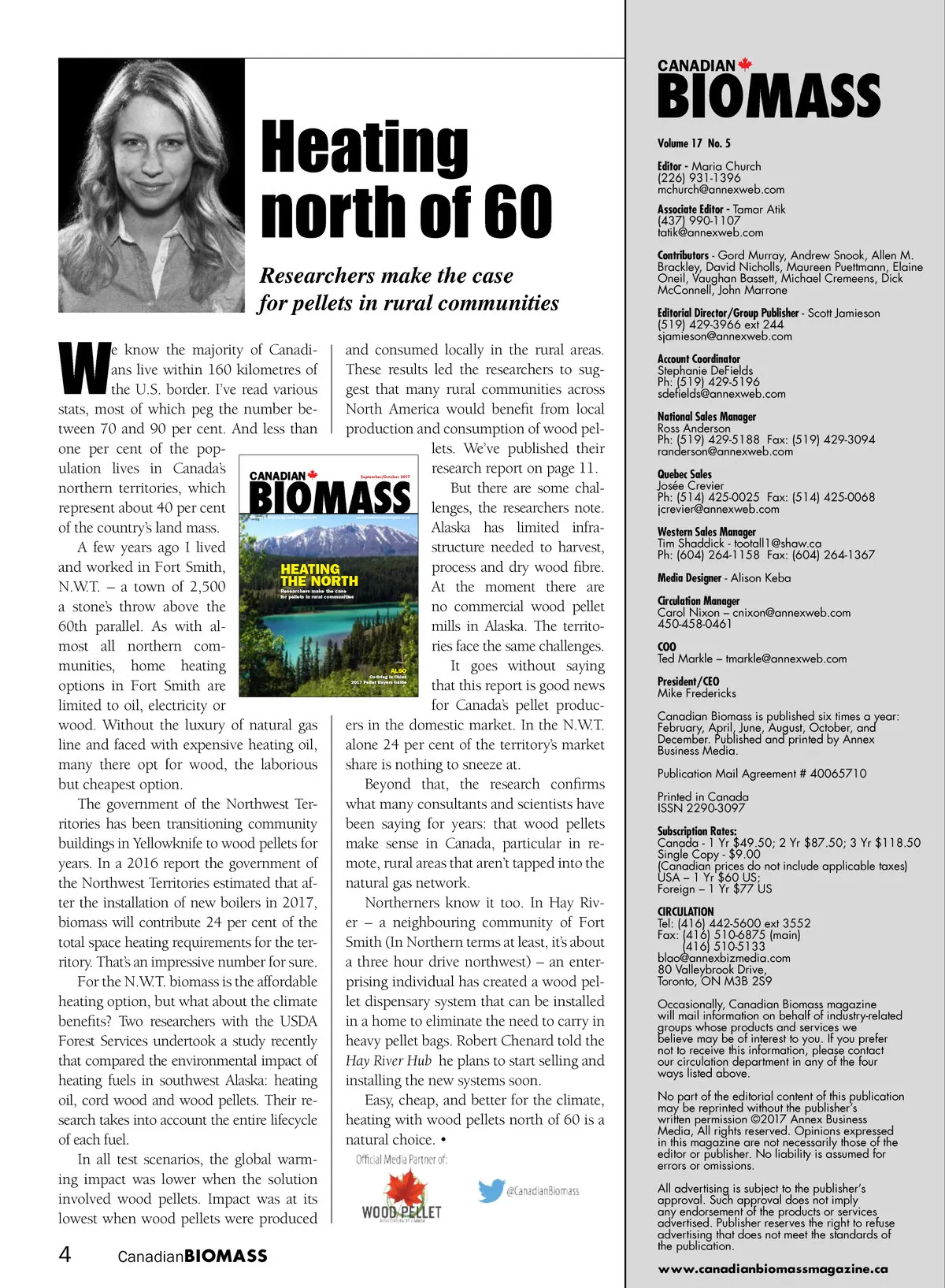
Heating north of 60 Researchers make the case for pellets in rural communities BIOMASS CANADIAN Volume 17 No. 5 Editor -Maria Church (226) 931-1396 [email protected] Associate Editor -Tamar Atik (437) 990-1107 [email protected] Contributors -Gord Murray, Andrew Snook, Allen M. Brackley, David Nicholls, Maureen Puettmann, Elaine Oneil, Vaughan Bassett, Michael Cremeens, Dick McConnell, John Marrone Editorial Director/Group Publisher -Scott Jamieson (519) 429-3966 ext 244 [email protected] Account Coordinator Stephanie DeFields Ph: (519) 429-5196 [email protected] National Sales Manager Ross Anderson Ph: (519) 429-5188 Fax: (519) 429-3094 [email protected] Quebec Sales Josée Crevier Ph: (514) 425-0025 Fax: (514) 425-0068 [email protected] Western Sales Manager Tim Shaddick [email protected] Ph: (604) 264-1158 Fax: (604) 264-1367 Media Designer -Alison Keba Circulation Manager Carol Nixon – [email protected] 450-458-0461 COO Ted Markle – [email protected] President/CEO Mike Fredericks Canadian Biomass is published six times a year: February, April, June, August, October, and December. Published and printed by Annex Business Media. Publication Mail Agreement # 40065710 Printed in Canada ISSN 2290-3097 Subscription Rates: Canada -1 Yr $49.50; 2 Yr $87.50; 3 Yr $118.50 Single Copy -$9.00 (Canadian prices do not include applicable taxes) USA – 1 Yr $60 US; Foreign – 1 Yr $77 US CIRCULATION Tel: (416) 442-5600 ext 3552 Fax: (416) 510-6875 (main) (416) 510-5133 [email protected] 80 Valleybrook Drive, Toronto, ON M3B 2S9 Occasionally, Canadian Biomass magazine will mail information on behalf of industry-related groups whose products and services we believe may be of interest to you. If you prefer not to receive this information, please contact our circulation department in any of the four ways listed above. No part of the editorial content of this publication may be reprinted without the publisher’s written permission ©2017 Annex Business Media, All rights reserved. Opinions expressed in this magazine are not necessarily those of the editor or publisher. No liability is assumed for errors or omissions. All advertising is subject to the publisher’s approval. Such approval does not imply any endorsement of the products or services advertised. Publisher reserves the right to refuse advertising that does not meet the standards of the publication. www.canadianbiomassmagazine.ca W and consumed locally in the rural areas. e know the majority of Canadi-These results led the researchers to sug-ans live within 160 kilometres of gest that many rural communities across the U.S. border. I’ve read various North America would benefit from local stats, most of which peg the number be-production and consumption of wood pel-tween 70 and 90 per cent. And less than lets. We’ve published their one per cent of the pop-research report on page 11. ulation lives in Canada’s But there are some chal-northern territories, which lenges, the researchers note. represent about 40 per cent Alaska has limited infra-of the country’s land mass. structure needed to harvest, A few years ago I lived process and dry wood fibre. and worked in Fort Smith, HEATING THE NORTH At the moment there are N.W.T. – a town of 2,500 no commercial wood pellet a stone’s throw above the mills in Alaska. The territo-60th parallel. As with al-ries face the same challenges. most all northern com-It goes without saying munities, home heating ALSO that this report is good news options in Fort Smith are for Canada’s pellet produc-limited to oil, electricity or ers in the domestic market. In the N.W.T. wood. Without the luxury of natural gas alone 24 per cent of the territory’s market line and faced with expensive heating oil, share is nothing to sneeze at. many there opt for wood, the laborious Beyond that, the research confirms but cheapest option. what many consultants and scientists have The government of the Northwest Ter-been saying for years: that wood pellets ritories has been transitioning community make sense in Canada, particular in re-buildings in Yellowknife to wood pellets for mote, rural areas that aren’t tapped into the years. In a 2016 report the government of natural gas network. the Northwest Territories estimated that af-Northerners know it too. In Hay Riv-ter the installation of new boilers in 2017, er – a neighbouring community of Fort biomass will contribute 24 per cent of the Smith (In Northern terms at least, it’s about total space heating requirements for the ter-a three hour drive northwest) – an enter-ritory. That’s an impressive number for sure. prising individual has created a wood pel-For the N.W.T. biomass is the affordable let dispensary system that can be installed heating option, but what about the climate in a home to eliminate the need to carry in benefits? Two researchers with the USDA heavy pellet bags. Robert Chenard told the Forest Services undertook a study recently Hay River Hub he plans to start selling and that compared the environmental impact of installing the new systems soon. heating fuels in southwest Alaska: heating Easy, cheap, and better for the climate, oil, cord wood and wood pellets. Their re-heating with wood pellets north of 60 is a search takes into account the entire lifecycle natural choice. • of each fuel. In all test scenarios, the global warm-ing impact was lower when the solution involved wood pellets. Impact was at its lowest when wood pellets were produced September/October 2017 Biomass, Bioenergy and Bioproducts canadianbiomassmagazine.ca Researchers make the case for pellets in rural communities Co-firing in China 2017 Pellet Buyers Guide PM 40065710 BM_SEPOCT17.indd 1 2017-09-15 11:59 AM 4 Canadian BIOMASS FEBRUARY 2016
Canadian Biomass September/October 2017: Page 4