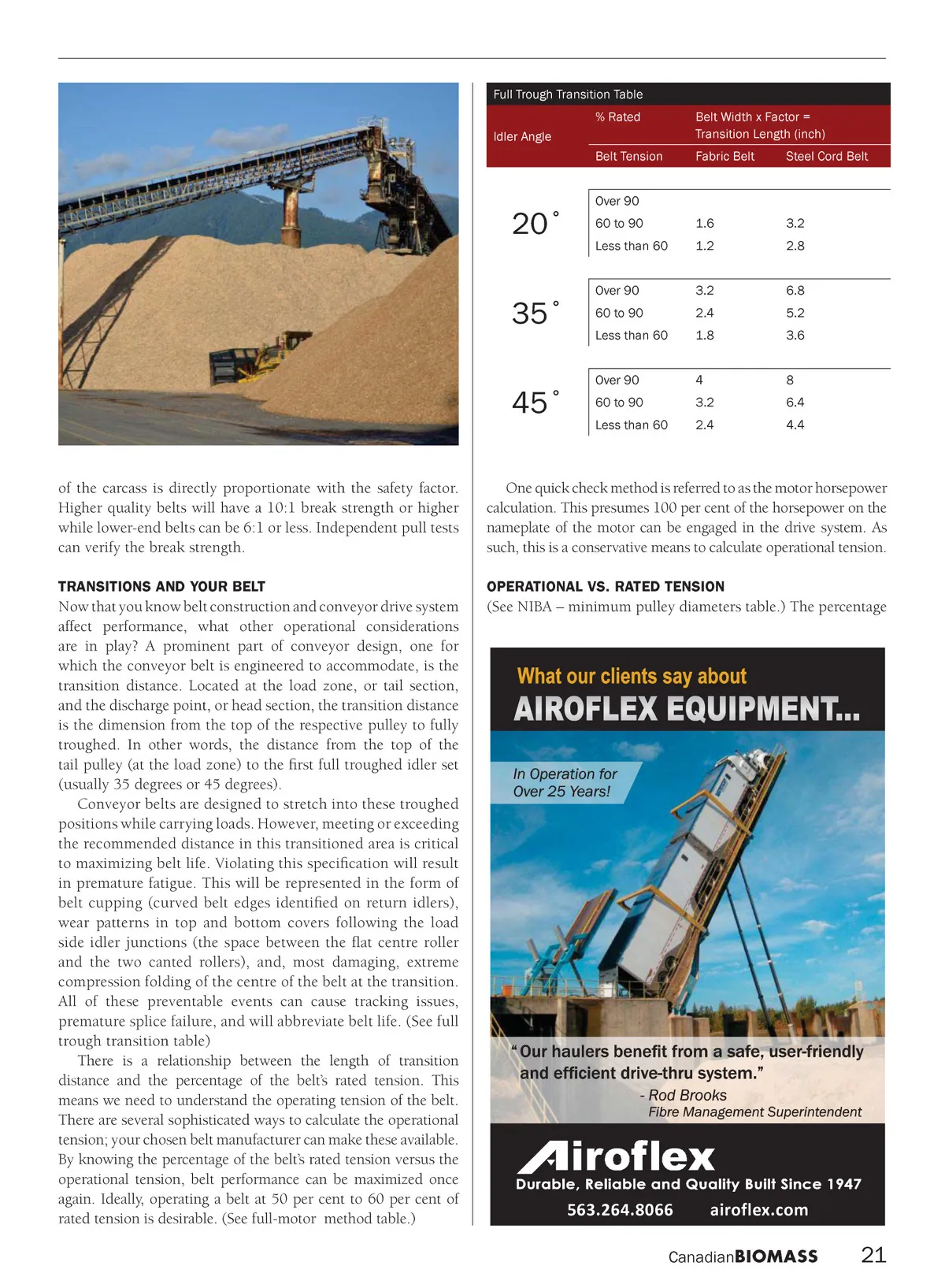
Full Trough Transition Table % Rated Idler Angle Belt Tension 2YHUc; Belt Width x Factor = Transition Length (inch) Fabric Belt Steel Cord Belt  Ü Ü Ü of the carcass is directly proportionate with the safety factor. Higher quality belts will have a 10:1 break strength or higher while lower-end belts can be 6:1 or less. Independent pull tests can verify the break strength. TRANSITIONS AND YOUR BELT 60 to 90 Less than 60 2YHUc; 60 to 90 Less than 60 2YHUc; 60 to 90 Less than 60 1.6 1.2 3.2 2.4 1.8 3.2 2.8 6.8 5.2 3.6 48 3.2 2.4 6.4 4.4 One quick check method is referred to as the motor horsepower calculation. This presumes 100 per cent of the horsepower on the nameplate of the motor can be engaged in the drive system. As such, this is a conservative means to calculate operational tension. OPERATIONAL VS. RATED TENSION Now that you know belt construction and conveyor drive system affect performance, what other operational considerations are in play? A prominent part of conveyor design, one for which the conveyor belt is engineered to accommodate, is the transition distance. Located at the load zone, or tail section, and the discharge point, or head section, the transition distance is the dimension from the top of the respective pulley to fully troughed. In other words, the distance from the top of the tail pulley (at the load zone) to the first full troughed idler set (usually 35 degrees or 45 degrees). Conveyor belts are designed to stretch into these troughed positions while carrying loads. However, meeting or exceeding the recommended distance in this transitioned area is critical to maximizing belt life. Violating this specification will result in premature fatigue. This will be represented in the form of belt cupping (curved belt edges identified on return idlers), wear patterns in top and bottom covers following the load side idler junctions (the space between the flat centre roller and the two canted rollers), and, most damaging, extreme compression folding of the centre of the belt at the transition. All of these preventable events can cause tracking issues, premature splice failure, and will abbreviate belt life. (See full trough transition table) There is a relationship between the length of transition distance and the percentage of the belt’s rated tension. This means we need to understand the operating tension of the belt. There are several sophisticated ways to calculate the operational tension; your chosen belt manufacturer can make these available. By knowing the percentage of the belt’s rated tension versus the operational tension, belt performance can be maximized once again. Ideally, operating a belt at 50 per cent to 60 per cent of rated tension is desirable. (See full-motor method table.) (See NIBA – minimum pulley diameters table.) The percentage 563.264.8066 airoflex.com Canadian BIOMASS 21
Canadian Biomass September/October 2017: Page 21