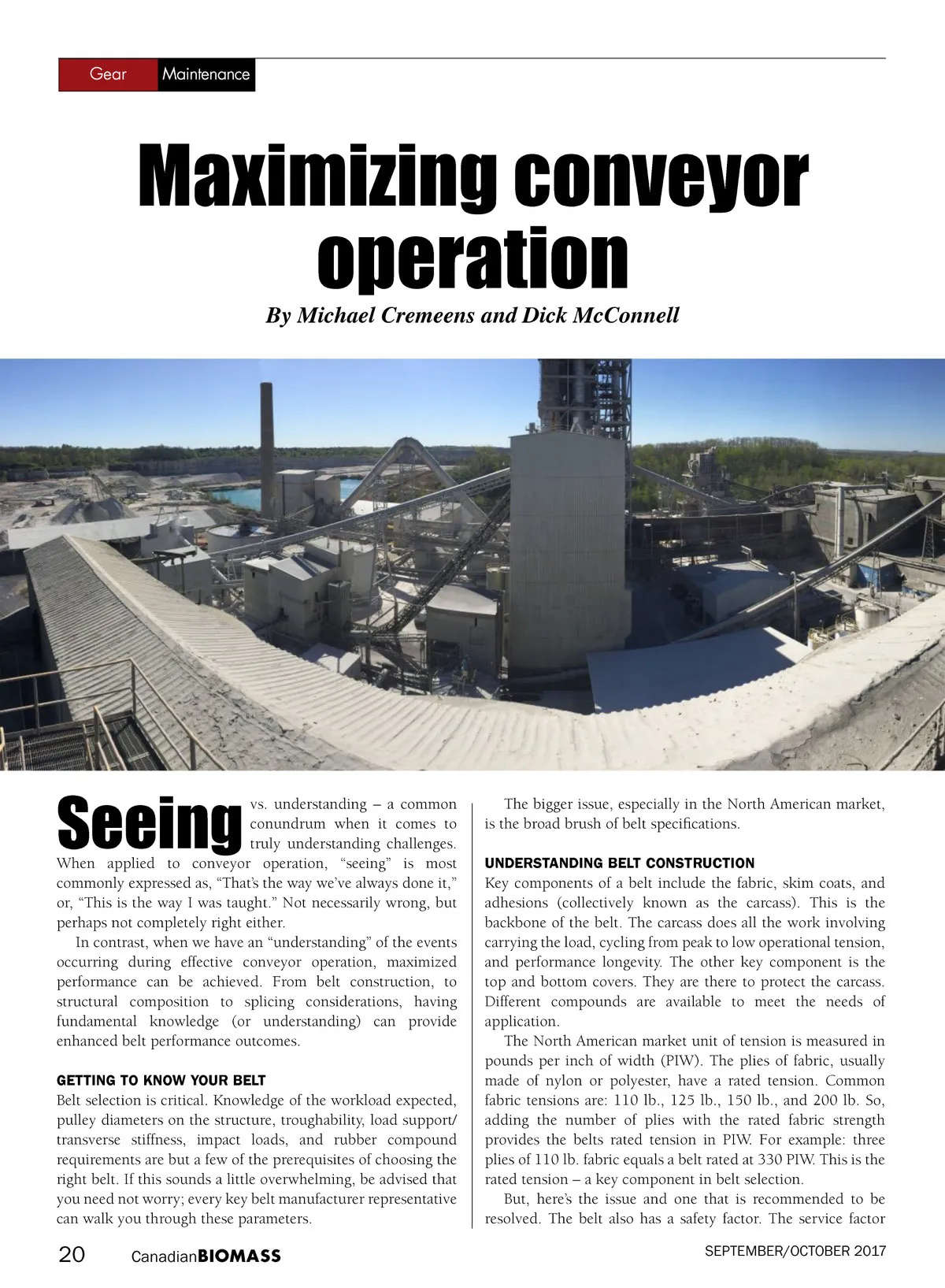
Gear Maintenance Maximizing conveyor operation By Michael Cremeens and Dick McConnell Seeing vs. understanding – a common conundrum when it comes to truly understanding challenges. When applied to conveyor operation, “seeing” is most commonly expressed as, “That’s the way we’ve always done it,” or, “This is the way I was taught.” Not necessarily wrong, but perhaps not completely right either. In contrast, when we have an “understanding” of the events occurring during effective conveyor operation, maximized performance can be achieved. From belt construction, to structural composition to splicing considerations, having fundamental knowledge (or understanding) can provide enhanced belt performance outcomes. The bigger issue, especially in the North American market, is the broad brush of belt specifications. UNDERSTANDING BELT CONSTRUCTION GETTING TO KNOW YOUR BELT Belt selection is critical. Knowledge of the workload expected, pulley diameters on the structure, troughability, load support/ transverse stiffness, impact loads, and rubber compound requirements are but a few of the prerequisites of choosing the right belt. If this sounds a little overwhelming, be advised that you need not worry; every key belt manufacturer representative can walk you through these parameters. Key components of a belt include the fabric, skim coats, and adhesions (collectively known as the carcass). This is the backbone of the belt. The carcass does all the work involving carrying the load, cycling from peak to low operational tension, and performance longevity. The other key component is the top and bottom covers. They are there to protect the carcass. Different compounds are available to meet the needs of application. The North American market unit of tension is measured in pounds per inch of width (PIW). The plies of fabric, usually made of nylon or polyester, have a rated tension. Common fabric tensions are: 110 lb., 125 lb., 150 lb., and 200 lb. So, adding the number of plies with the rated fabric strength provides the belts rated tension in PIW. For example: three plies of 110 lb. fabric equals a belt rated at 330 PIW. This is the rated tension – a key component in belt selection. But, here’s the issue and one that is recommended to be resolved. The belt also has a safety factor. The service factor SEPTEMBER/OCTOBER 2017 20 Canadian BIOMASS
Canadian Biomass September/October 2017: Page 20