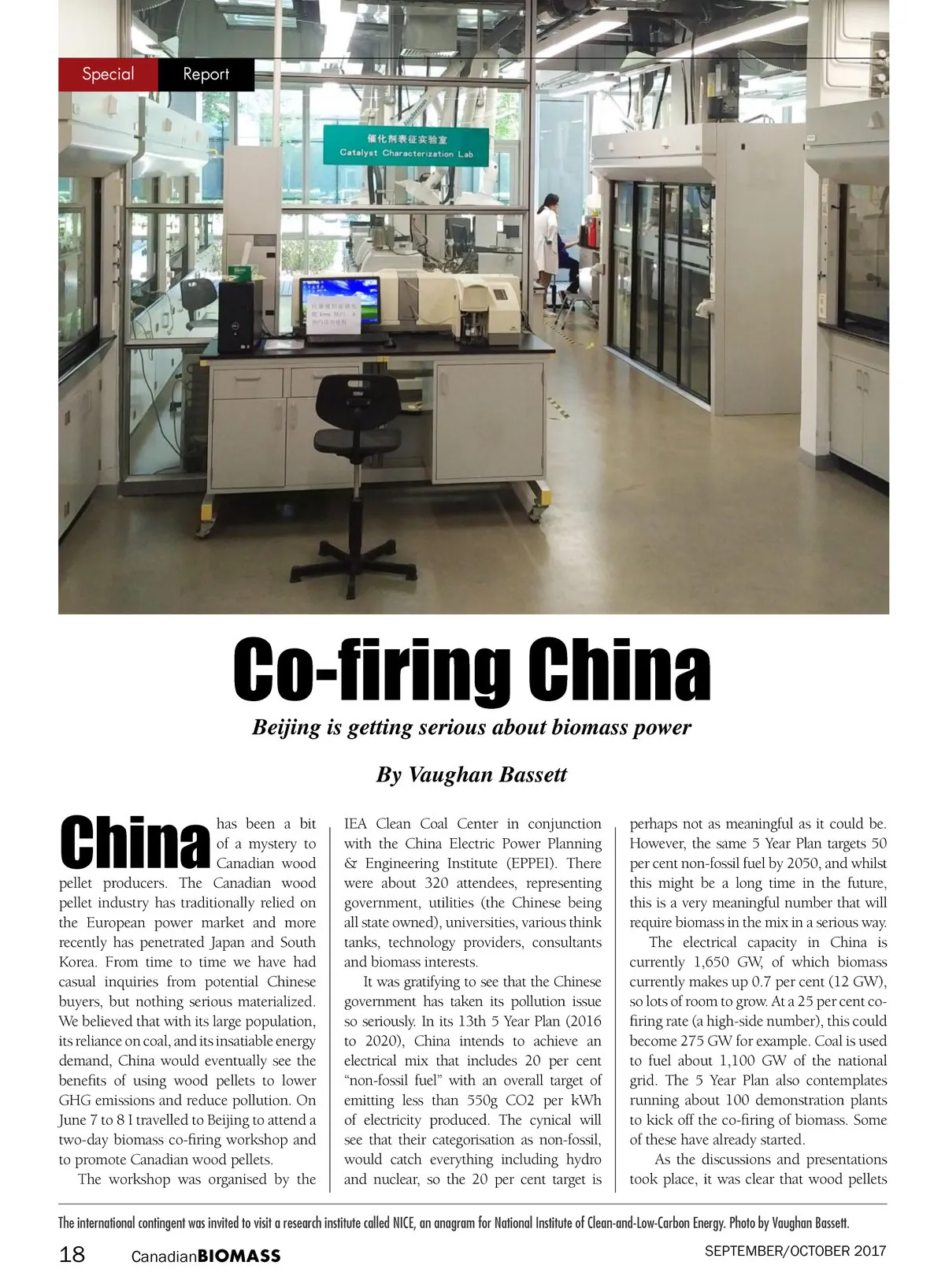
were the best technical and logistical biomass option. However, the subject is politically sensitive. The issue in China today is that they claim that a significant portion of their particulate pollution comes from farmers burning their stover/stalks after harvesting. Therefore, the Chinese government is trying to kill two birds with one stone by co-firing these agricultural residues to both lift the Chinese non-fossil percentage, whilst simultaneously addressing the farmers’ pollution problem. A beneficial side effect of this strategy is that by providing farmers with another revenue stream (for their biomass), the government hopes to arrest the human migration from rural into urban areas. So the emphasis in China is currently on agricultural biomass. They believe that there are some one billion tons of the stuff available, which theoretically could fuel their entire electricity requirement. So another political objective is for the country to reduce its energy dependence on imports, which is already low in percentage terms. On the technical front, there was consensus that direct co-firing of these agri residues would create slagging and fouling of the boiler tubes and associated de-rating of the boilers. The root cause of this ash deposition has been identified as high alkali elements (mainly potassium) combining with chlorine in the fly ash. Apparently this can be mitigated by the introduction of sulphur in the boiler. To avoid this issue altogether however, they are looking hard at first gasifying the biomass, then co-firing the gas indirectly. In addition, there is the issue of logistics. A university study suggested that if every power plant were given a 50-kilometre collection radius around itself, it could secure enough agricultural biomass to co-fire at the required level, albeit seasonally. However, this would require the physical movement of huge amounts of biomass. The cutting and hauling requirement alone is daunting, never mind the storage required at either end. Wood pellet imports are currently banned (to keep the focus on domestic agricultural residues), but it seems that if the Chinese government wishes to get really serious about biomass, wood pellets cannot remain in banned indefinitely. It might take a while, but expect to see changes in policy in this respect. NICE TOUR The international contingent was invited to visit a research institute called NICE, an anagram for National Institute for Clean and low carbon Energy, situated on the campus of Shenhua Group, China’s largest mining and energy company. Shenhua is state owned. It started as a coal mining company, but has diversified into power and transportation. Today it runs the country’s largest fleet of coal fired thermal power stations, owns 2,000 miles of railroad and a couple of ports. The company has made huge investments in wind and solar, which currently amount to 7GW of its 80GW capacity. Shenhua is in discussions to merge with two other large state-owned utilities, which will probably make it the largest power company in the world. Shenhua is not focused on biomass co-firing. Many of its thermal power stations are in the north (near its coal mines) and reasonably removed from any material biomass sources. It is growing its renewable portfolio in wind and solar and is doing a lot in hydrogen. The company will supposedly be rolling out 300 hydrogen filling stations across the country in the next five years. However, at some stage post-merger (due to size alone), Shenhua is likely to become a target of government pressure to co-fire. Its generally poor proximity to agricultural residues could make it an ideal candidate for imported wood pellets. Furthermore, Shenhua’s port ownership should help the logistics of importing wood pellets once that ban is lifted. Shenhua set up NICE in 2009 initially to find new commercial applications for coal. It has an imposing line up of technology, from mass spectrometry labs to a Fischer-Tropsch pilot plant. Its efforts have lead to the discovery of an ultra-strong plastic, a revolutionary water treatment process and a quick charging soft carbon battery technology, amongst others. This visit was an impressive window on what is possible in China today. Despite the easy rhetoric, we would be wise to not discount the Chinese efforts and we should continue to pay close attention to what is going on there. • CBM_Belldune_MarApr17_CSA.indd 1 Canadian BIOMASS 2017-03-07 8:30 AM 19
Canadian Biomass September/October 2017: Page 19