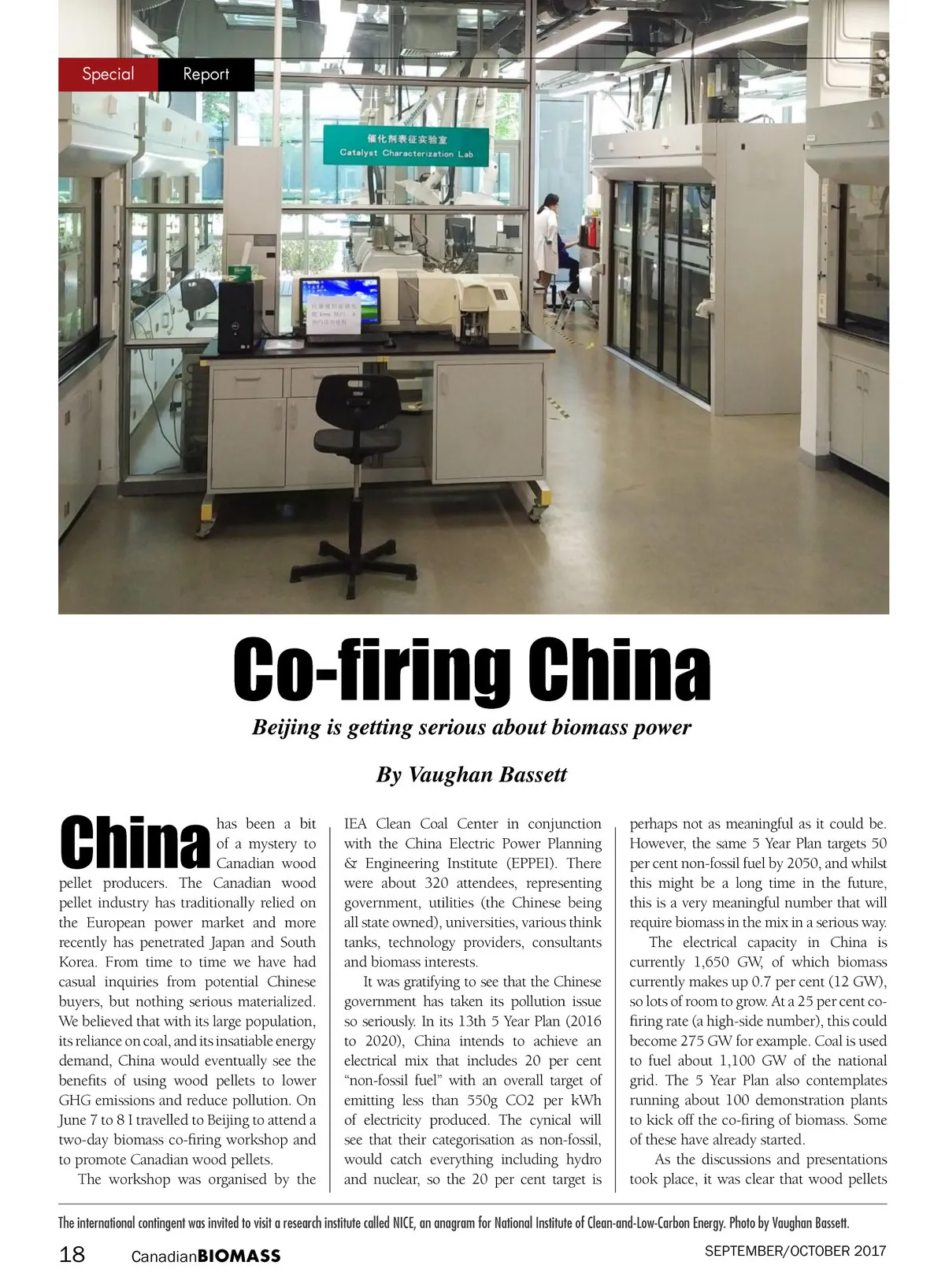
Special Report Co-firing China Beijing is getting serious about biomass power By Vaughan Bassett China has been a bit of a mystery to Canadian wood pellet producers. The Canadian wood pellet industry has traditionally relied on the European power market and more recently has penetrated Japan and South Korea. From time to time we have had casual inquiries from potential Chinese buyers, but nothing serious materialized. We believed that with its large population, its reliance on coal, and its insatiable energy demand, China would eventually see the benefits of using wood pellets to lower GHG emissions and reduce pollution. On June 7 to 8 I travelled to Beijing to attend a two-day biomass co-firing workshop and to promote Canadian wood pellets. The workshop was organised by the IEA Clean Coal Center in conjunction with the China Electric Power Planning & Engineering Institute (EPPEI). There were about 320 attendees, representing government, utilities (the Chinese being all state owned), universities, various think tanks, technology providers, consultants and biomass interests. It was gratifying to see that the Chinese government has taken its pollution issue so seriously. In its 13th 5 Year Plan (2016 to 2020), China intends to achieve an electrical mix that includes 20 per cent “non-fossil fuel” with an overall target of emitting less than 550g CO2 per kWh of electricity produced. The cynical will see that their categorisation as non-fossil, would catch everything including hydro and nuclear, so the 20 per cent target is perhaps not as meaningful as it could be. However, the same 5 Year Plan targets 50 per cent non-fossil fuel by 2050, and whilst this might be a long time in the future, this is a very meaningful number that will require biomass in the mix in a serious way. The electrical capacity in China is currently 1,650 GW, of which biomass currently makes up 0.7 per cent (12 GW), so lots of room to grow. At a 25 per cent co-firing rate (a high-side number), this could become 275 GW for example. Coal is used to fuel about 1,100 GW of the national grid. The 5 Year Plan also contemplates running about 100 demonstration plants to kick off the co-firing of biomass. Some of these have already started. As the discussions and presentations took place, it was clear that wood pellets The international contingent was invited to visit a research institute called NICE, an anagram for National Institute of Clean-and-Low-Carbon Energy. Photo by Vaughan Bassett. 18 Canadian BIOMASS SEPTEMBER/OCTOBER 2017
Canadian Biomass September/October 2017: Page 18