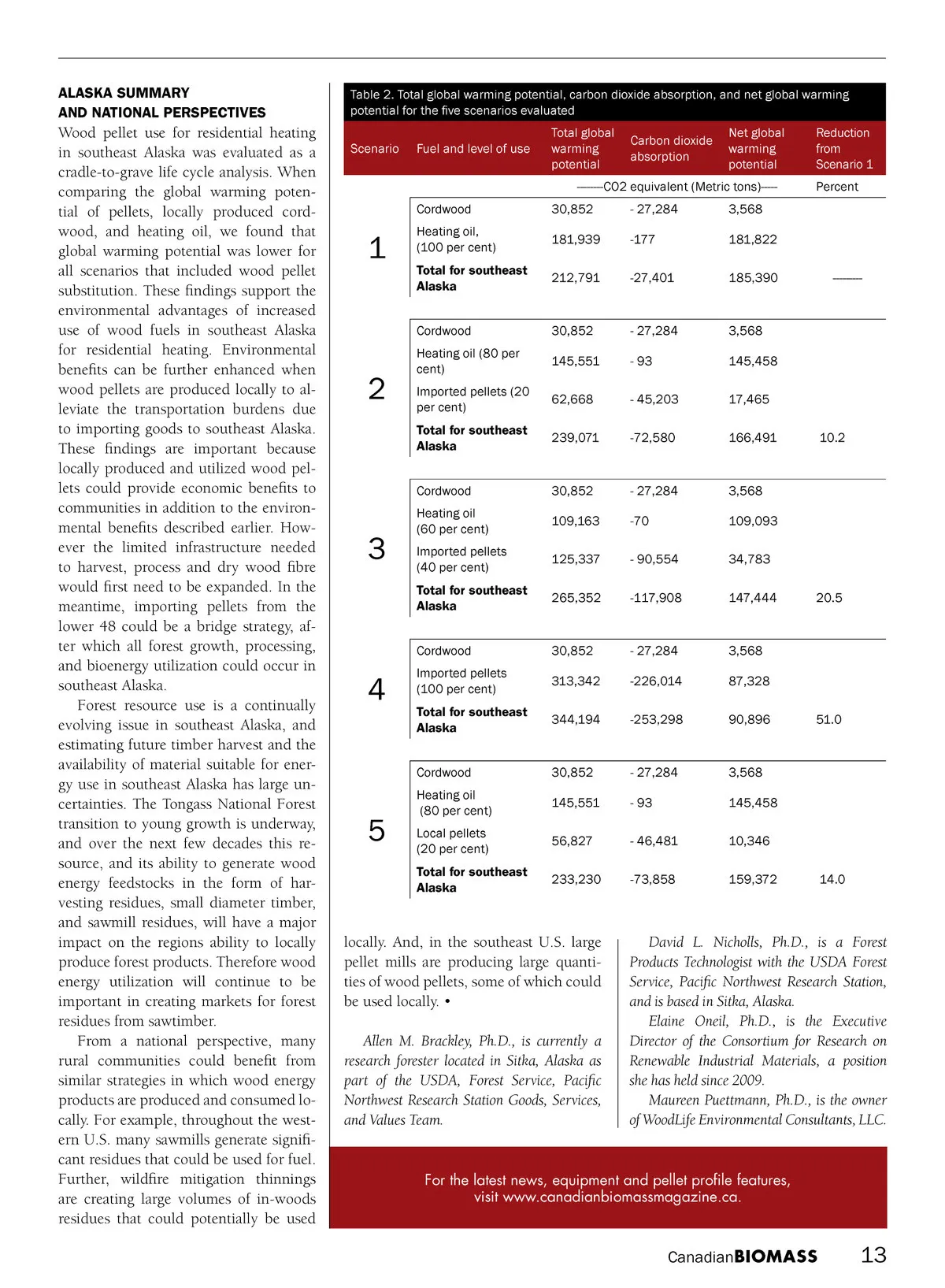
ALASKA SUMMARY AND NATIONAL PERSPECTIVES Table 2. Total global warming potential, carbon dioxide absorption, and net global warming potential for the five scenarios evaluated Scenario Fuel and level of use Total global warming potential 30,852 181,939 212,791 Carbon dioxide absorption Net global warming potential 3,568 181,822 185,390 ---------Reduction from Scenario 1 Percent Wood pellet use for residential heating in southeast Alaska was evaluated as a cradle-to-grave life cycle analysis. When comparing the global warming poten-tial of pellets, locally produced cord-wood, and heating oil, we found that global warming potential was lower for all scenarios that included wood pellet substitution. These findings support the environmental advantages of increased use of wood fuels in southeast Alaska for residential heating. Environmental benefits can be further enhanced when wood pellets are produced locally to al-leviate the transportation burdens due to importing goods to southeast Alaska. These findings are important because locally produced and utilized wood pel-lets could provide economic benefits to communities in addition to the environ-mental benefits described earlier. How-ever the limited infrastructure needed to harvest, process and dry wood fibre would first need to be expanded. In the meantime, importing pellets from the lower 48 could be a bridge strategy, af-ter which all forest growth, processing, and bioenergy utilization could occur in southeast Alaska. Forest resource use is a continually evolving issue in southeast Alaska, and estimating future timber harvest and the availability of material suitable for ener-gy use in southeast Alaska has large un-certainties. The Tongass National Forest transition to young growth is underway, and over the next few decades this re-source, and its ability to generate wood energy feedstocks in the form of har-vesting residues, small diameter timber, and sawmill residues, will have a major impact on the regions ability to locally produce forest products. Therefore wood energy utilization will continue to be important in creating markets for forest residues from sawtimber. From a national perspective, many rural communities could benefit from similar strategies in which wood energy products are produced and consumed lo-cally. For example, throughout the west-ern U.S. many sawmills generate signifi-cant residues that could be used for fuel. Further, wildfire mitigation thinnings are creating large volumes of in-woods residues that could potentially be used --------CO2 equivalent (Metric tons)-----Cordwood -27,284 -177 -27,401 Heating oil, (100 per cent) Total for southeast Alaska Cordwood 1 30,852 145,551 62,668 239,071 -27,284 -93 -45,203 -72,580 3,568 145,458 17,465 166,491 10.2 2 Heating oil (80 per cent) Imported pellets (20 per cent) Total for southeast Alaska Cordwood 30,852 109,163 125,337 265,352 -27,284 -70 -90,554 -117,908 3,568 109,093 34,783 147,444 20.5 3 Heating oil (60 per cent) Imported pellets (40 per cent) Total for southeast Alaska Cordwood 30,852 313,342 344,194 -27,284 -226,014 -253,298 3,568 87,328 90,896 51.0 4 Imported pellets (100 per cent) Total for southeast Alaska Cordwood 30,852 145,551 56,827 233,230 -27,284 -93 -46,481 -73,858 3,568 145,458 10,346 159,372 14.0 5 Heating oil (80 per cent) Local pellets (20 per cent) Total for southeast Alaska locally. And, in the southeast U.S. large pellet mills are producing large quanti-ties of wood pellets, some of which could be used locally. • Allen M. Brackley, Ph.D., is currently a research forester located in Sitka, Alaska as part of the USDA, Forest Service, Pacific Northwest Research Station Goods, Services, and Values Team. David L. Nicholls, Ph.D., is a Forest Products Technologist with the USDA Forest Service, Pacific Northwest Research Station, and is based in Sitka, Alaska. Elaine Oneil, Ph.D., is the Executive Director of the Consortium for Research on Renewable Industrial Materials, a position she has held since 2009. Maureen Puettmann, Ph.D., is the owner of WoodLife Environmental Consultants, LLC. For the latest news, equipment and pellet profile features, visit www.canadianbiomassmagazine.ca. Canadian BIOMASS 13
Canadian Biomass September/October 2017: Page 13