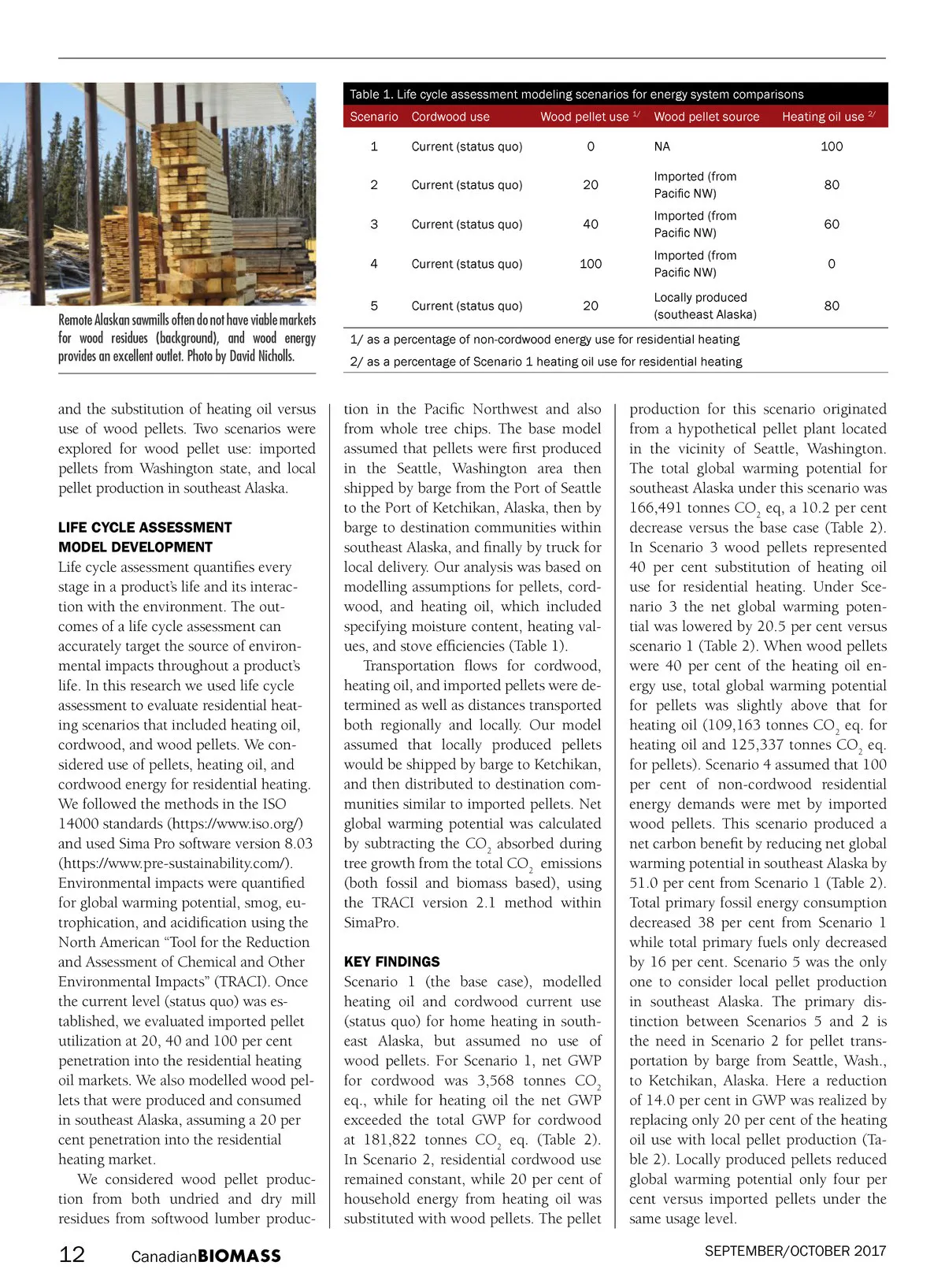
Table 1. Life cycle assessment modeling scenarios for energy system comparisons Scenario Cordwood use 1 2 3 4 5 Current (status quo) Current (status quo) Current (status quo) Current (status quo) Current (status quo) Wood pellet use 1/ 0 20 40 100 20 Wood pellet source NA Imported (from Pacific NW) Imported (from Pacific NW) Imported (from Pacific NW) Locally produced (southeast Alaska) Heating oil use 2/ 100 80 60 0 80 Remote Alaskan sawmills often do not have viable markets for wood residues (background), and wood energy provides an excellent outlet. Photo by David Nicholls. 1/ as a percentage of non-cordwood energy use for residential heating 2/ as a percentage of Scenario 1 heating oil use for residential heating and the substitution of heating oil versus use of wood pellets. Two scenarios were explored for wood pellet use: imported pellets from Washington state, and local pellet production in southeast Alaska. LIFE CYCLE ASSESSMENT MODEL DEVELOPMENT Life cycle assessment quantifies every stage in a product’s life and its interac-tion with the environment. The out-comes of a life cycle assessment can accurately target the source of environ-mental impacts throughout a product’s life. In this research we used life cycle assessment to evaluate residential heat-ing scenarios that included heating oil, cordwood, and wood pellets. We con-sidered use of pellets, heating oil, and cordwood energy for residential heating. We followed the methods in the ISO 14000 standards (https://www.iso.org/) and used Sima Pro software version 8.03 (https://www.pre-sustainability.com/). Environmental impacts were quantified for global warming potential, smog, eu-trophication, and acidification using the North American “Tool for the Reduction and Assessment of Chemical and Other Environmental Impacts” (TRACI). Once the current level (status quo) was es-tablished, we evaluated imported pellet utilization at 20, 40 and 100 per cent penetration into the residential heating oil markets. We also modelled wood pel-lets that were produced and consumed in southeast Alaska, assuming a 20 per cent penetration into the residential heating market. We considered wood pellet produc-tion from both undried and dry mill residues from softwood lumber produc-tion in the Pacific Northwest and also from whole tree chips. The base model assumed that pellets were first produced in the Seattle, Washington area then shipped by barge from the Port of Seattle to the Port of Ketchikan, Alaska, then by barge to destination communities within southeast Alaska, and finally by truck for local delivery. Our analysis was based on modelling assumptions for pellets, cord-wood, and heating oil, which included specifying moisture content, heating val-ues, and stove efficiencies (Table 1). Transportation flows for cordwood, heating oil, and imported pellets were de-termined as well as distances transported both regionally and locally. Our model assumed that locally produced pellets would be shipped by barge to Ketchikan, and then distributed to destination com-munities similar to imported pellets. Net global warming potential was calculated by subtracting the CO 2 absorbed during tree growth from the total CO 2 emissions (both fossil and biomass based), using the TRACI version 2.1 method within SimaPro. KEY FINDINGS Scenario 1 (the base case), modelled heating oil and cordwood current use (status quo) for home heating in south-east Alaska, but assumed no use of wood pellets. For Scenario 1, net GWP for cordwood was 3,568 tonnes CO 2 eq., while for heating oil the net GWP exceeded the total GWP for cordwood at 181,822 tonnes CO 2 eq. (Table 2). In Scenario 2, residential cordwood use remained constant, while 20 per cent of household energy from heating oil was substituted with wood pellets. The pellet production for this scenario originated from a hypothetical pellet plant located in the vicinity of Seattle, Washington. The total global warming potential for southeast Alaska under this scenario was 166,491 tonnes CO 2 eq, a 10.2 per cent decrease versus the base case (Table 2). In Scenario 3 wood pellets represented 40 per cent substitution of heating oil use for residential heating. Under Sce-nario 3 the net global warming poten-tial was lowered by 20.5 per cent versus scenario 1 (Table 2). When wood pellets were 40 per cent of the heating oil en-ergy use, total global warming potential for pellets was slightly above that for heating oil (109,163 tonnes CO 2 eq. for heating oil and 125,337 tonnes CO 2 eq. for pellets). Scenario 4 assumed that 100 per cent of non-cordwood residential energy demands were met by imported wood pellets. This scenario produced a net carbon benefit by reducing net global warming potential in southeast Alaska by 51.0 per cent from Scenario 1 (Table 2). Total primary fossil energy consumption decreased 38 per cent from Scenario 1 while total primary fuels only decreased by 16 per cent. Scenario 5 was the only one to consider local pellet production in southeast Alaska. The primary dis-tinction between Scenarios 5 and 2 is the need in Scenario 2 for pellet trans-portation by barge from Seattle, Wash., to Ketchikan, Alaska. Here a reduction of 14.0 per cent in GWP was realized by replacing only 20 per cent of the heating oil use with local pellet production (Ta-ble 2). Locally produced pellets reduced global warming potential only four per cent versus imported pellets under the same usage level. SEPTEMBER/OCTOBER 2017 12 Canadian BIOMASS
Canadian Biomass September/October 2017: Page 12