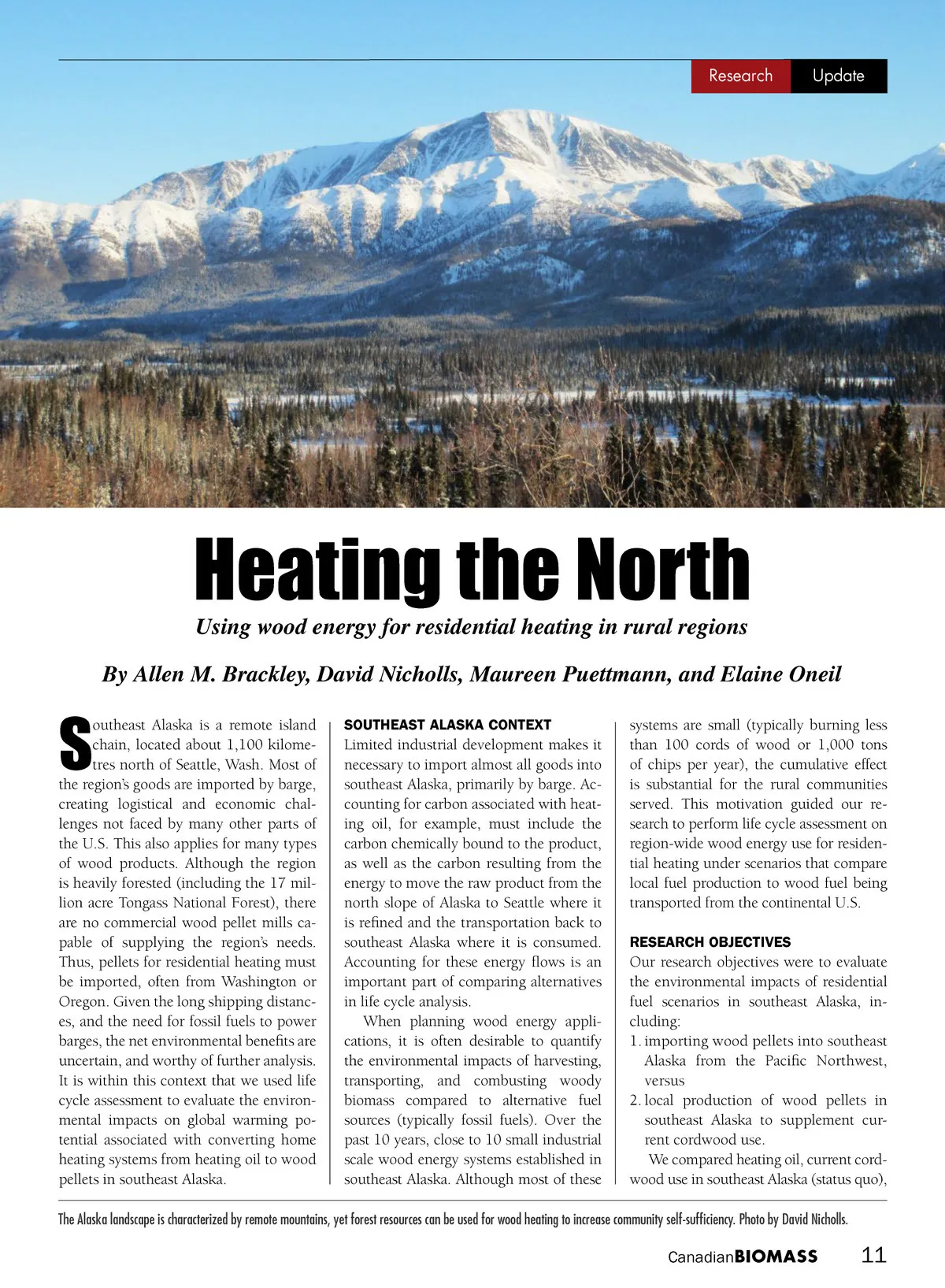
Research Update Heating the North Using wood energy for residential heating in rural regions By Allen M. Brackley, David Nicholls, Maureen Puettmann, and Elaine Oneil outheast Alaska is a remote island chain, located about 1,100 kilome-tres north of Seattle, Wash. Most of the region’s goods are imported by barge, creating logistical and economic chal-lenges not faced by many other parts of the U.S. This also applies for many types of wood products. Although the region is heavily forested (including the 17 mil-lion acre Tongass National Forest), there are no commercial wood pellet mills ca-pable of supplying the region’s needs. Thus, pellets for residential heating must be imported, often from Washington or Oregon. Given the long shipping distanc-es, and the need for fossil fuels to power barges, the net environmental benefits are uncertain, and worthy of further analysis. It is within this context that we used life cycle assessment to evaluate the environ-mental impacts on global warming po-tential associated with converting home heating systems from heating oil to wood pellets in southeast Alaska. S SOUTHEAST ALASKA CONTEXT Limited industrial development makes it necessary to import almost all goods into southeast Alaska, primarily by barge. Ac-counting for carbon associated with heat-ing oil, for example, must include the carbon chemically bound to the product, as well as the carbon resulting from the energy to move the raw product from the north slope of Alaska to Seattle where it is refined and the transportation back to southeast Alaska where it is consumed. Accounting for these energy flows is an important part of comparing alternatives in life cycle analysis. When planning wood energy appli-cations, it is often desirable to quantify the environmental impacts of harvesting, transporting, and combusting woody biomass compared to alternative fuel sources (typically fossil fuels). Over the past 10 years, close to 10 small industrial scale wood energy systems established in southeast Alaska. Although most of these systems are small (typically burning less than 100 cords of wood or 1,000 tons of chips per year), the cumulative effect is substantial for the rural communities served. This motivation guided our re-search to perform life cycle assessment on region-wide wood energy use for residen-tial heating under scenarios that compare local fuel production to wood fuel being transported from the continental U.S. RESEARCH OBJECTIVES Our research objectives were to evaluate the environmental impacts of residential fuel scenarios in southeast Alaska, in-cluding: 1. importing wood pellets into southeast Alaska from the Pacific Northwest, versus 2. local production of wood pellets in southeast Alaska to supplement cur-rent cordwood use. We compared heating oil, current cord-wood use in southeast Alaska (status quo), The Alaska landscape is characterized by remote mountains, yet forest resources can be used for wood heating to increase community self-sufficiency. Photo by David Nicholls. Canadian BIOMASS 11
Canadian Biomass September/October 2017: Page 11