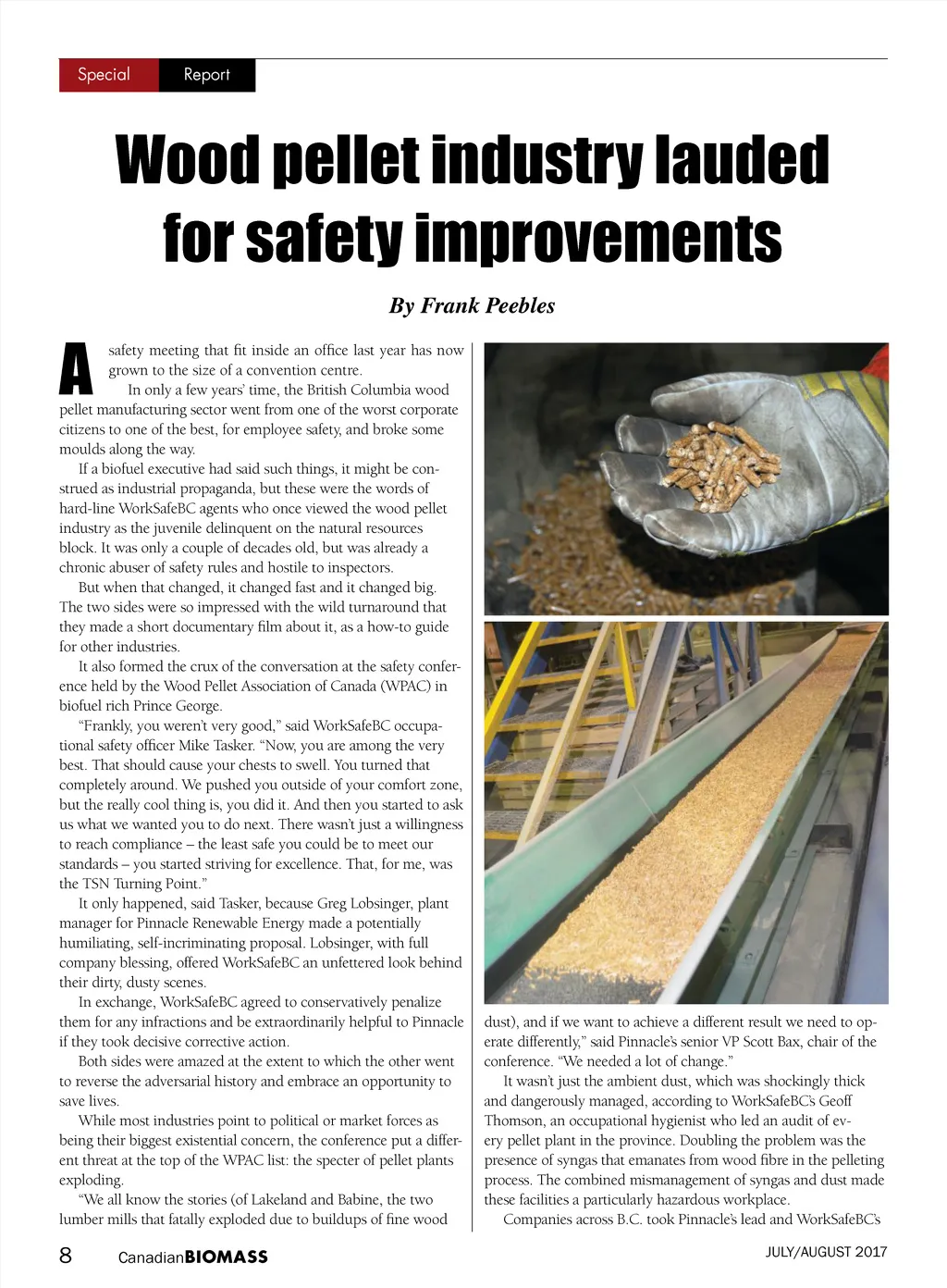
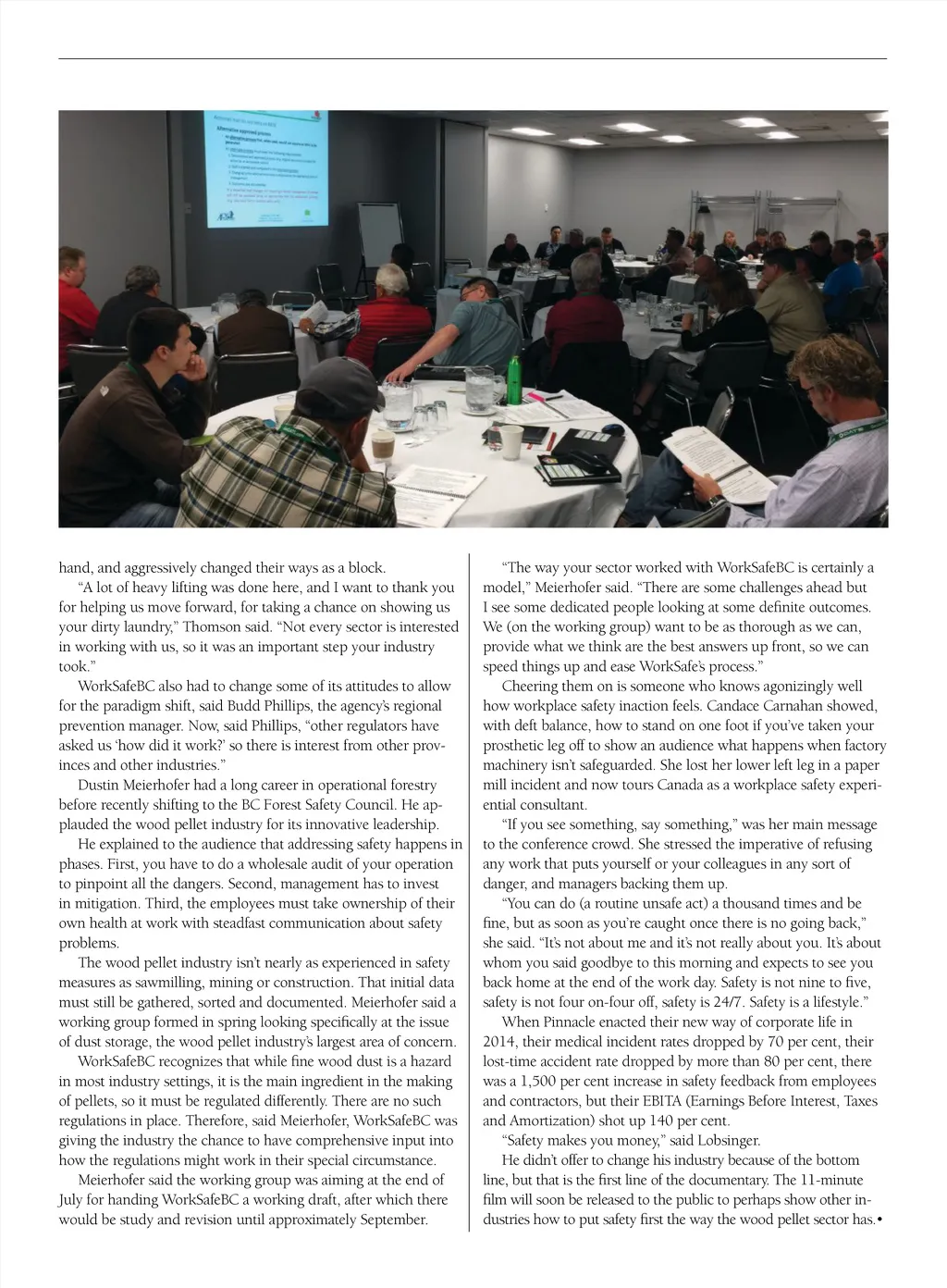
Special Report Wood pellet industry lauded for safety improvements A By Frank Peebles safety meeting that fit inside an office last year has now grown to the size of a convention centre. In only a few years’ time, the British Columbia wood pellet manufacturing sector went from one of the worst corporate citizens to one of the best, for employee safety, and broke some moulds along the way. If a biofuel executive had said such things, it might be con-strued as industrial propaganda, but these were the words of hard-line WorkSafeBC agents who once viewed the wood pellet industry as the juvenile delinquent on the natural resources block. It was only a couple of decades old, but was already a chronic abuser of safety rules and hostile to inspectors. But when that changed, it changed fast and it changed big. The two sides were so impressed with the wild turnaround that they made a short documentary film about it, as a how-to guide for other industries. It also formed the crux of the conversation at the safety confer-ence held by the Wood Pellet Association of Canada (WPAC) in biofuel rich Prince George. “Frankly, you weren’t very good,” said WorkSafeBC occupa-tional safety officer Mike Tasker. “Now, you are among the very best. That should cause your chests to swell. You turned that completely around. We pushed you outside of your comfort zone, but the really cool thing is, you did it. And then you started to ask us what we wanted you to do next. There wasn’t just a willingness to reach compliance – the least safe you could be to meet our standards – you started striving for excellence. That, for me, was the TSN Turning Point.” It only happened, said Tasker, because Greg Lobsinger, plant manager for Pinnacle Renewable Energy made a potentially humiliating, self-incriminating proposal. Lobsinger, with full company blessing, offered WorkSafeBC an unfettered look behind their dirty, dusty scenes. In exchange, WorkSafeBC agreed to conservatively penalize them for any infractions and be extraordinarily helpful to Pinnacle if they took decisive corrective action. Both sides were amazed at the extent to which the other went to reverse the adversarial history and embrace an opportunity to save lives. While most industries point to political or market forces as being their biggest existential concern, the conference put a differ-ent threat at the top of the WPAC list: the specter of pellet plants exploding. “We all know the stories (of Lakeland and Babine, the two lumber mills that fatally exploded due to buildups of fine wood dust), and if we want to achieve a different result we need to op-erate differently,” said Pinnacle’s senior VP Scott Bax, chair of the conference. “We needed a lot of change.” It wasn’t just the ambient dust, which was shockingly thick and dangerously managed, according to WorkSafeBC’s Geoff Thomson, an occupational hygienist who led an audit of ev-ery pellet plant in the province. Doubling the problem was the presence of syngas that emanates from wood fibre in the pelleting process. The combined mismanagement of syngas and dust made these facilities a particularly hazardous workplace. Companies across B.C. took Pinnacle’s lead and WorkSafeBC’s JULY/AUGUST 2017 8 Canadian BIOMASS
Canadian Biomass July/August 2017: Page 8