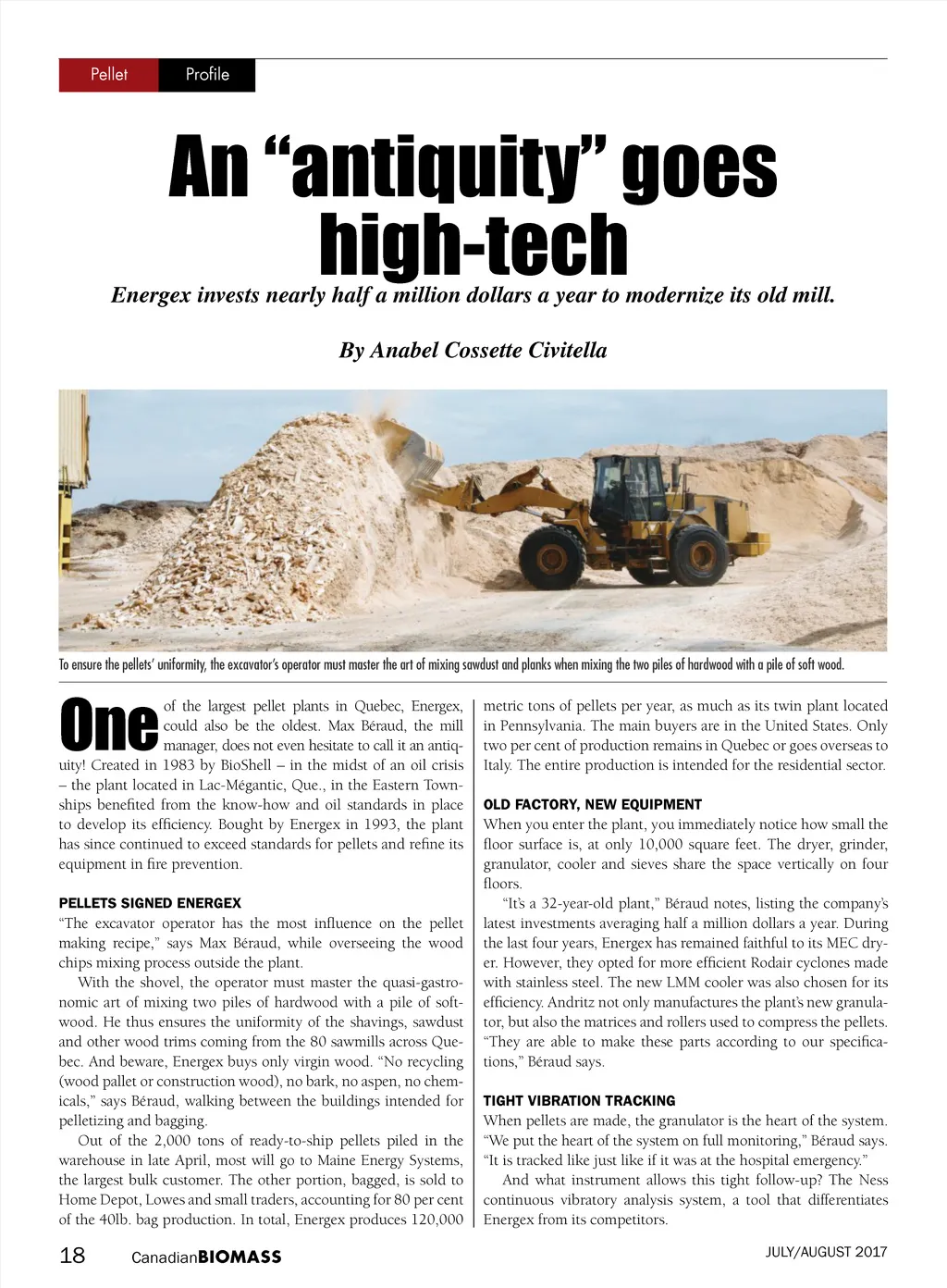
Pellet Profile Energex invests nearly half a million dollars a year to modernize its old mill. By Anabel Cossette Civitella An “antiquity” goes high-tech To ensure the pellets’ uniformity, the excavator’s operator must master the art of mixing sawdust and planks when mixing the two piles of hardwood with a pile of soft wood. One of the largest pellet plants in Quebec, Energex, could also be the oldest. Max Béraud, the mill manager, does not even hesitate to call it an antiq-uity! Created in 1983 by BioShell – in the midst of an oil crisis – the plant located in Lac-Mégantic, Que., in the Eastern Town-ships benefited from the know-how and oil standards in place to develop its efficiency. Bought by Energex in 1993, the plant has since continued to exceed standards for pellets and refine its equipment in fire prevention. metric tons of pellets per year, as much as its twin plant located in Pennsylvania. The main buyers are in the United States. Only two per cent of production remains in Quebec or goes overseas to Italy. The entire production is intended for the residential sector. OLD FACTORY, NEW EQUIPMENT PELLETS SIGNED ENERGEX “The excavator operator has the most influence on the pellet making recipe,” says Max Béraud, while overseeing the wood chips mixing process outside the plant. With the shovel, the operator must master the quasi-gastro-nomic art of mixing two piles of hardwood with a pile of soft-wood. He thus ensures the uniformity of the shavings, sawdust and other wood trims coming from the 80 sawmills across Que-bec. And beware, Energex buys only virgin wood. “No recycling (wood pallet or construction wood), no bark, no aspen, no chem-icals,” says Béraud, walking between the buildings intended for pelletizing and bagging. Out of the 2,000 tons of ready-to-ship pellets piled in the warehouse in late April, most will go to Maine Energy Systems, the largest bulk customer. The other portion, bagged, is sold to Home Depot, Lowes and small traders, accounting for 80 per cent of the 40lb. bag production. In total, Energex produces 120,000 When you enter the plant, you immediately notice how small the floor surface is, at only 10,000 square feet. The dryer, grinder, granulator, cooler and sieves share the space vertically on four floors. “It’s a 32-year-old plant,” Béraud notes, listing the company’s latest investments averaging half a million dollars a year. During the last four years, Energex has remained faithful to its MEC dry-er. However, they opted for more efficient Rodair cyclones made with stainless steel. The new LMM cooler was also chosen for its efficiency. Andritz not only manufactures the plant’s new granula-tor, but also the matrices and rollers used to compress the pellets. “They are able to make these parts according to our specifica-tions,” Béraud says. TIGHT VIBRATION TRACKING When pellets are made, the granulator is the heart of the system. “We put the heart of the system on full monitoring,” Béraud says. “It is tracked like just like if it was at the hospital emergency.” And what instrument allows this tight follow-up? The Ness continuous vibratory analysis system, a tool that differentiates Energex from its competitors. JULY/AUGUST 2017 18 Canadian BIOMASS
Canadian Biomass July/August 2017: Page 18