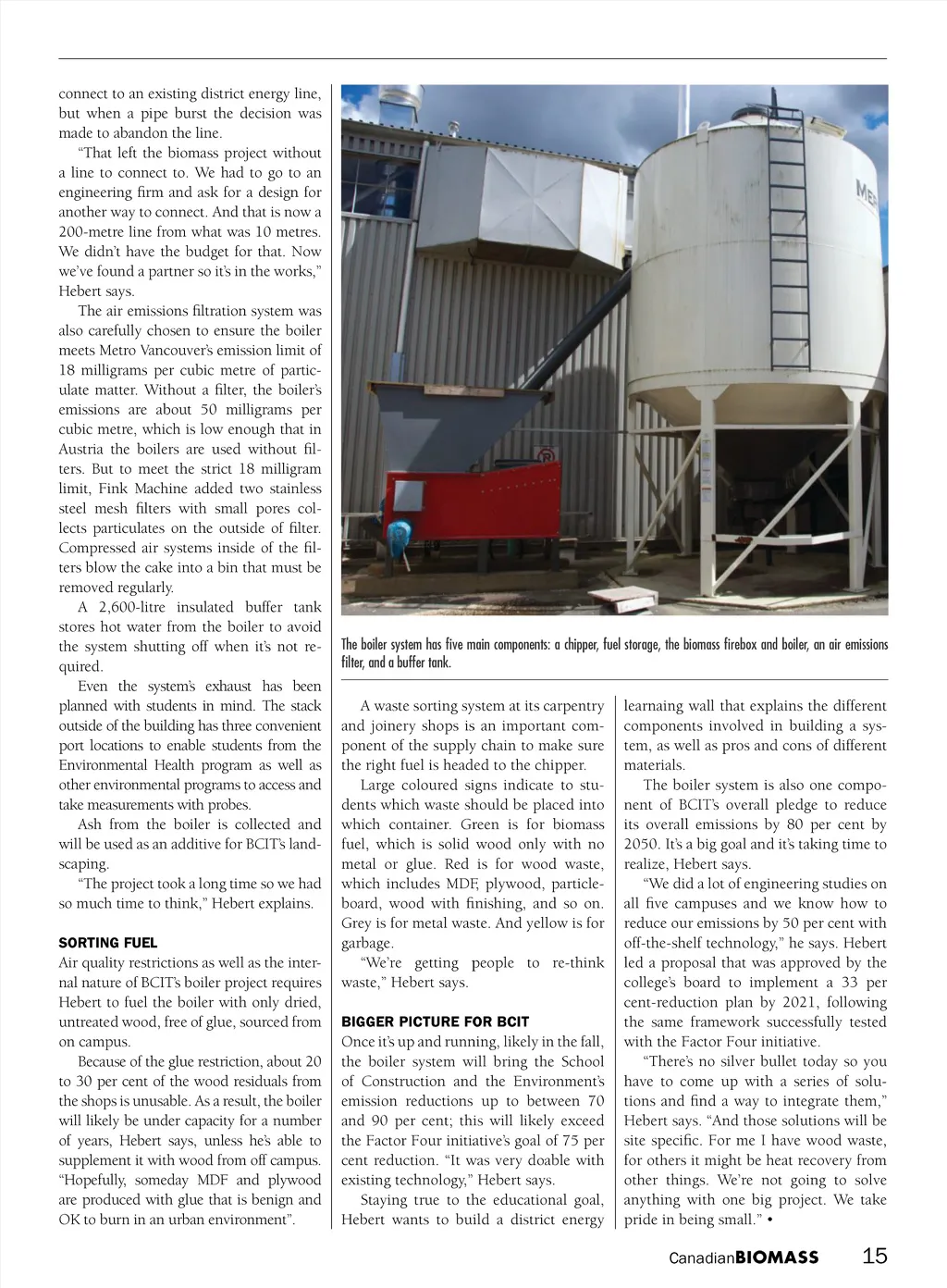
connect to an existing district energy line, but when a pipe burst the decision was made to abandon the line. “That left the biomass project without a line to connect to. We had to go to an engineering firm and ask for a design for another way to connect. And that is now a 200-metre line from what was 10 metres. We didn’t have the budget for that. Now we’ve found a partner so it’s in the works,” Hebert says. The air emissions filtration system was also carefully chosen to ensure the boiler meets Metro Vancouver’s emission limit of 18 milligrams per cubic metre of partic-ulate matter. Without a filter, the boiler’s emissions are about 50 milligrams per cubic metre, which is low enough that in Austria the boilers are used without fil-ters. But to meet the strict 18 milligram limit, Fink Machine added two stainless steel mesh filters with small pores col-lects particulates on the outside of filter. Compressed air systems inside of the fil-ters blow the cake into a bin that must be removed regularly. A 2,600-litre insulated buffer tank stores hot water from the boiler to avoid the system shutting off when it’s not re-quired. Even the system’s exhaust has been planned with students in mind. The stack outside of the building has three convenient port locations to enable students from the Environmental Health program as well as other environmental programs to access and take measurements with probes. Ash from the boiler is collected and will be used as an additive for BCIT’s land-scaping. “The project took a long time so we had so much time to think,” Hebert explains. SORTING FUEL The boiler system has five main components: a chipper, fuel storage, the biomass firebox and boiler, an air emissions filter, and a buffer tank. Air quality restrictions as well as the inter-nal nature of BCIT’s boiler project requires Hebert to fuel the boiler with only dried, untreated wood, free of glue, sourced from on campus. Because of the glue restriction, about 20 to 30 per cent of the wood residuals from the shops is unusable. As a result, the boiler will likely be under capacity for a number of years, Hebert says, unless he’s able to supplement it with wood from off campus. “Hopefully, someday MDF and plywood are produced with glue that is benign and OK to burn in an urban environment”. A waste sorting system at its carpentry and joinery shops is an important com-ponent of the supply chain to make sure the right fuel is headed to the chipper. Large coloured signs indicate to stu-dents which waste should be placed into which container. Green is for biomass fuel, which is solid wood only with no metal or glue. Red is for wood waste, which includes MDF, plywood, particle-board, wood with finishing, and so on. Grey is for metal waste. And yellow is for garbage. “We’re getting people to re-think waste,” Hebert says. BIGGER PICTURE FOR BCIT Once it’s up and running, likely in the fall, the boiler system will bring the School of Construction and the Environment’s emission reductions up to between 70 and 90 per cent; this will likely exceed the Factor Four initiative’s goal of 75 per cent reduction. “It was very doable with existing technology,” Hebert says. Staying true to the educational goal, Hebert wants to build a district energy learnaing wall that explains the different components involved in building a sys-tem, as well as pros and cons of different materials. The boiler system is also one compo-nent of BCIT’s overall pledge to reduce its overall emissions by 80 per cent by 2050. It’s a big goal and it’s taking time to realize, Hebert says. “We did a lot of engineering studies on all five campuses and we know how to reduce our emissions by 50 per cent with off-the-shelf technology,” he says. Hebert led a proposal that was approved by the college’s board to implement a 33 per cent-reduction plan by 2021, following the same framework successfully tested with the Factor Four initiative. “There’s no silver bullet today so you have to come up with a series of solu-tions and find a way to integrate them,” Hebert says. “And those solutions will be site specific. For me I have wood waste, for others it might be heat recovery from other things. We’re not going to solve anything with one big project. We take pride in being small.” • Canadian BIOMASS 15
Canadian Biomass July/August 2017: Page 15