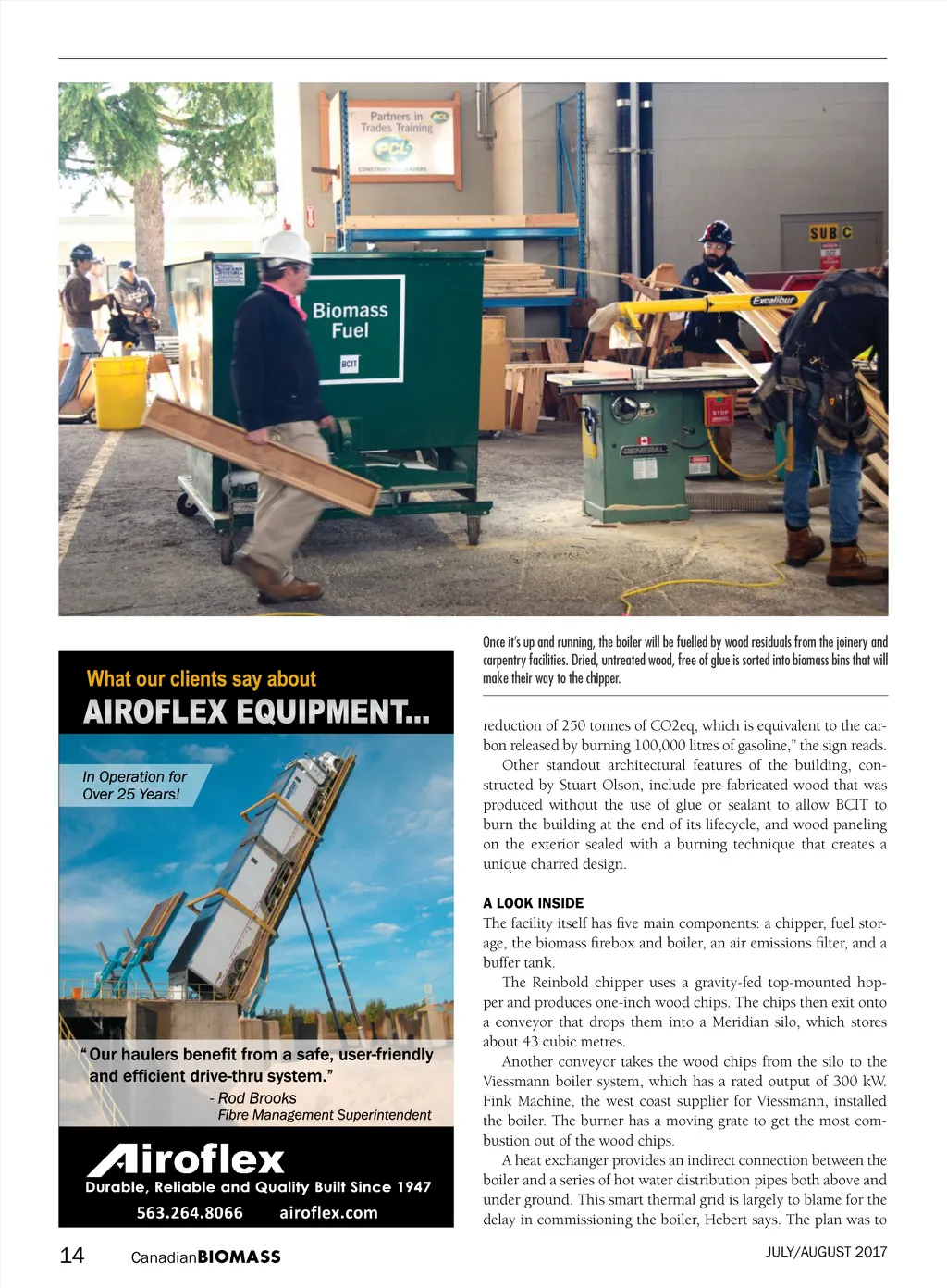
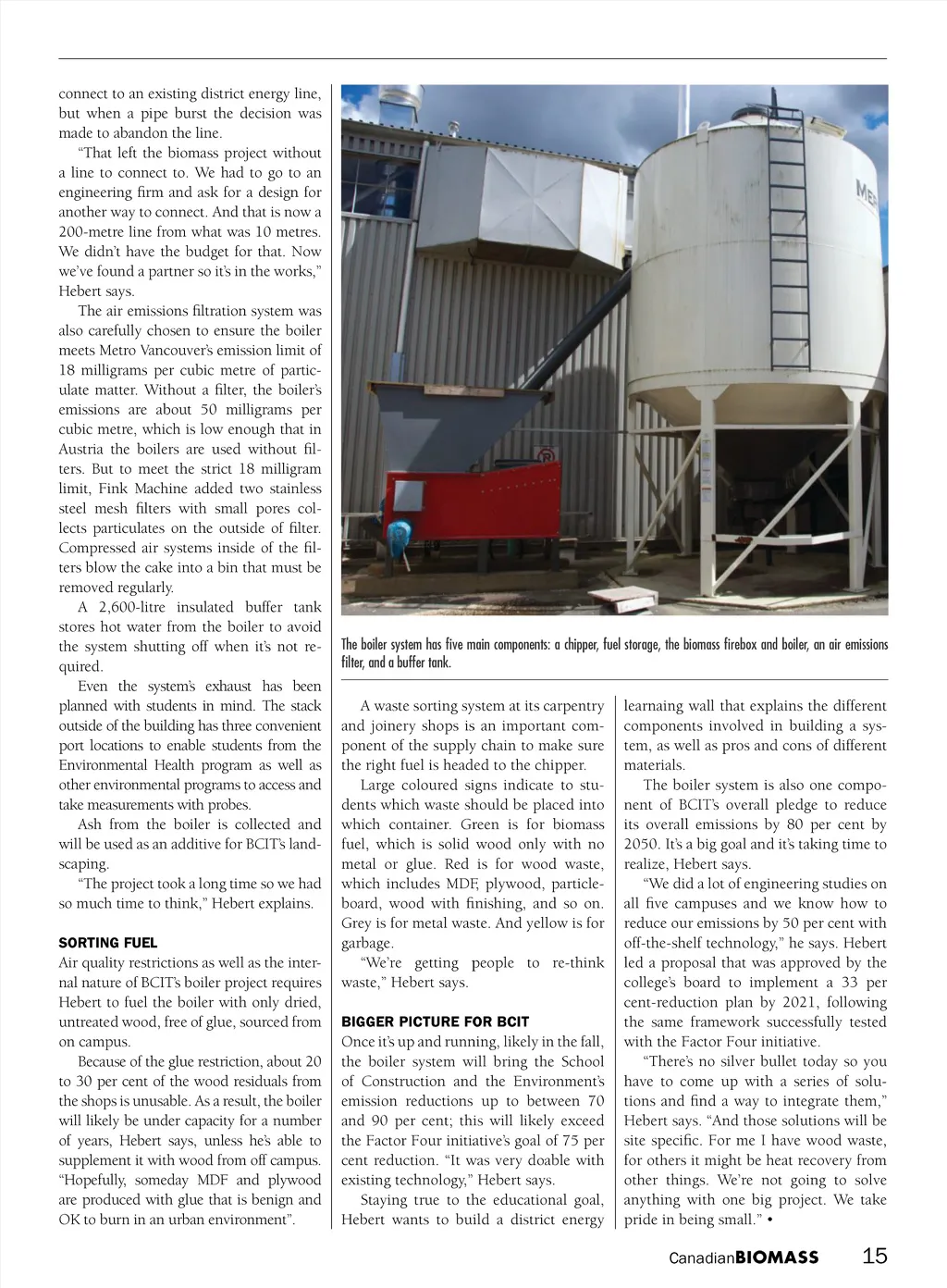
Once it’s up and running, the boiler will be fuelled by wood residuals from the joinery and carpentry facilities. Dried, untreated wood, free of glue is sorted into biomass bins that will make their way to the chipper. reduction of 250 tonnes of CO2eq, which is equivalent to the car-bon released by burning 100,000 litres of gasoline,” the sign reads. Other standout architectural features of the building, con-structed by Stuart Olson, include pre-fabricated wood that was produced without the use of glue or sealant to allow BCIT to burn the building at the end of its lifecycle, and wood paneling on the exterior sealed with a burning technique that creates a unique charred design. A LOOK INSIDE 563.264.8066 airoflex.com The facility itself has five main components: a chipper, fuel stor-age, the biomass firebox and boiler, an air emissions filter, and a buffer tank. The Reinbold chipper uses a gravity-fed top-mounted hop-per and produces one-inch wood chips. The chips then exit onto a conveyor that drops them into a Meridian silo, which stores about 43 cubic metres. Another conveyor takes the wood chips from the silo to the Viessmann boiler system, which has a rated output of 300 kW. Fink Machine, the west coast supplier for Viessmann, installed the boiler. The burner has a moving grate to get the most com-bustion out of the wood chips. A heat exchanger provides an indirect connection between the boiler and a series of hot water distribution pipes both above and under ground. This smart thermal grid is largely to blame for the delay in commissioning the boiler, Hebert says. The plan was to JULY/AUGUST 2017 2017-05-17 7:25 AM 14 Canadian BIOMASS CBM_Airoflex_MayJune17_CSA.indd 1
Canadian Biomass July/August 2017: Page 14