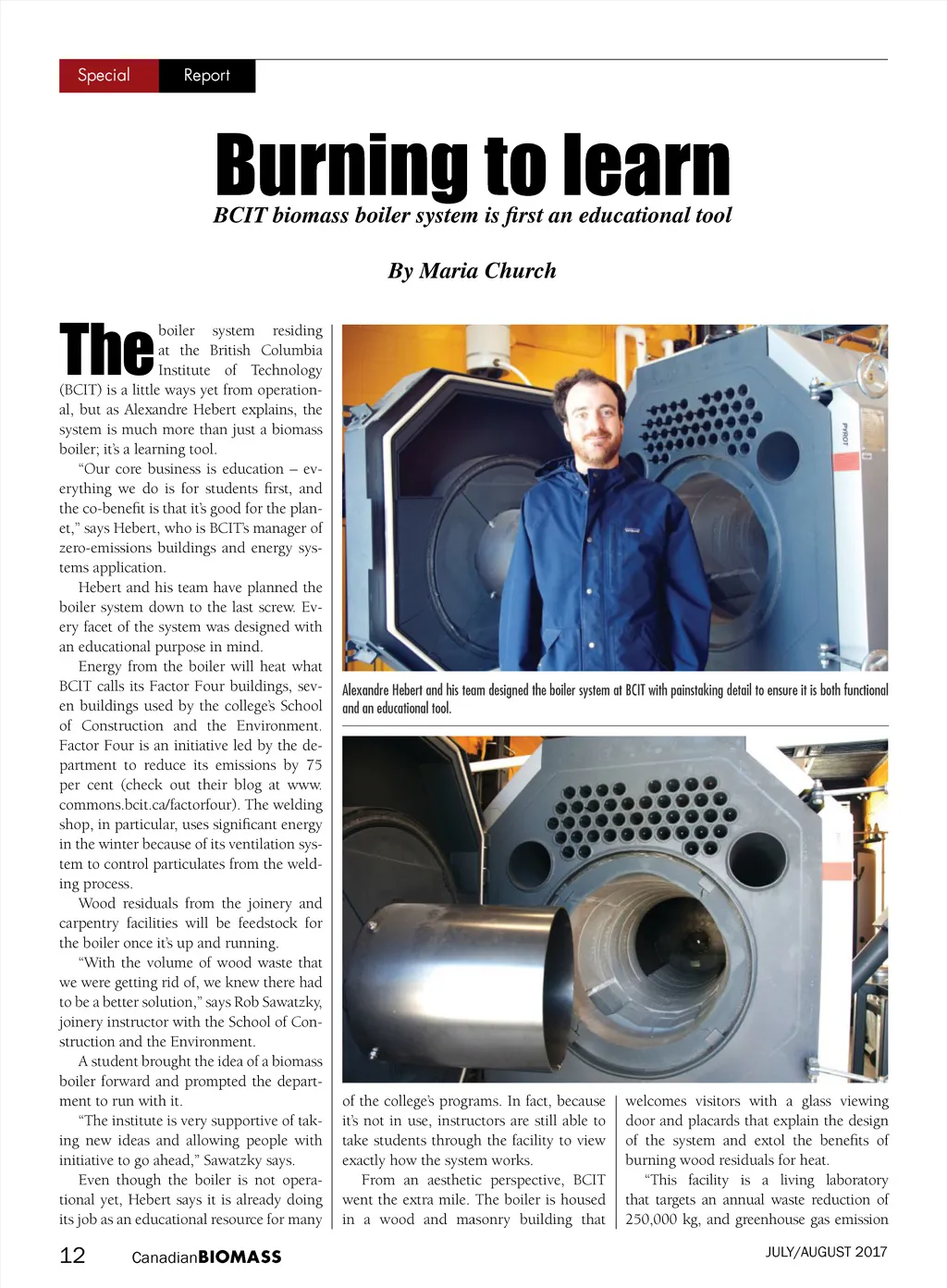
Special Report BCIT biomass boiler system is first an educational tool By Maria Church Burning to learn The boiler system residing at the British Columbia Institute of Technology (BCIT) is a little ways yet from operation-al, but as Alexandre Hebert explains, the system is much more than just a biomass boiler; it’s a learning tool. “Our core business is education – ev-erything we do is for students first, and the co-benefit is that it’s good for the plan-et,” says Hebert, who is BCIT’s manager of zero-emissions buildings and energy sys-tems application. Hebert and his team have planned the boiler system down to the last screw. Ev-ery facet of the system was designed with an educational purpose in mind. Energy from the boiler will heat what BCIT calls its Factor Four buildings, sev-en buildings used by the college’s School of Construction and the Environment. Factor Four is an initiative led by the de-partment to reduce its emissions by 75 per cent (check out their blog at www. commons.bcit.ca/factorfour). The welding shop, in particular, uses significant energy in the winter because of its ventilation sys-tem to control particulates from the weld-ing process. Wood residuals from the joinery and carpentry facilities will be feedstock for the boiler once it’s up and running. “With the volume of wood waste that we were getting rid of, we knew there had to be a better solution,” says Rob Sawatzky, joinery instructor with the School of Con-struction and the Environment. A student brought the idea of a biomass boiler forward and prompted the depart-ment to run with it. “The institute is very supportive of tak-ing new ideas and allowing people with initiative to go ahead,” Sawatzky says. Even though the boiler is not opera-tional yet, Hebert says it is already doing its job as an educational resource for many Alexandre Hebert and his team designed the boiler system at BCIT with painstaking detail to ensure it is both functional and an educational tool. of the college’s programs. In fact, because it’s not in use, instructors are still able to take students through the facility to view exactly how the system works. From an aesthetic perspective, BCIT went the extra mile. The boiler is housed in a wood and masonry building that welcomes visitors with a glass viewing door and placards that explain the design of the system and extol the benefits of burning wood residuals for heat. “This facility is a living laboratory that targets an annual waste reduction of 250,000 kg, and greenhouse gas emission JULY/AUGUST 2017 12 Canadian BIOMASS
Canadian Biomass July/August 2017: Page 12