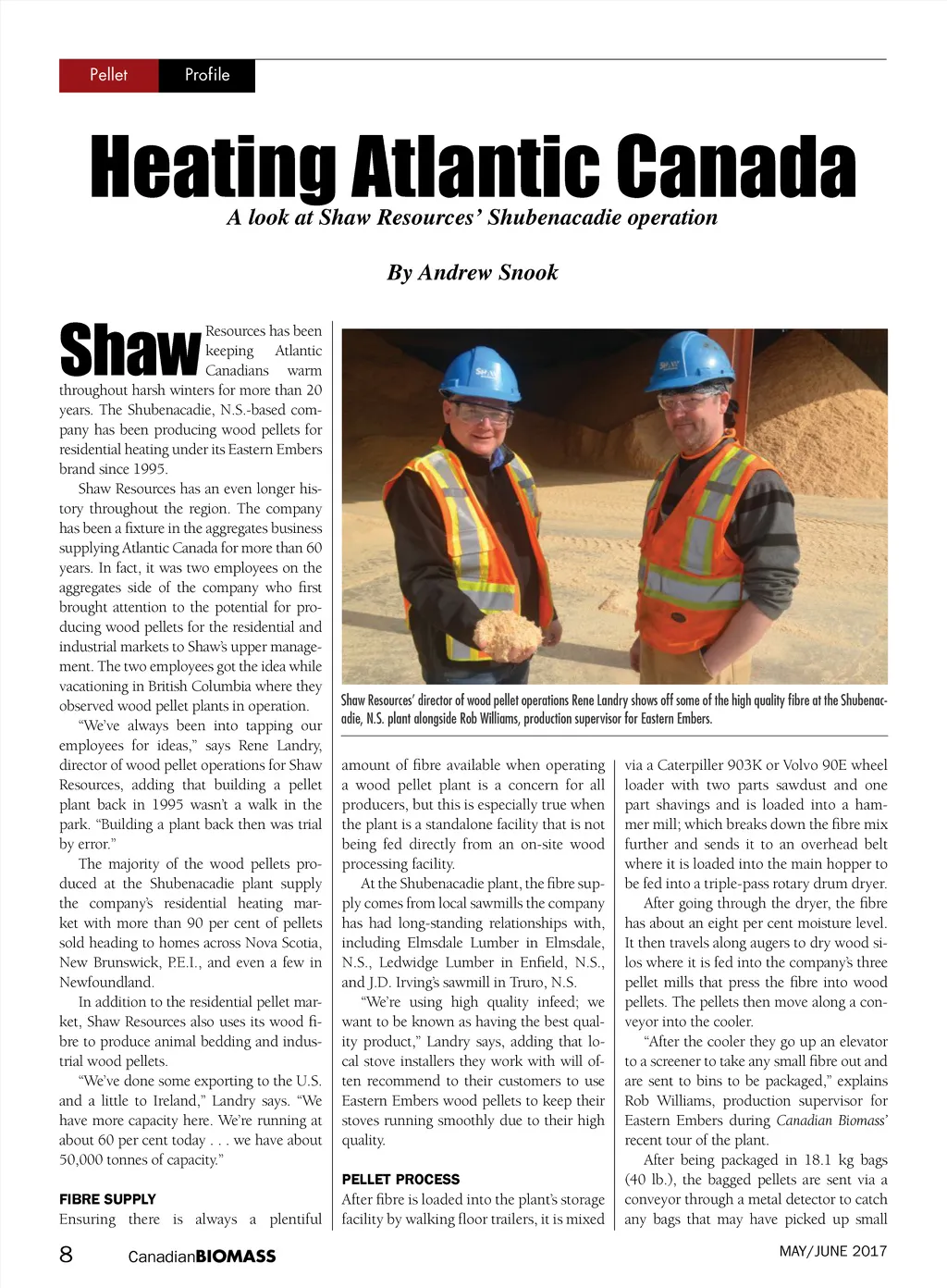
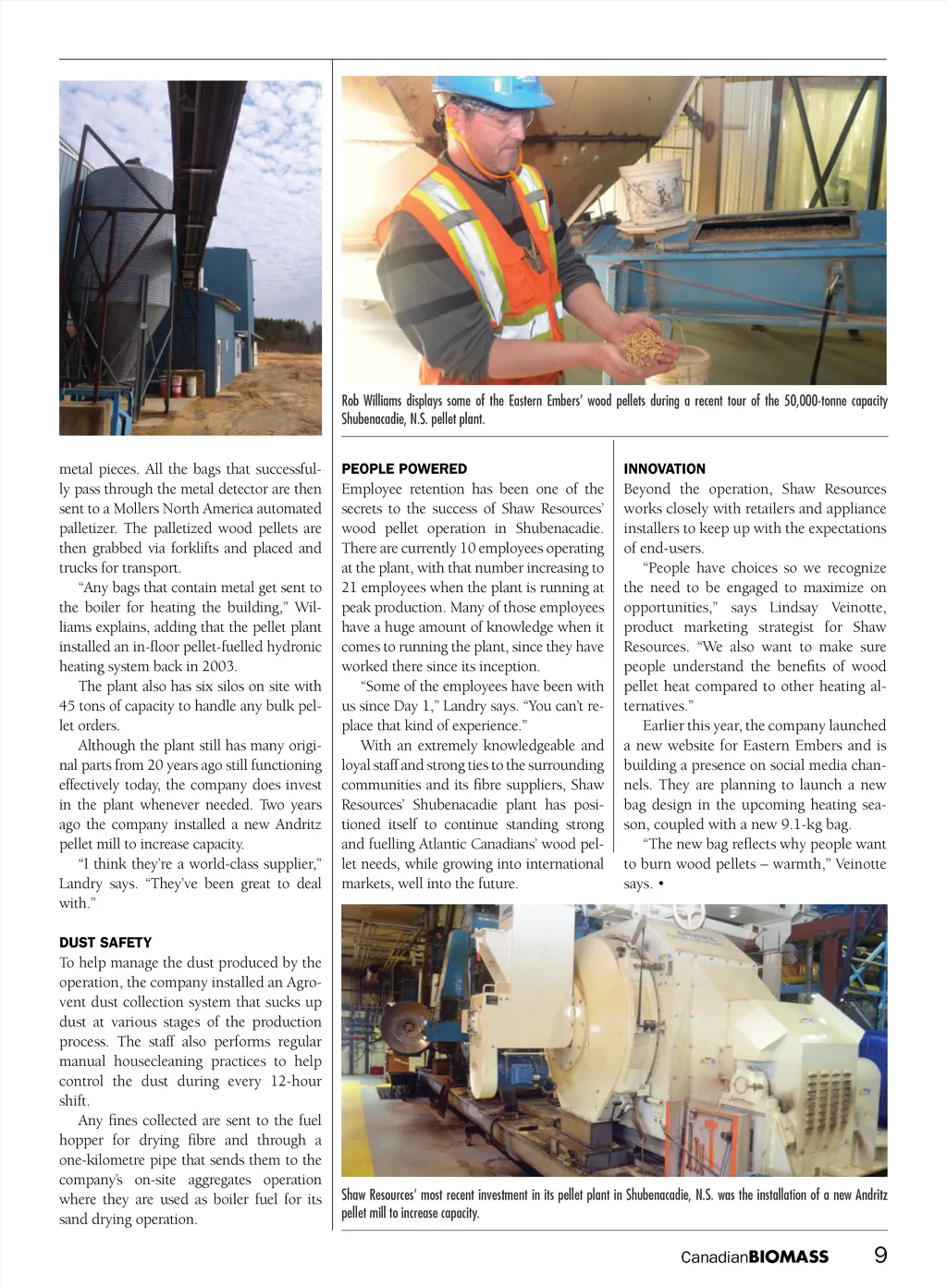
Pellet Profile Heating Atlantic Canada A look at Shaw Resources’ Shubenacadie operation By Andrew Snook Resources has been keeping Atlantic Canadians warm throughout harsh winters for more than 20 years. The Shubenacadie, N.S.-based com-pany has been producing wood pellets for residential heating under its Eastern Embers brand since 1995. Shaw Resources has an even longer his-tory throughout the region. The company has been a fixture in the aggregates business supplying Atlantic Canada for more than 60 years. In fact, it was two employees on the aggregates side of the company who first brought attention to the potential for pro-ducing wood pellets for the residential and industrial markets to Shaw’s upper manage-ment. The two employees got the idea while vacationing in British Columbia where they observed wood pellet plants in operation. “We’ve always been into tapping our employees for ideas,” says Rene Landry, director of wood pellet operations for Shaw Resources, adding that building a pellet plant back in 1995 wasn’t a walk in the park. “Building a plant back then was trial by error.” The majority of the wood pellets pro-duced at the Shubenacadie plant supply the company’s residential heating mar-ket with more than 90 per cent of pellets sold heading to homes across Nova Scotia, New Brunswick, P.E.I., and even a few in Newfoundland. In addition to the residential pellet mar-ket, Shaw Resources also uses its wood fi-bre to produce animal bedding and indus-trial wood pellets. “We’ve done some exporting to the U.S. and a little to Ireland,” Landry says. “We have more capacity here. We’re running at about 60 per cent today . . . we have about 50,000 tonnes of capacity.” FIBRE SUPPLY Shaw Shaw Resources’ director of wood pellet operations Rene Landry shows off some of the high quality fibre at the Shubenac-adie, N.S. plant alongside Rob Williams, production supervisor for Eastern Embers. amount of fibre available when operating a wood pellet plant is a concern for all producers, but this is especially true when the plant is a standalone facility that is not being fed directly from an on-site wood processing facility. At the Shubenacadie plant, the fibre sup-ply comes from local sawmills the company has had long-standing relationships with, including Elmsdale Lumber in Elmsdale, N.S., Ledwidge Lumber in Enfield, N.S., and J.D. Irving’s sawmill in Truro, N.S. “We’re using high quality infeed; we want to be known as having the best qual-ity product,” Landry says, adding that lo-cal stove installers they work with will of-ten recommend to their customers to use Eastern Embers wood pellets to keep their stoves running smoothly due to their high quality. PELLET PROCESS Ensuring there is always a plentiful After fibre is loaded into the plant’s storage facility by walking floor trailers, it is mixed via a Caterpiller 903K or Volvo 90E wheel loader with two parts sawdust and one part shavings and is loaded into a ham-mer mill; which breaks down the fibre mix further and sends it to an overhead belt where it is loaded into the main hopper to be fed into a triple-pass rotary drum dryer. After going through the dryer, the fibre has about an eight per cent moisture level. It then travels along augers to dry wood si-los where it is fed into the company’s three pellet mills that press the fibre into wood pellets. The pellets then move along a con-veyor into the cooler. “After the cooler they go up an elevator to a screener to take any small fibre out and are sent to bins to be packaged,” explains Rob Williams, production supervisor for Eastern Embers during Canadian Biomass’ recent tour of the plant. After being packaged in 18.1 kg bags (40 lb.), the bagged pellets are sent via a conveyor through a metal detector to catch any bags that may have picked up small MAY/JUNE 2017 8 Canadian BIOMASS
Canadian Biomass May-June 2017: Page 8