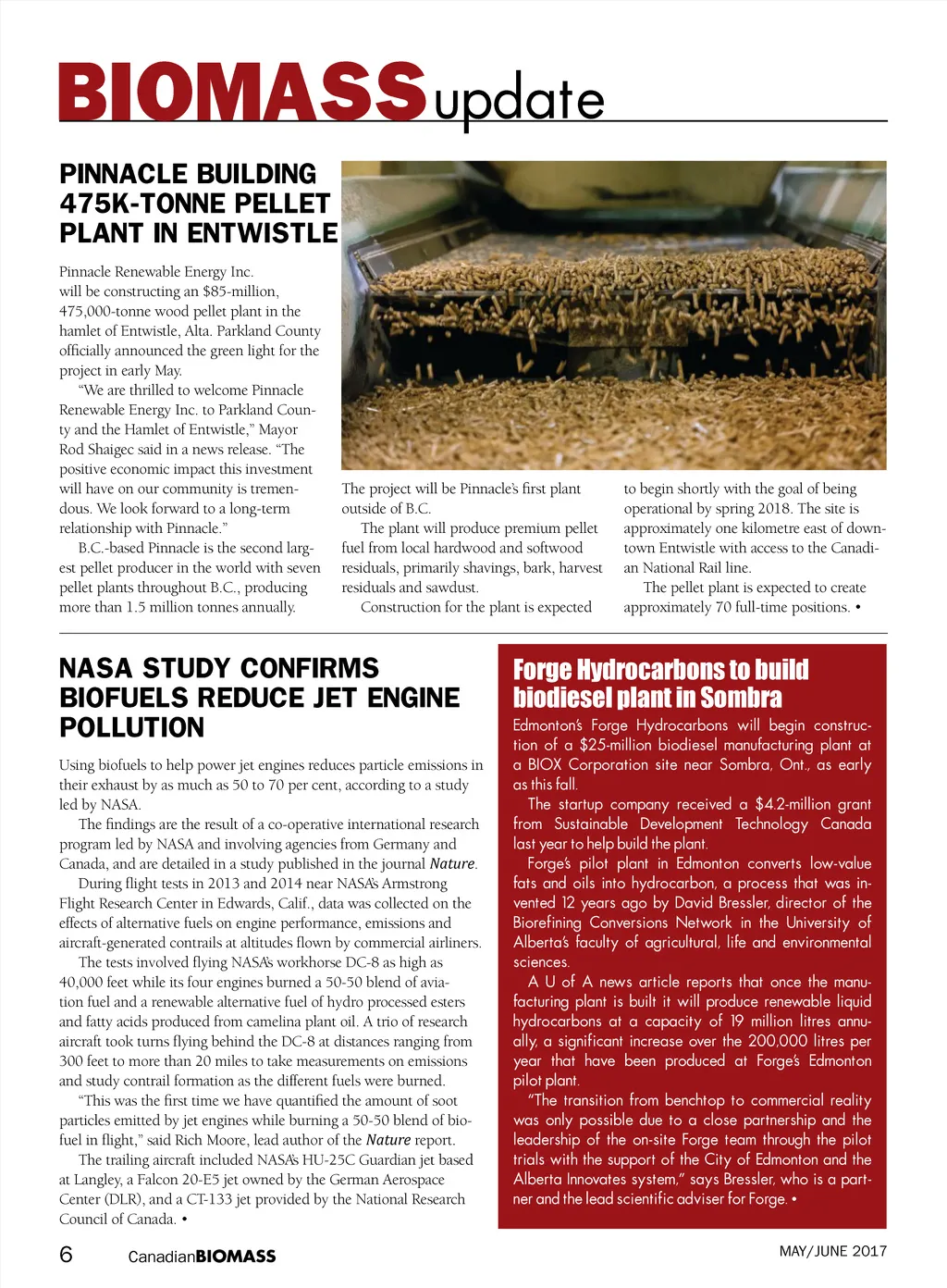
BC ISSUES ENERKEM ETHANOL LOWEST CARBON INTENSITY VALUE EVER Enerkem Inc. has received the lowest carbon intensity value ever issued by the British Columbia Ministry of Energy and Mines for its eth-anol product under the Renewable and Low Carbon Fuel Requirements Regulation. The confirmed carbon intensity of Enerkem’s waste-based ethanol is set at -55 gCO2e/MJ. As a comparison, gasoline has an intensity of +88 gCO2e/MJ. This approval under the British Columbia Renewable and Low Carbon Fuel Requirements Regulation opens up the door for Enerkem to sell its advanced ethanol in the province, in addition to the local Alberta market where its world’s first full-scale facility in operation is located. “We are thrilled to be recognized for having the lowest carbon transportation fuel solution ever approved by B.C. under its Low Carbon Fuel Regulation,” says Vincent Chornet, president and chief executive officer of Enerkem. “This clearly demonstrates Enerkem’s clean technology and advanced bio-fuels provide significant greenhouse gas emission reductions. With the worldwide adoption of Renewable and Low Carbon Fuel Standards and the move toward a low carbon global econ-omy, we look forward to working with other jurisdictions in helping them meet their greenhouse gas targets.” The British Columbia Renewable and Low Carbon Fuel Requirements Regulation was introduced to reduce reliance on non-renewable fuels and the environmental impact of trans-portation fuels. Under this requirement, fuel suppliers must progressively decrease the average carbon intensity of their fuels by 10 per cent by 2020 relative to 2010. Enerkem’s proprietary technology decreases greenhouse gas (GHG) emissions by producing low carbon fuels that displace a portion of the gasoline used to fuel cars. Moreover, by using non-recyclable, non-compostable household waste – otherwise destined to landfills – and converting this waste feedstock into advanced biofuels, it also avoids methane emissions from landfills. Carbon intensity is the measure of GHG emissions associat-ed with producing and consuming a transportation fuel, mea-sured in grams of carbon dioxide equivalent per megajoule of energy (gCO2e/MJ). It accounts for the GHG emissions associ-ated with extracting, producing, transporting, and consuming a unit of energy of transportation fuel. It is a measure of the GHG emissions from the complete life cycle assessment of a fuel. • HAMILTON BIO-SOLIDS PROJ-ECT TO BEGIN CONSTRUCTION THIS SUMMER G4 INSIGHTS RECEIVES FEDERAL FUNDS FOR RNG PRODUCTION G4 Insights has received $800,000 from the Canadian government to build an RNG demonstration plant in Edmonton. The plant, hosted by ATCO, will allow G4 Insights to test a range of forest residues and collect operational data with the goal of developing technology to convert forestry residue into renewable natural gas (RNG) that can be distributed through Canada’s natural gas pipelines. Canada’s Minister of Natural Resources Jim Carr made the funding announcement today. “By investing in clean technology industries we can help them be more innovative, more competitive and more successful,” Carr said in a news release. Edson Ng, principal for G4 Insights Inc., said the funding support will help the compa-ny forge a path for greenhouse gas reductions that are affordable, reliable and sustainable. “This project will advance G4 technology to-ward commercialization through field trials of enhanced subsystems for robust continuous operation and grid injection,” Ng said. G4 Insights is partnering with the Cana-dian Gas Association members Enbridge Gas Distribution, FortisBC, Gaz Metro, Union Gas, utility host ATCO, the Natural Gas Innovation Fund, Alberta Innovates, and FPInnovations, who are contributing a combined $1.35 mil-lion towards the RNG project. Timothy Egan, president and CEO of the Canadian Gas Association, said the project will support the industry’s aspirational target of blending 10 per cent RNG in the Canadian natural gas distribution system by 2030. Pierre Lapointe, president and CEO of FPInnovations, said he looks forward to RNG becoming a viable renewable energy source in the future. “This project demonstrates the importance of bringing together scientific expertise, industrial sector know-how and government support to solve the challenges of creating a clean tech economy,” he said. “ATCO is excited to host and sponsor G4 in Edmonton. RNG is a largely untapped renewable resource that Canadians can use to heat and power their homes and businesses using a carbon-neutral fuel. ATCO is support-ive of RNG as a technology and is hopeful that their support will help accelerate the adoption of RNG in Alberta and commercialization of the G4 technology,” said Dean Reeve, senior vice-president and general manager, gas distri-bution, for ATCO Pipelines & Liquids Global Business Unit. • Bird Construction, as part of the Harbour City Solutions consortium, executed a contract on March 28, 2017 to design, build, finance, operate and maintain a biosolids management facility for the City of Hamilton, Ont. On Jan. 30, 2017, the company announced that it was part of the consortium named preferred propo-nent for the project. The consortium has since achieved financial close. The facility will use a thermal drying process to produce pellets, which will be used as fertilizer or fuel. The plant will process up to 60,000 wet tonnes per year of biosolids over the 30-year term of the contract. Bird expects to start site prepara-tion this summer with full construc-tion commencing shortly thereafter. The facility is expected to be opera-tional in the spring of 2020. • Canadian BIOMASS 7
Canadian Biomass May-June 2017: Page 7