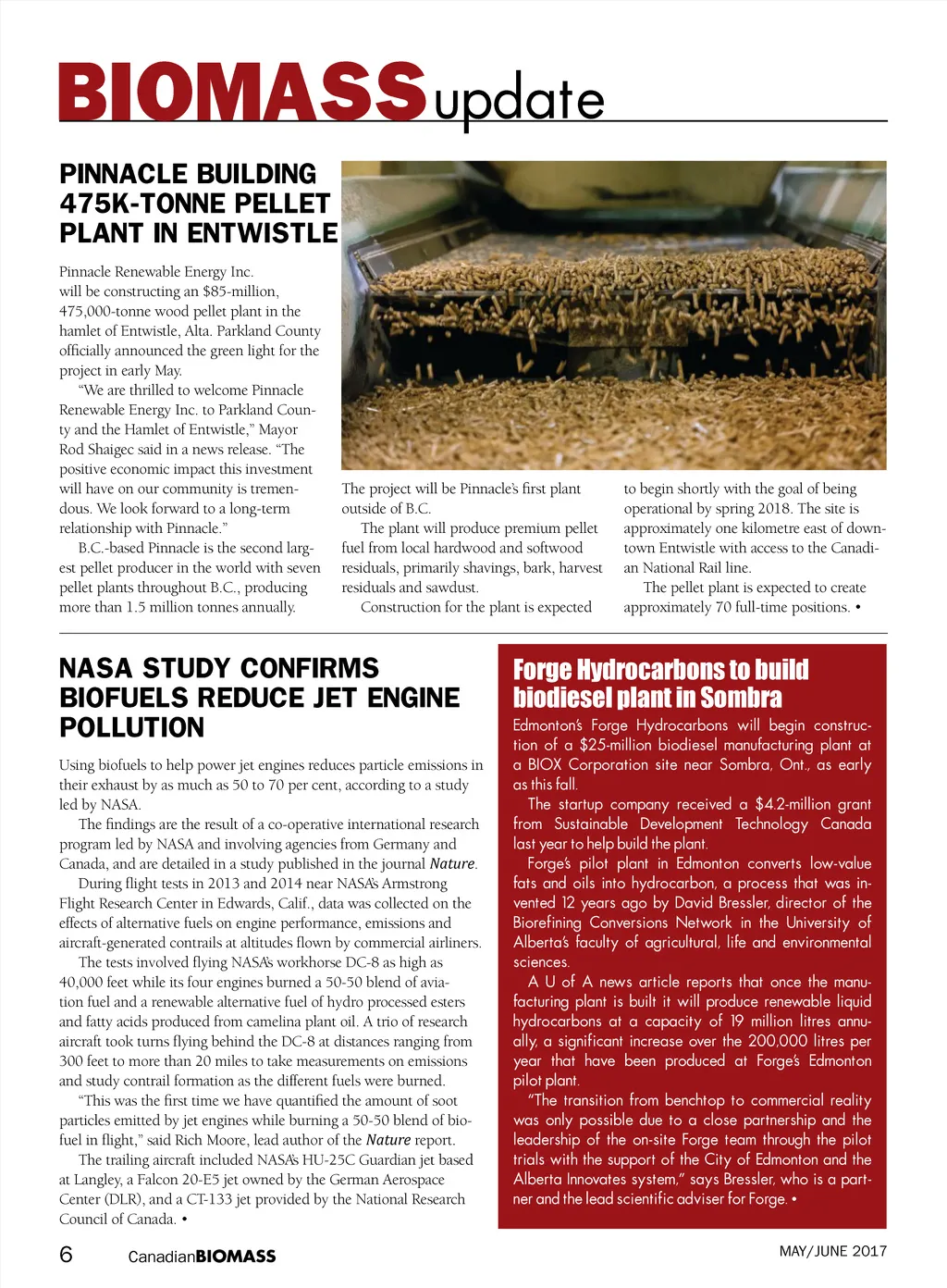
BIOMASS update PINNACLE BUILDING 475K-TONNE PELLET PLANT IN ENTWISTLE Pinnacle Renewable Energy Inc. will be constructing an $85-million, 475,000-tonne wood pellet plant in the hamlet of Entwistle, Alta. Parkland County officially announced the green light for the project in early May. “We are thrilled to welcome Pinnacle Renewable Energy Inc. to Parkland Coun-ty and the Hamlet of Entwistle,” Mayor Rod Shaigec said in a news release. “The positive economic impact this investment will have on our community is tremen-dous. We look forward to a long-term relationship with Pinnacle.” B.C.-based Pinnacle is the second larg-est pellet producer in the world with seven pellet plants throughout B.C., producing more than 1.5 million tonnes annually. The project will be Pinnacle’s first plant outside of B.C. The plant will produce premium pellet fuel from local hardwood and softwood residuals, primarily shavings, bark, harvest residuals and sawdust. Construction for the plant is expected to begin shortly with the goal of being operational by spring 2018. The site is approximately one kilometre east of down-town Entwistle with access to the Canadi-an National Rail line. The pellet plant is expected to create approximately 70 full-time positions. • NASA STUDY CONFIRMS BIOFUELS REDUCE JET ENGINE POLLUTION Using biofuels to help power jet engines reduces particle emissions in their exhaust by as much as 50 to 70 per cent, according to a study led by NASA. The findings are the result of a co-operative international research program led by NASA and involving agencies from Germany and Canada, and are detailed in a study published in the journal Nature . During flight tests in 2013 and 2014 near NASA’s Armstrong Flight Research Center in Edwards, Calif., data was collected on the effects of alternative fuels on engine performance, emissions and aircraft-generated contrails at altitudes flown by commercial airliners. The tests involved flying NASA’s workhorse DC-8 as high as 40,000 feet while its four engines burned a 50-50 blend of avia-tion fuel and a renewable alternative fuel of hydro processed esters and fatty acids produced from camelina plant oil. A trio of research aircraft took turns flying behind the DC-8 at distances ranging from 300 feet to more than 20 miles to take measurements on emissions and study contrail formation as the different fuels were burned. “This was the first time we have quantified the amount of soot particles emitted by jet engines while burning a 50-50 blend of bio-fuel in flight,” said Rich Moore, lead author of the Nature report. The trailing aircraft included NASA’s HU-25C Guardian jet based at Langley, a Falcon 20-E5 jet owned by the German Aerospace Center (DLR), and a CT-133 jet provided by the National Research Council of Canada. • Forge Hydrocarbons to build biodiesel plant in Sombra Edmonton’ s Forge Hydrocarbons will begin construc-tion of a $25-million biodiesel manufacturing plant at a BIOX Corporation site near Sombra, Ont., as early as this fall. The startup company received a $4.2-million grant from Sustainable Development Technology Canada last year to help build the plant. Forge’ s pilot plant in Edmonton converts low-value fats and oils into hydrocarbon, a process that was in-vented 12 years ago by David Bressler, director of the Biorefining Conversions Network in the University of Alberta’ s faculty of agricultural, life and environmental sciences. A U of A news article reports that once the manu-facturing plant is built it will produce renewable liquid hydrocarbons at a capacity of 19 million litres annu-ally, a significant increase over the 200,000 litres per year that have been produced at Forge’ s Edmonton pilot plant. “The transition from benchtop to commercial reality was only possible due to a close partnership and the leadership of the on-site Forge team through the pilot trials with the support of the City of Edmonton and the Alberta Innovates system,” says Bressler, who is a part-ner and the lead scientific adviser for Forge. • MAY/JUNE 2017 6 Canadian BIOMASS
Canadian Biomass May-June 2017: Page 6