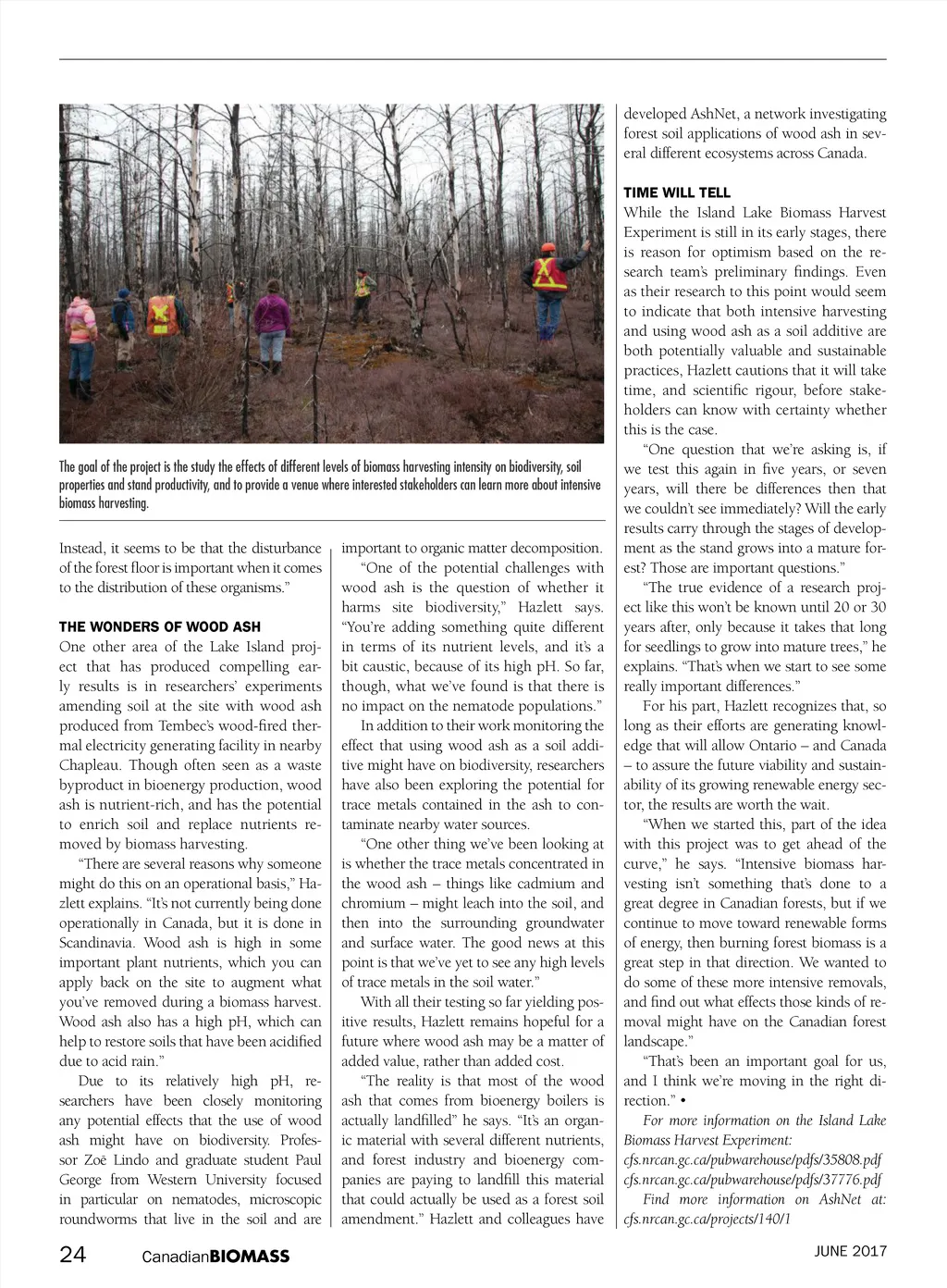
developed AshNet, a network investigating forest soil applications of wood ash in sev-eral different ecosystems across Canada. TIME WILL TELL The goal of the project is the study the effects of different levels of biomass harvesting intensity on biodiversity, soil properties and stand productivity, and to provide a venue where interested stakeholders can learn more about intensive biomass harvesting. Instead, it seems to be that the disturbance of the forest floor is important when it comes to the distribution of these organisms.” THE WONDERS OF WOOD ASH One other area of the Lake Island proj-ect that has produced compelling ear-ly results is in researchers’ experiments amending soil at the site with wood ash produced from Tembec’s wood-fired ther-mal electricity generating facility in nearby Chapleau. Though often seen as a waste byproduct in bioenergy production, wood ash is nutrient-rich, and has the potential to enrich soil and replace nutrients re-moved by biomass harvesting. “There are several reasons why someone might do this on an operational basis,” Ha-zlett explains. “It’s not currently being done operationally in Canada, but it is done in Scandinavia. Wood ash is high in some important plant nutrients, which you can apply back on the site to augment what you’ve removed during a biomass harvest. Wood ash also has a high pH, which can help to restore soils that have been acidified due to acid rain.” Due to its relatively high pH, re-searchers have been closely monitoring any potential effects that the use of wood ash might have on biodiversity. Profes-sor Zoë Lindo and graduate student Paul George from Western University focused in particular on nematodes, microscopic roundworms that live in the soil and are important to organic matter decomposition. “One of the potential challenges with wood ash is the question of whether it harms site biodiversity,” Hazlett says. “You’re adding something quite different in terms of its nutrient levels, and it’s a bit caustic, because of its high pH. So far, though, what we’ve found is that there is no impact on the nematode populations.” In addition to their work monitoring the effect that using wood ash as a soil addi-tive might have on biodiversity, researchers have also been exploring the potential for trace metals contained in the ash to con-taminate nearby water sources. “One other thing we’ve been looking at is whether the trace metals concentrated in the wood ash – things like cadmium and chromium – might leach into the soil, and then into the surrounding groundwater and surface water. The good news at this point is that we’ve yet to see any high levels of trace metals in the soil water.” With all their testing so far yielding pos-itive results, Hazlett remains hopeful for a future where wood ash may be a matter of added value, rather than added cost. “The reality is that most of the wood ash that comes from bioenergy boilers is actually landfilled” he says. “It’s an organ-ic material with several different nutrients, and forest industry and bioenergy com-panies are paying to landfill this material that could actually be used as a forest soil amendment.” Hazlett and colleagues have While the Island Lake Biomass Harvest Experiment is still in its early stages, there is reason for optimism based on the re-search team’s preliminary findings. Even as their research to this point would seem to indicate that both intensive harvesting and using wood ash as a soil additive are both potentially valuable and sustainable practices, Hazlett cautions that it will take time, and scientific rigour, before stake-holders can know with certainty whether this is the case. “One question that we’re asking is, if we test this again in five years, or seven years, will there be differences then that we couldn’t see immediately? Will the early results carry through the stages of develop-ment as the stand grows into a mature for-est? Those are important questions.” “The true evidence of a research proj-ect like this won’t be known until 20 or 30 years after, only because it takes that long for seedlings to grow into mature trees,” he explains. “That’s when we start to see some really important differences.” For his part, Hazlett recognizes that, so long as their efforts are generating knowl-edge that will allow Ontario – and Canada – to assure the future viability and sustain-ability of its growing renewable energy sec-tor, the results are worth the wait. “When we started this, part of the idea with this project was to get ahead of the curve,” he says. “Intensive biomass har-vesting isn’t something that’s done to a great degree in Canadian forests, but if we continue to move toward renewable forms of energy, then burning forest biomass is a great step in that direction. We wanted to do some of these more intensive removals, and find out what effects those kinds of re-moval might have on the Canadian forest landscape.” “That’s been an important goal for us, and I think we’re moving in the right di-rection.” • For more information on the Island Lake Biomass Harvest Experiment: cfs.nrcan.gc.ca/pubwarehouse/pdfs/35808.pdf cfs.nrcan.gc.ca/pubwarehouse/pdfs/37776.pdf Find more information on AshNet at: cfs.nrcan.gc.ca/projects/140/1 JUNE 2017 24 Canadian BIOMASS
Canadian Biomass May-June 2017: Page 24