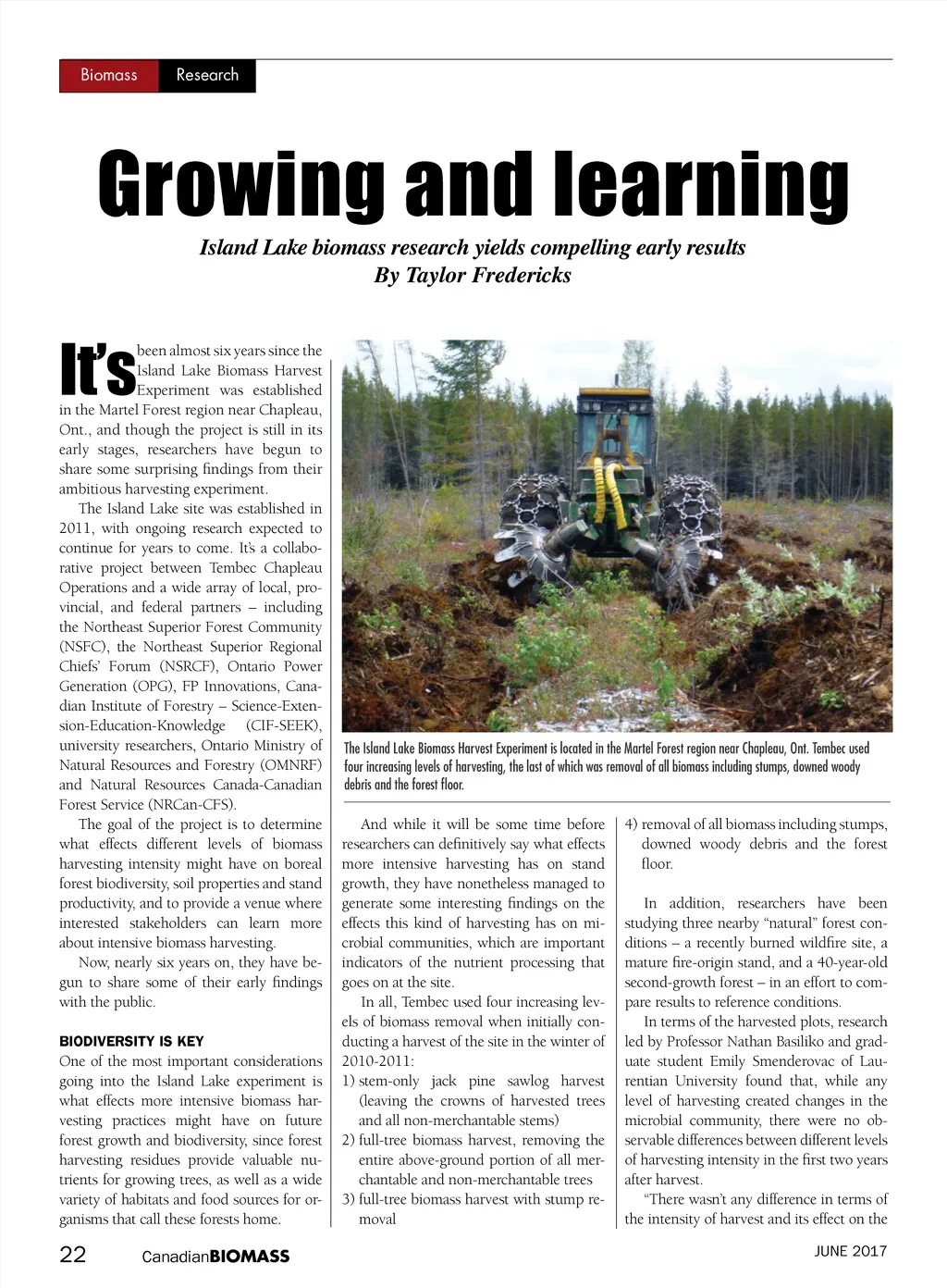
Biomass Research Growing and learning Island Lake biomass research yields compelling early results By Taylor Fredericks It’s been almost six years since the Island Lake Biomass Harvest Experiment was established in the Martel Forest region near Chapleau, Ont., and though the project is still in its early stages, researchers have begun to share some surprising findings from their ambitious harvesting experiment. The Island Lake site was established in 2011, with ongoing research expected to continue for years to come. It’s a collabo-rative project between Tembec Chapleau Operations and a wide array of local, pro-vincial, and federal partners – including the Northeast Superior Forest Community (NSFC), the Northeast Superior Regional Chiefs’ Forum (NSRCF), Ontario Power Generation (OPG), FP Innovations, Cana-dian Institute of Forestry – Science-Exten-sion-Education-Knowledge (CIF-SEEK), university researchers, Ontario Ministry of Natural Resources and Forestry (OMNRF) and Natural Resources Canada-Canadian Forest Service (NRCan-CFS). The goal of the project is to determine what effects different levels of biomass harvesting intensity might have on boreal forest biodiversity, soil properties and stand productivity, and to provide a venue where interested stakeholders can learn more about intensive biomass harvesting. Now, nearly six years on, they have be-gun to share some of their early findings with the public. BIODIVERSITY IS KEY The Island Lake Biomass Harvest Experiment is located in the Martel Forest region near Chapleau, Ont. Tembec used four increasing levels of harvesting, the last of which was removal of all biomass including stumps, downed woody debris and the forest floor. One of the most important considerations going into the Island Lake experiment is what effects more intensive biomass har-vesting practices might have on future forest growth and biodiversity, since forest harvesting residues provide valuable nu-trients for growing trees, as well as a wide variety of habitats and food sources for or-ganisms that call these forests home. And while it will be some time before researchers can definitively say what effects more intensive harvesting has on stand growth, they have nonetheless managed to generate some interesting findings on the effects this kind of harvesting has on mi-crobial communities, which are important indicators of the nutrient processing that goes on at the site. In all, Tembec used four increasing lev-els of biomass removal when initially con-ducting a harvest of the site in the winter of 2010-2011: 1) stem-only jack pine sawlog harvest (leaving the crowns of harvested trees and all non-merchantable stems) 2) full-tree biomass harvest, removing the entire above-ground portion of all mer-chantable and non-merchantable trees 3) full-tree biomass harvest with stump re-moval 4) removal of all biomass including stumps, downed woody debris and the forest floor. In addition, researchers have been studying three nearby “natural” forest con-ditions – a recently burned wildfire site, a mature fire-origin stand, and a 40-year-old second-growth forest – in an effort to com-pare results to reference conditions. In terms of the harvested plots, research led by Professor Nathan Basiliko and grad-uate student Emily Smenderovac of Lau-rentian University found that, while any level of harvesting created changes in the microbial community, there were no ob-servable differences between different levels of harvesting intensity in the first two years after harvest. “There wasn’t any difference in terms of the intensity of harvest and its effect on the JUNE 2017 22 Canadian BIOMASS
Canadian Biomass May-June 2017: Page 22