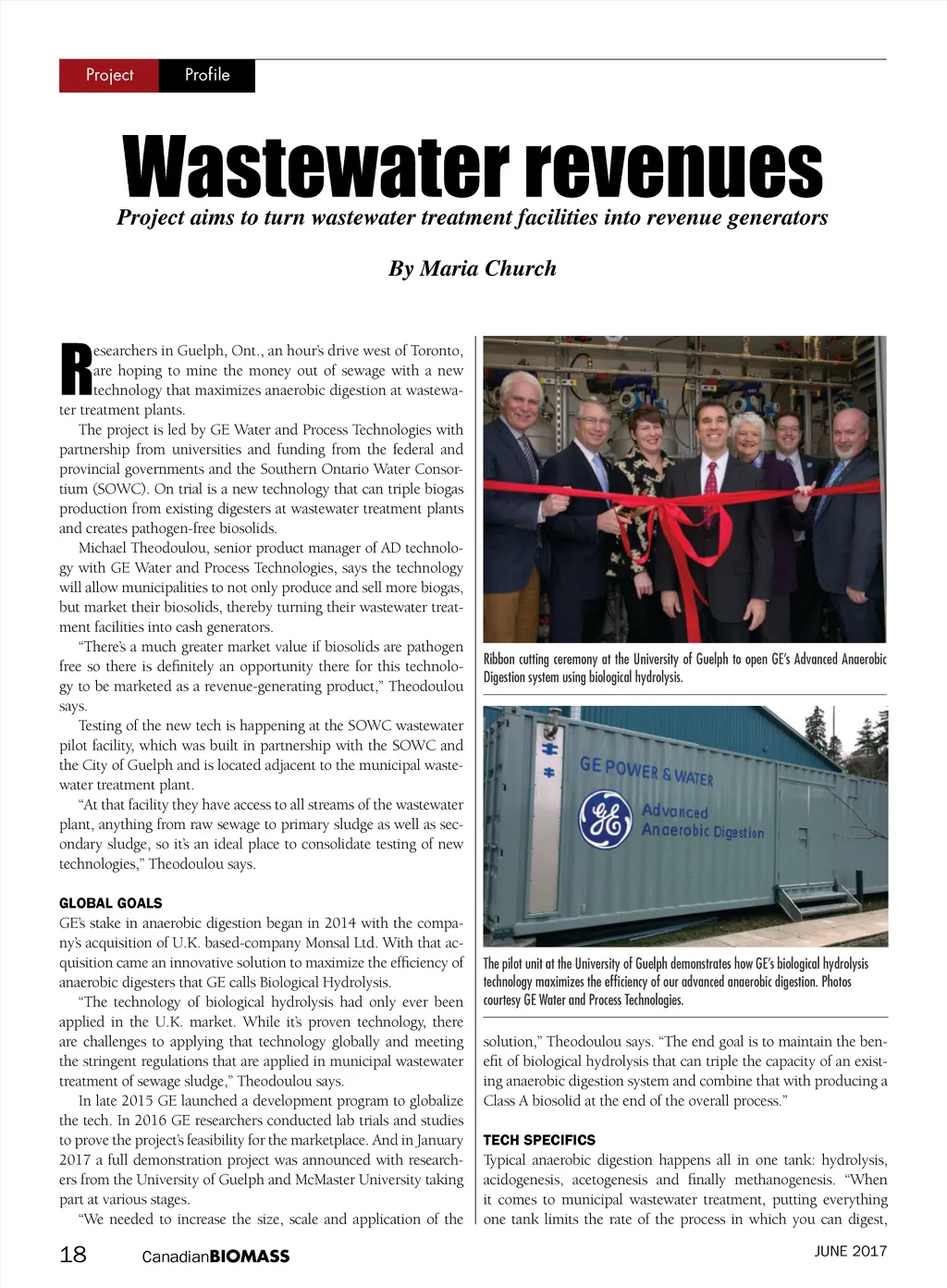
recognizing that hydrolysis is the rate limiting step. It’s like taking a peel off an orange,” Theodoulou says. GE’s biological hydrolysis takes the hydrolysis and acidification steps out of the tank and moves them up the process chain, allow-ing these steps to occur in optimal conditions. Once the sludge has passed through the biological hydrolysis stage, it enters the tank where it performs methanogenesis to create methane. Thus more biogas is produced per tank. “It really is an enabling technology to put more sludge through the digester,” Theodoulou says. The other goal of the project is to create pathogen-free biosol-ids, which requires subjecting the sludge to a particular tempera-ture over time. “There are growing restrictions globally for biosol-ids that are not treated to the equivalent of Class A standards,” Theodoulou says. “We are adjusting the biological hydrolysis process conditions so that not only do we get that acceleration of the digestion rate but also to make sure that all of the pathogens are nullified and the biosolids are free of those,” he says. The technology is applied as a retrofit to existing anaerobic di-gesters. A six-tank reactor system is placed upstream of the digester tank in the process line, with a total retention time of two to three days. At the pilot plant in Guelph GE researchers have applied the biological hydrolysis tech and are looking to cut the retention time of sludge in the test digester in half. “With the first results from our trials we’re showing that the efficiencies of the digesters at the wastewater plant could be increased twofold,” Theodoulou says. An increase in biogas production could potentially lead to a waste treatment facility offsetting the energy it requires to run, ei-ther by converting biogas to electricity and heat or upgrading it to renewable natural gas. MEETING DEMAND Glenn Vicevic, executive, product management of GE’s Water & Process Technologies, conducts tours of the GE advanced anaerobic digestion pilot for dignitaries at the grand opening event. is the biggest challenge I see in terms of the rollout and showing its viability at full scale.” By end of the year, he says, the research project at the demon-stration plant will be completed to allow GE to take the technology to market. It remains to be seen if a Canadian municipality will be first in line to turn their refuse into revenues. • Beyond the revenue opportunities of increased biogas yields and the production of Class A biosolids, the biological hydrolysis tech-nology also means municipalities will be able to handle population and industry growth without building new wastewater treatment infrastructure. As urban centres grow across Canada, the demand on existing wastewater treatment facilities will only increase. “Based on our estimates, when you apply biological hydrolysis in comparison to building a new digestion infrastructure, you’re going to save over 40 per cent,” Theodoulou says. Once GE’s technology is in place in a facility, the freed up tank space can then be used to co-digest other organic waste streams such as residential and industrial food waste that would otherwise go to a landfill. UPSCALE GET READY: THERMOCHEMICAL BIOMASS CONVERSION MEETS CHICAGO. Theodoulou says he’s confident that once the biological hydroly-sis technology is past the demonstration phase it will be ready for commercial application. That could be as early as next year. “What I see is the biggest challenge of the scale up is finding an early adopter,” Theodoulou says. “For North America anyway, this is a new technology and we are going to be selling this into the municipal marketplace which is relatively conservative. Finding a wastewater plant that is willing to be that first full-scale installation THE INTERNATIONAL CONFERENCE ON THERMOCHEMICAL CONVERSION SCIENCE 7 September 19-21 | Chicago, IL www.gastechnology.org/tcbiomass Canadian BIOMASS 19
Canadian Biomass May-June 2017: Page 19