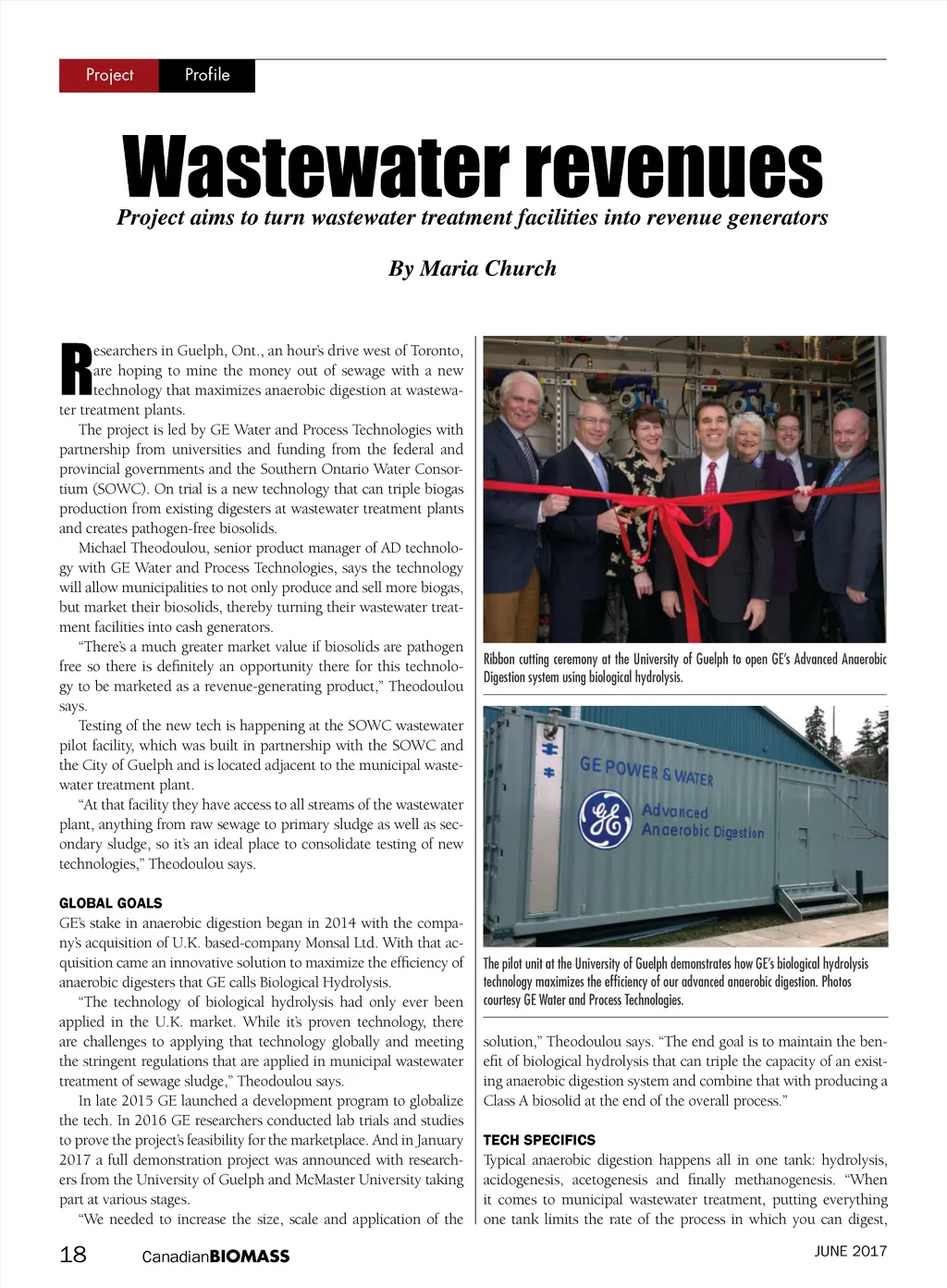
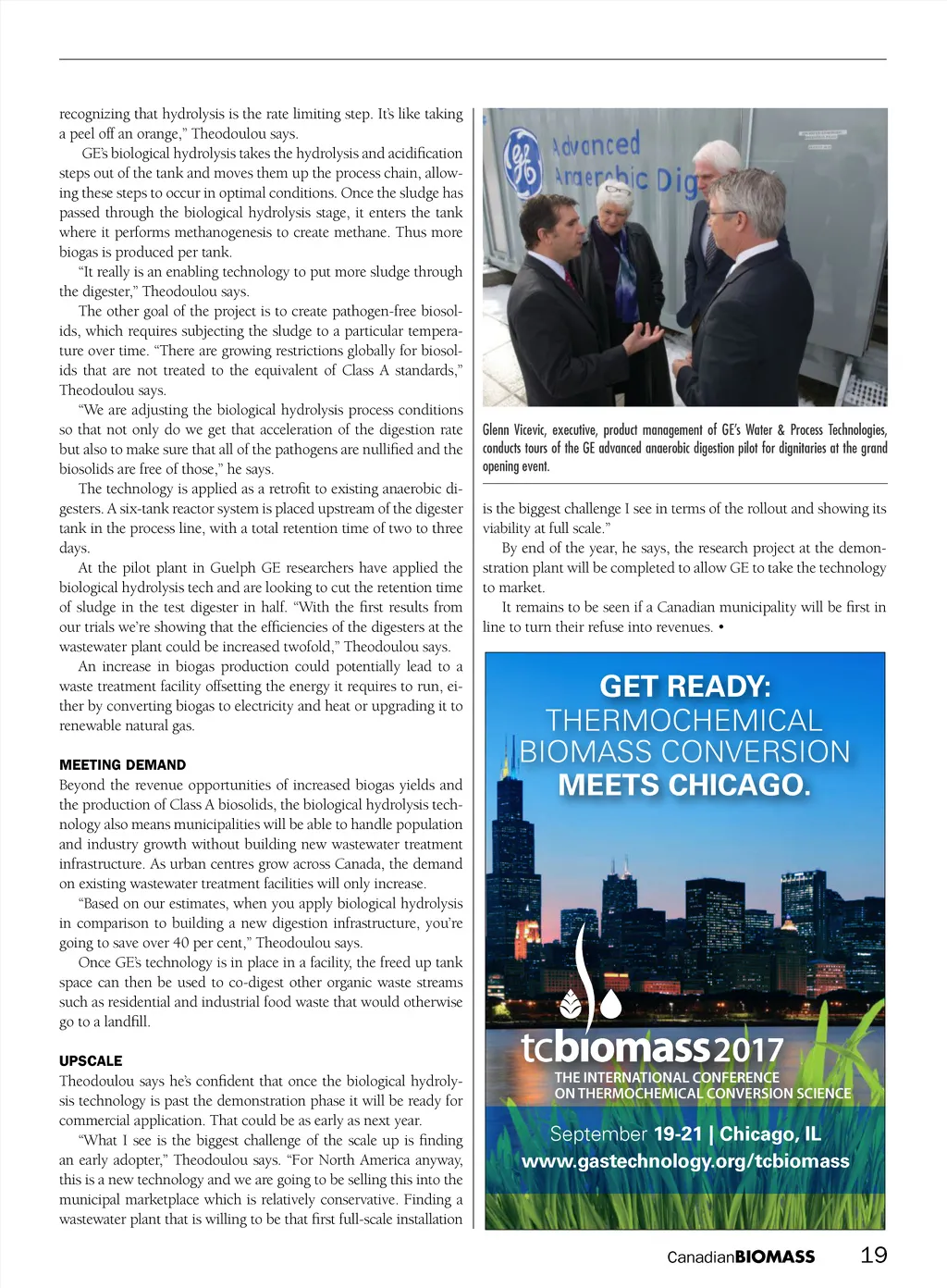
Project Profile Project aims to turn wastewater treatment facilities into revenue generators By Maria Church Wastewater revenues esearchers in Guelph, Ont., an hour’s drive west of Toronto, are hoping to mine the money out of sewage with a new technology that maximizes anaerobic digestion at wastewa-ter treatment plants. The project is led by GE Water and Process Technologies with partnership from universities and funding from the federal and provincial governments and the Southern Ontario Water Consor-tium (SOWC). On trial is a new technology that can triple biogas production from existing digesters at wastewater treatment plants and creates pathogen-free biosolids. Michael Theodoulou, senior product manager of AD technolo-gy with GE Water and Process Technologies, says the technology will allow municipalities to not only produce and sell more biogas, but market their biosolids, thereby turning their wastewater treat-ment facilities into cash generators. “There’s a much greater market value if biosolids are pathogen free so there is definitely an opportunity there for this technolo-gy to be marketed as a revenue-generating product,” Theodoulou says. Testing of the new tech is happening at the SOWC wastewater pilot facility, which was built in partnership with the SOWC and the City of Guelph and is located adjacent to the municipal waste-water treatment plant. “At that facility they have access to all streams of the wastewater plant, anything from raw sewage to primary sludge as well as sec-ondary sludge, so it’s an ideal place to consolidate testing of new technologies,” Theodoulou says. GLOBAL GOALS R Ribbon cutting ceremony at the University of Guelph to open GE’s Advanced Anaerobic Digestion system using biological hydrolysis. GE’s stake in anaerobic digestion began in 2014 with the compa-ny’s acquisition of U.K. based-company Monsal Ltd. With that ac-quisition came an innovative solution to maximize the efficiency of anaerobic digesters that GE calls Biological Hydrolysis. “The technology of biological hydrolysis had only ever been applied in the U.K. market. While it’s proven technology, there are challenges to applying that technology globally and meeting the stringent regulations that are applied in municipal wastewater treatment of sewage sludge,” Theodoulou says. In late 2015 GE launched a development program to globalize the tech. In 2016 GE researchers conducted lab trials and studies to prove the project’s feasibility for the marketplace. And in January 2017 a full demonstration project was announced with research-ers from the University of Guelph and McMaster University taking part at various stages. “We needed to increase the size, scale and application of the The pilot unit at the University of Guelph demonstrates how GE’s biological hydrolysis technology maximizes the efficiency of our advanced anaerobic digestion. Photos courtesy GE Water and Process Technologies. solution,” Theodoulou says. “The end goal is to maintain the ben-efit of biological hydrolysis that can triple the capacity of an exist-ing anaerobic digestion system and combine that with producing a Class A biosolid at the end of the overall process.” TECH SPECIFICS Typical anaerobic digestion happens all in one tank: hydrolysis, acidogenesis, acetogenesis and finally methanogenesis. “When it comes to municipal wastewater treatment, putting everything one tank limits the rate of the process in which you can digest, JUNE 2017 18 Canadian BIOMASS
Canadian Biomass May-June 2017: Page 18