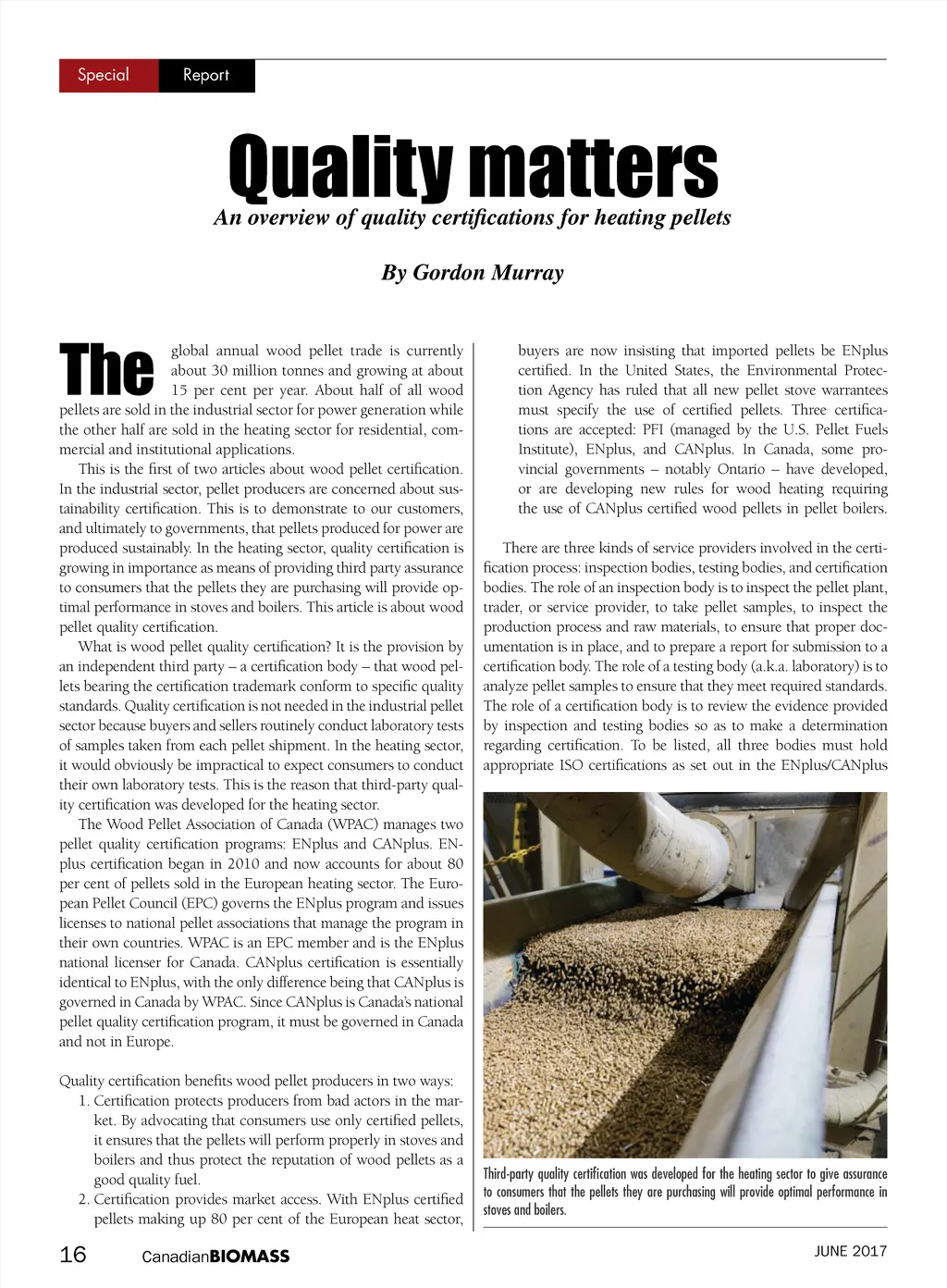
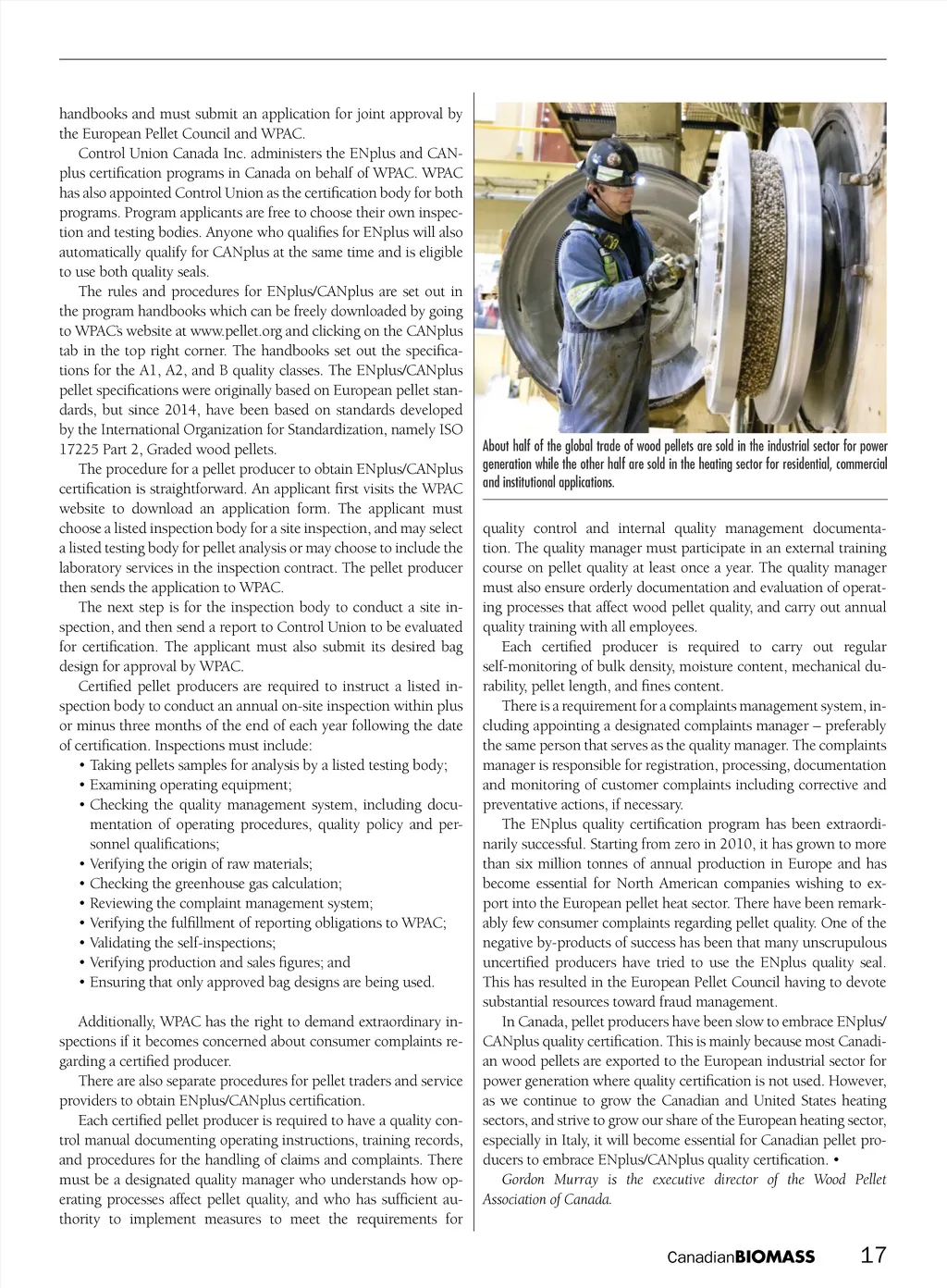
handbooks and must submit an application for joint approval by the European Pellet Council and WPAC. Control Union Canada Inc. administers the ENplus and CAN-plus certification programs in Canada on behalf of WPAC. WPAC has also appointed Control Union as the certification body for both programs. Program applicants are free to choose their own inspec-tion and testing bodies. Anyone who qualifies for ENplus will also automatically qualify for CANplus at the same time and is eligible to use both quality seals. The rules and procedures for ENplus/CANplus are set out in the program handbooks which can be freely downloaded by going to WPAC’s website at www.pellet.org and clicking on the CANplus tab in the top right corner. The handbooks set out the specifica-tions for the A1, A2, and B quality classes. The ENplus/CANplus pellet specifications were originally based on European pellet stan-dards, but since 2014, have been based on standards developed by the International Organization for Standardization, namely ISO 17225 Part 2, Graded wood pellets. The procedure for a pellet producer to obtain ENplus/CANplus certification is straightforward. An applicant first visits the WPAC website to download an application form. The applicant must choose a listed inspection body for a site inspection, and may select a listed testing body for pellet analysis or may choose to include the laboratory services in the inspection contract. The pellet producer then sends the application to WPAC. The next step is for the inspection body to conduct a site in-spection, and then send a report to Control Union to be evaluated for certification. The applicant must also submit its desired bag design for approval by WPAC. Certified pellet producers are required to instruct a listed in-spection body to conduct an annual on-site inspection within plus or minus three months of the end of each year following the date of certification. Inspections must include: • Taking pellets samples for analysis by a listed testing body; • Examining operating equipment; • Checking the quality management system, including docu-mentation of operating procedures, quality policy and per-sonnel qualifications; • Verifying the origin of raw materials; • Checking the greenhouse gas calculation; • Reviewing the complaint management system; • Verifying the fulfillment of reporting obligations to WPAC; • Validating the self-inspections; • Verifying production and sales figures; and • Ensuring that only approved bag designs are being used. Additionally, WPAC has the right to demand extraordinary in-spections if it becomes concerned about consumer complaints re-garding a certified producer. There are also separate procedures for pellet traders and service providers to obtain ENplus/CANplus certification. Each certified pellet producer is required to have a quality con-trol manual documenting operating instructions, training records, and procedures for the handling of claims and complaints. There must be a designated quality manager who understands how op-erating processes affect pellet quality, and who has sufficient au-thority to implement measures to meet the requirements for About half of the global trade of wood pellets are sold in the industrial sector for power generation while the other half are sold in the heating sector for residential, commercial and institutional applications. quality control and internal quality management documenta-tion. The quality manager must participate in an external training course on pellet quality at least once a year. The quality manager must also ensure orderly documentation and evaluation of operat-ing processes that affect wood pellet quality, and carry out annual quality training with all employees. Each certified producer is required to carry out regular self-monitoring of bulk density, moisture content, mechanical du-rability, pellet length, and fines content. There is a requirement for a complaints management system, in-cluding appointing a designated complaints manager – preferably the same person that serves as the quality manager. The complaints manager is responsible for registration, processing, documentation and monitoring of customer complaints including corrective and preventative actions, if necessary. The ENplus quality certification program has been extraordi-narily successful. Starting from zero in 2010, it has grown to more than six million tonnes of annual production in Europe and has become essential for North American companies wishing to ex-port into the European pellet heat sector. There have been remark-ably few consumer complaints regarding pellet quality. One of the negative by-products of success has been that many unscrupulous uncertified producers have tried to use the ENplus quality seal. This has resulted in the European Pellet Council having to devote substantial resources toward fraud management. In Canada, pellet producers have been slow to embrace ENplus/ CANplus quality certification. This is mainly because most Canadi-an wood pellets are exported to the European industrial sector for power generation where quality certification is not used. However, as we continue to grow the Canadian and United States heating sectors, and strive to grow our share of the European heating sector, especially in Italy, it will become essential for Canadian pellet pro-ducers to embrace ENplus/CANplus quality certification. • Gordon Murray is the executive director of the Wood Pellet Association of Canada. Canadian BIOMASS 17
Canadian Biomass May-June 2017: Page 17