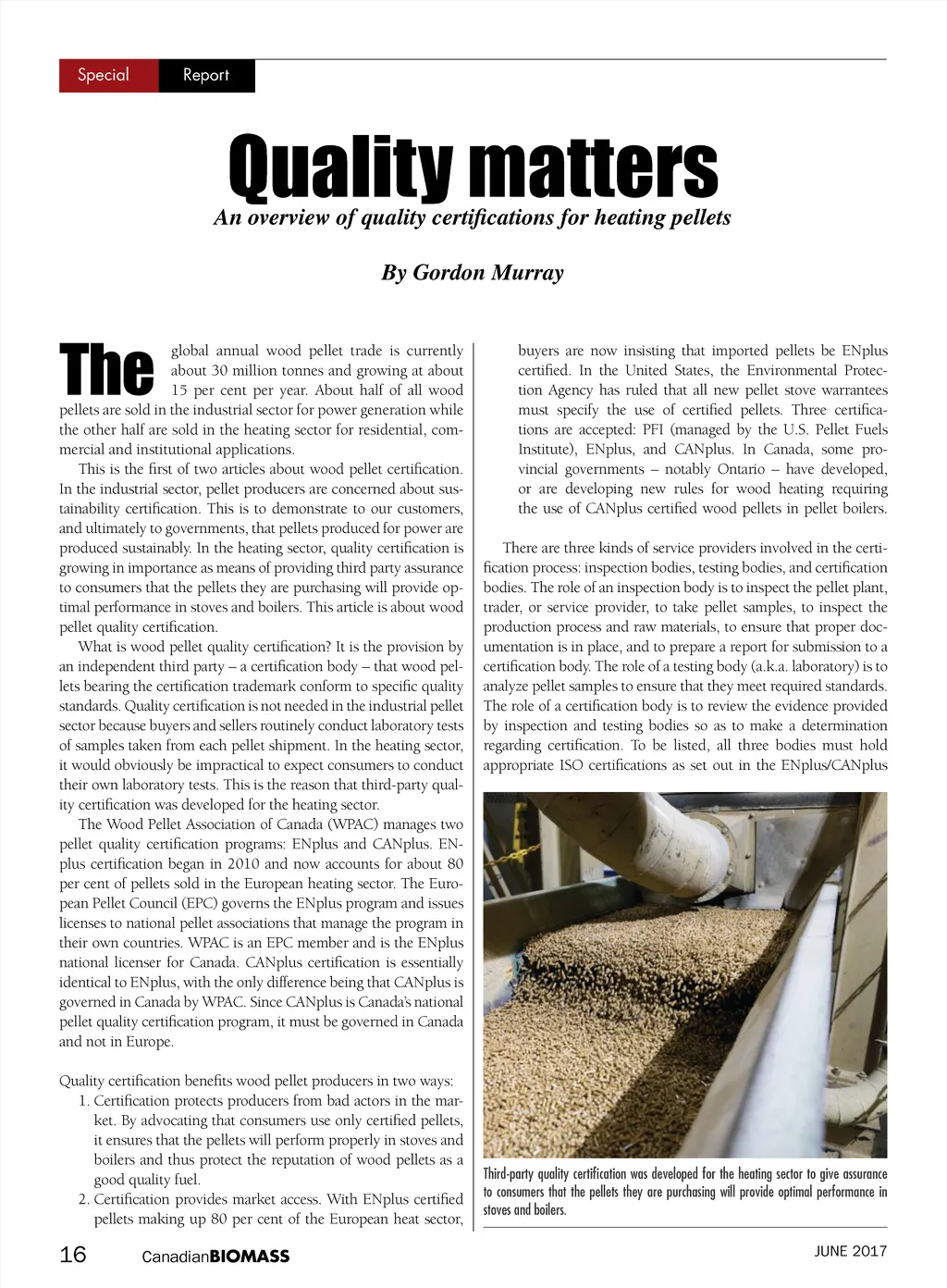
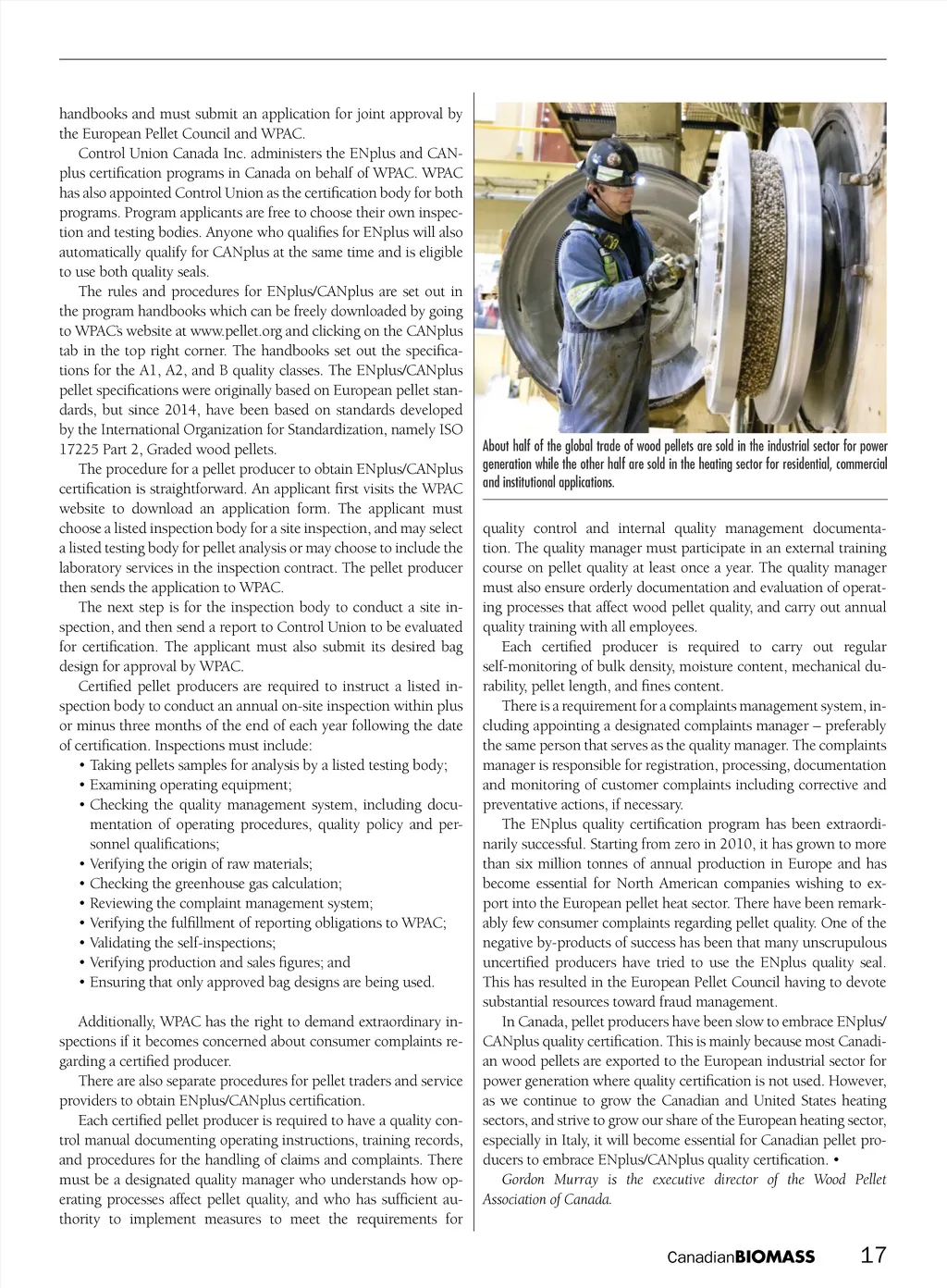
Special Report An overview of quality certifications for heating pellets By Gordon Murray global annual wood pellet trade is currently about 30 million tonnes and growing at about 15 per cent per year. About half of all wood pellets are sold in the industrial sector for power generation while the other half are sold in the heating sector for residential, com-mercial and institutional applications. This is the first of two articles about wood pellet certification. In the industrial sector, pellet producers are concerned about sus-tainability certification. This is to demonstrate to our customers, and ultimately to governments, that pellets produced for power are produced sustainably. In the heating sector, quality certification is growing in importance as means of providing third party assurance to consumers that the pellets they are purchasing will provide op-timal performance in stoves and boilers. This article is about wood pellet quality certification. What is wood pellet quality certification? It is the provision by an independent third party – a certification body – that wood pel-lets bearing the certification trademark conform to specific quality standards. Quality certification is not needed in the industrial pellet sector because buyers and sellers routinely conduct laboratory tests of samples taken from each pellet shipment. In the heating sector, it would obviously be impractical to expect consumers to conduct their own laboratory tests. This is the reason that third-party qual-ity certification was developed for the heating sector. The Wood Pellet Association of Canada (WPAC) manages two pellet quality certification programs: ENplus and CANplus. EN-plus certification began in 2010 and now accounts for about 80 per cent of pellets sold in the European heating sector. The Euro-pean Pellet Council (EPC) governs the ENplus program and issues licenses to national pellet associations that manage the program in their own countries. WPAC is an EPC member and is the ENplus national licenser for Canada. CANplus certification is essentially identical to ENplus, with the only difference being that CANplus is governed in Canada by WPAC. Since CANplus is Canada’s national pellet quality certification program, it must be governed in Canada and not in Europe. Quality certification benefits wood pellet producers in two ways: 1. Certification protects producers from bad actors in the mar-ket. By advocating that consumers use only certified pellets, it ensures that the pellets will perform properly in stoves and boilers and thus protect the reputation of wood pellets as a good quality fuel. 2. Certification provides market access. With ENplus certified pellets making up 80 per cent of the European heat sector, Quality matters The buyers are now insisting that imported pellets be ENplus certified. In the United States, the Environmental Protec-tion Agency has ruled that all new pellet stove warrantees must specify the use of certified pellets. Three certifica-tions are accepted: PFI (managed by the U.S. Pellet Fuels Institute), ENplus, and CANplus. In Canada, some pro-vincial governments – notably Ontario – have developed, or are developing new rules for wood heating requiring the use of CANplus certified wood pellets in pellet boilers. There are three kinds of service providers involved in the certi-fication process: inspection bodies, testing bodies, and certification bodies. The role of an inspection body is to inspect the pellet plant, trader, or service provider, to take pellet samples, to inspect the production process and raw materials, to ensure that proper doc-umentation is in place, and to prepare a report for submission to a certification body. The role of a testing body (a.k.a. laboratory) is to analyze pellet samples to ensure that they meet required standards. The role of a certification body is to review the evidence provided by inspection and testing bodies so as to make a determination regarding certification. To be listed, all three bodies must hold appropriate ISO certifications as set out in the ENplus/CANplus Third-party quality certification was developed for the heating sector to give assurance to consumers that the pellets they are purchasing will provide optimal performance in stoves and boilers. JUNE 2017 16 Canadian BIOMASS
Canadian Biomass May-June 2017: Page 16