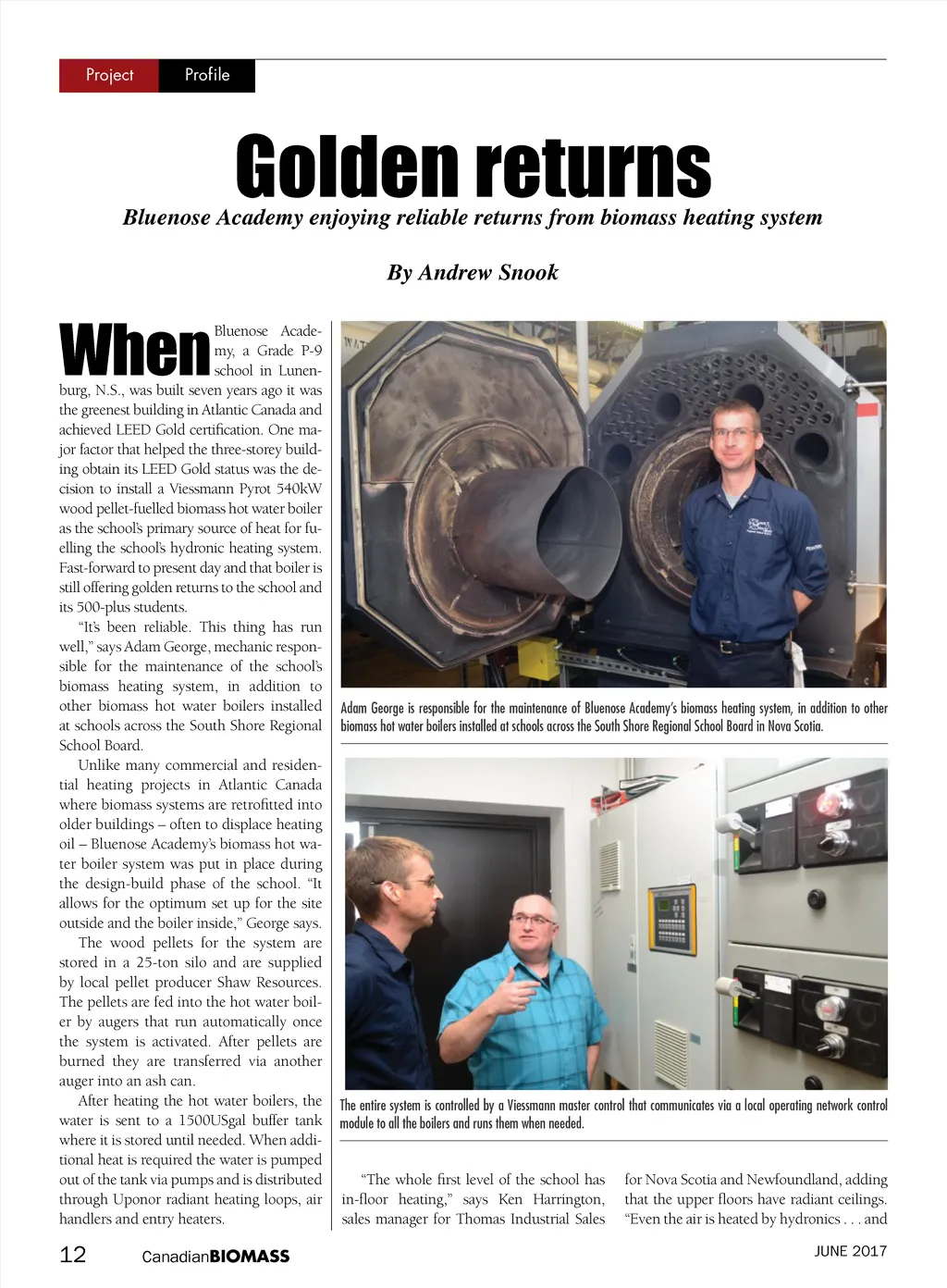
with the buffer tank there is never a short-age of hot water.” A Viessmann Vitorond 200 oil/gas-fired hot water heating boiler was also installed during the design-build phase of the school to ensure the system had the neces-sary backup heating requirements in place. “This allows for 100 per cent redun-dancy if the biomass boiler goes down,” explains Harrington. The oil-fired unit does not start up unless the biomass boiler system is down for routine maintenance. The entire system is controlled by a Viessmann master control that communi-cates via a local operating network (LON) control module. The biomass system burns about 3/4 of a ton of wood pellets per day, which costs the school about half of what it typically costs to heat a facility of its size with heat-ing oil, Harrington says. Although it took a little while for George to get accustomed to working on wood pel-let-fuelled boiler systems – he was originally trained to work on oil-fired units – he says the system has been consistently running as smoothly as the day it was installed. George has not had to install any parts on the bio-mass boiler outside of routine maintenance. “I’ve just bought a spare igniter and an O2 sensor, but I haven’t had to install them,” he says. “Nothing on the boiler has failed to date. It’s very good.” WHW Architects was the principal ar-chitect that designed the Bluenose Academy design-build LEED Gold project. Dumac Energy Ltd. was the mechanical contractor that installed the mechanical systems and Bird Construction was lead contractor for the construction of the facility. Additional green features throughout Bluenose Academy include solar air, solar thermal and solar PV technologies; a green roof to harvest rainwater; low-flow fixtures to reduce water consumption; and natural light for 75 per cent of the occupied space. The academy won the Canadian So-lar Thermal Project of the Year, which was awarded by the Canadian Solar Industries Association. (CanSIA) in 2012. Mechanically the system was designed, installed and commissioned with little is-sue. This was the first modern biomass system in Nova Scotia in years. Many sets of eyes were following the project, with trepidation. If the province was going to do more biomass systems everyone knew the system had to be flawless. • When the Grade P-9 school in Lunenburg, N.S., was built seven years ago it was the greenest building in Atlantic Canada and achieved LEED Gold certification. A Viessmann Pyrot 540kW wood pellet-fuelled biomass hot water boiler is the school’s primary source of heat for fuelling the school’s hydronic heating system. Canadian BIOMASS CBM_DetroitStoker_June17_CSA.indd 1 13 2017-05-25 7:46 AM
Canadian Biomass May-June 2017: Page 13