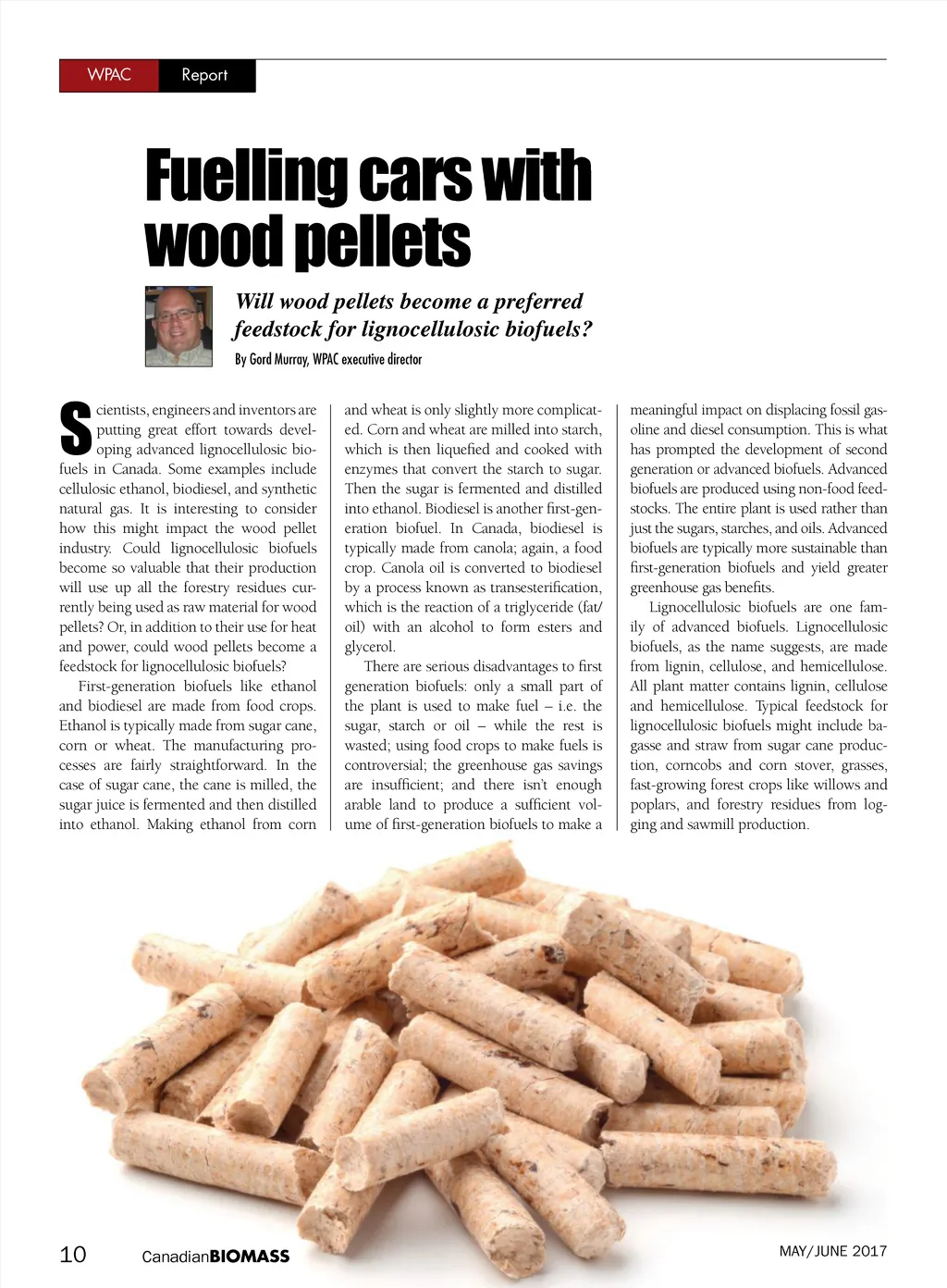
WPAC Report Fuelling cars with wood pellets Will wood pellets become a preferred feedstock for lignocellulosic biofuels? By Gord Murray, WPAC executive director S cientists, engineers and inventors are putting great effort towards devel-oping advanced lignocellulosic bio-fuels in Canada. Some examples include cellulosic ethanol, biodiesel, and synthetic natural gas. It is interesting to consider how this might impact the wood pellet industry. Could lignocellulosic biofuels become so valuable that their production will use up all the forestry residues cur-rently being used as raw material for wood pellets? Or, in addition to their use for heat and power, could wood pellets become a feedstock for lignocellulosic biofuels? First-generation biofuels like ethanol and biodiesel are made from food crops. Ethanol is typically made from sugar cane, corn or wheat. The manufacturing pro-cesses are fairly straightforward. In the case of sugar cane, the cane is milled, the sugar juice is fermented and then distilled into ethanol. Making ethanol from corn and wheat is only slightly more complicat-ed. Corn and wheat are milled into starch, which is then liquefied and cooked with enzymes that convert the starch to sugar. Then the sugar is fermented and distilled into ethanol. Biodiesel is another first-gen-eration biofuel. In Canada, biodiesel is typically made from canola; again, a food crop. Canola oil is converted to biodiesel by a process known as transesterification, which is the reaction of a triglyceride (fat/ oil) with an alcohol to form esters and glycerol. There are serious disadvantages to first generation biofuels: only a small part of the plant is used to make fuel – i.e. the sugar, starch or oil – while the rest is wasted; using food crops to make fuels is controversial; the greenhouse gas savings are insufficient; and there isn’t enough arable land to produce a sufficient vol-ume of first-generation biofuels to make a meaningful impact on displacing fossil gas-oline and diesel consumption. This is what has prompted the development of second generation or advanced biofuels. Advanced biofuels are produced using non-food feed-stocks. The entire plant is used rather than just the sugars, starches, and oils. Advanced biofuels are typically more sustainable than first-generation biofuels and yield greater greenhouse gas benefits. Lignocellulosic biofuels are one fam-ily of advanced biofuels. Lignocellulosic biofuels, as the name suggests, are made from lignin, cellulose, and hemicellulose. All plant matter contains lignin, cellulose and hemicellulose. Typical feedstock for lignocellulosic biofuels might include ba-gasse and straw from sugar cane produc-tion, corncobs and corn stover, grasses, fast-growing forest crops like willows and poplars, and forestry residues from log-ging and sawmill production. 10 Canadian BIOMASS MAY/JUNE 2017
Canadian Biomass May-June 2017: Page 10