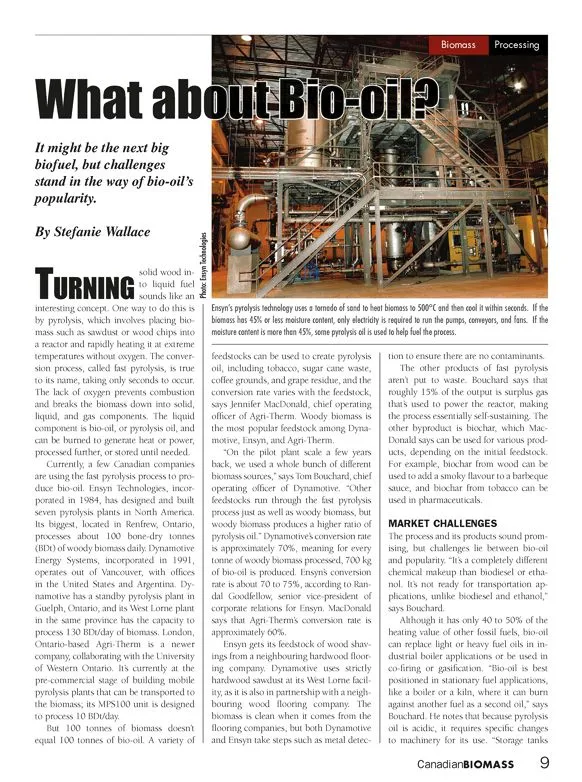
Biomass What about Bio-oil? It might be the next big biofuel, but challenges stand in the way of bio-oil’s popularity. By Stefanie Wallace Turning solid wood in- to liquid fuel sounds like an interesting concept. One way to do this is by pyrolysis, which involves placing bio- mass such as sawdust or wood chips into a reactor and rapidly heating it at extreme temperatures without oxygen. The conver- sion process, called fast pyrolysis, is true to its name, taking only seconds to occur. The lack of oxygen prevents combustion and breaks the biomass down into solid, liquid, and gas components. The liquid component is bio-oil, or pyrolysis oil, and can be burned to generate heat or power, processed further, or stored until needed. Currently, a few Canadian companies are using the fast pyrolysis process to pro- duce bio-oil. Ensyn Technologies, incor- porated in 1984, has designed and built seven pyrolysis plants in North America. Its biggest, located in Renfrew, Ontario, processes about 100 bone-dry tonnes (BDt) of woody biomass daily. Dynamotive Energy Systems, incorporated in 1991, operates out of Vancouver, with offices in the United States and Argentina. Dy- namotive has a standby pyrolysis plant in Guelph, Ontario, and its West Lorne plant in the same province has the capacity to process 130 BDt/day of biomass. London, Ontario-based Agri-Therm is a newer company, collaborating with the University of Western Ontario. It’s currently at the pre-commercial stage of building mobile pyrolysis plants that can be transported to the biomass; its MPS100 unit is designed to process 10 BDt/day. But 100 tonnes of biomass doesn’t equal 100 tonnes of bio-oil. A variety of Ensyn’s pyrolysis technology uses a tornado of sand to heat biomass to 500°C and then cool it within seconds. If the biomass has 45% or less moisture content, only electricity is required to run the pumps, conveyors, and fans. If the moisture content is more than 45%, some pyrolysis oil is used to help fuel the process. feedstocks can be used to create pyrolysis oil, including tobacco, sugar cane waste, coffee grounds, and grape residue, and the conversion rate varies with the feedstock, says Jennifer MacDonald, chief operating officer of Agri-Therm. Woody biomass is the most popular feedstock among Dyna- motive, Ensyn, and Agri-Therm. “On the pilot plant scale a few years back, we used a whole bunch of different biomass sources,” says Tom Bouchard, chief operating officer of Dynamotive. “Other feedstocks run through the fast pyrolysis process just as well as woody biomass, but woody biomass produces a higher ratio of pyrolysis oil.” Dynamotive’s conversion rate is approximately 70%, meaning for every tonne of woody biomass processed, 700 kg of bio-oil is produced. Ensyn’s conversion rate is about 70 to 75%, according to Ran- dal Goodfellow, senior vice-president of corporate relations for Ensyn. MacDonald says that Agri-Therm’s conversion rate is approximately 60%. Ensyn gets its feedstock of wood shav- ings from a neighbouring hardwood floor- ing company. Dynamotive uses strictly hardwood sawdust at its West Lorne facil- ity, as it is also in partnership with a neigh- bouring wood flooring company. The biomass is clean when it comes from the flooring companies, but both Dynamotive and Ensyn take steps such as metal detec- tion to ensure there are no contaminants. The other products of fast pyrolysis aren’t put to waste. Bouchard says that roughly 15% of the output is surplus gas that’s used to power the reactor, making the process essentially self-sustaining. The other byproduct is biochar, which Mac- Donald says can be used for various prod- ucts, depending on the initial feedstock. For example, biochar from wood can be used to add a smoky flavour to a barbeque sauce, and biochar from tobacco can be used in pharmaceuticals. market Challenges The process and its products sound prom- ising, but challenges lie between bio-oil and popularity. “It’s a completely different chemical makeup than biodiesel or etha- nol. It’s not ready for transportation ap- plications, unlike biodiesel and ethanol,” says Bouchard. Although it has only 40 to 50% of the heating value of other fossil fuels, bio-oil can replace light or heavy fuel oils in in- dustrial boiler applications or be used in co-firing or gasification. “Bio-oil is best positioned in stationary fuel applications, like a boiler or a kiln, where it can burn against another fuel as a second oil,” says Bouchard. He notes that because pyrolysis oil is acidic, it requires specific changes to machinery for its use. “Storage tanks CanadianBIOMASS 9 Processing Photo: Ensyn Technologies
Canadian Biomass May/June 2010: Page 9