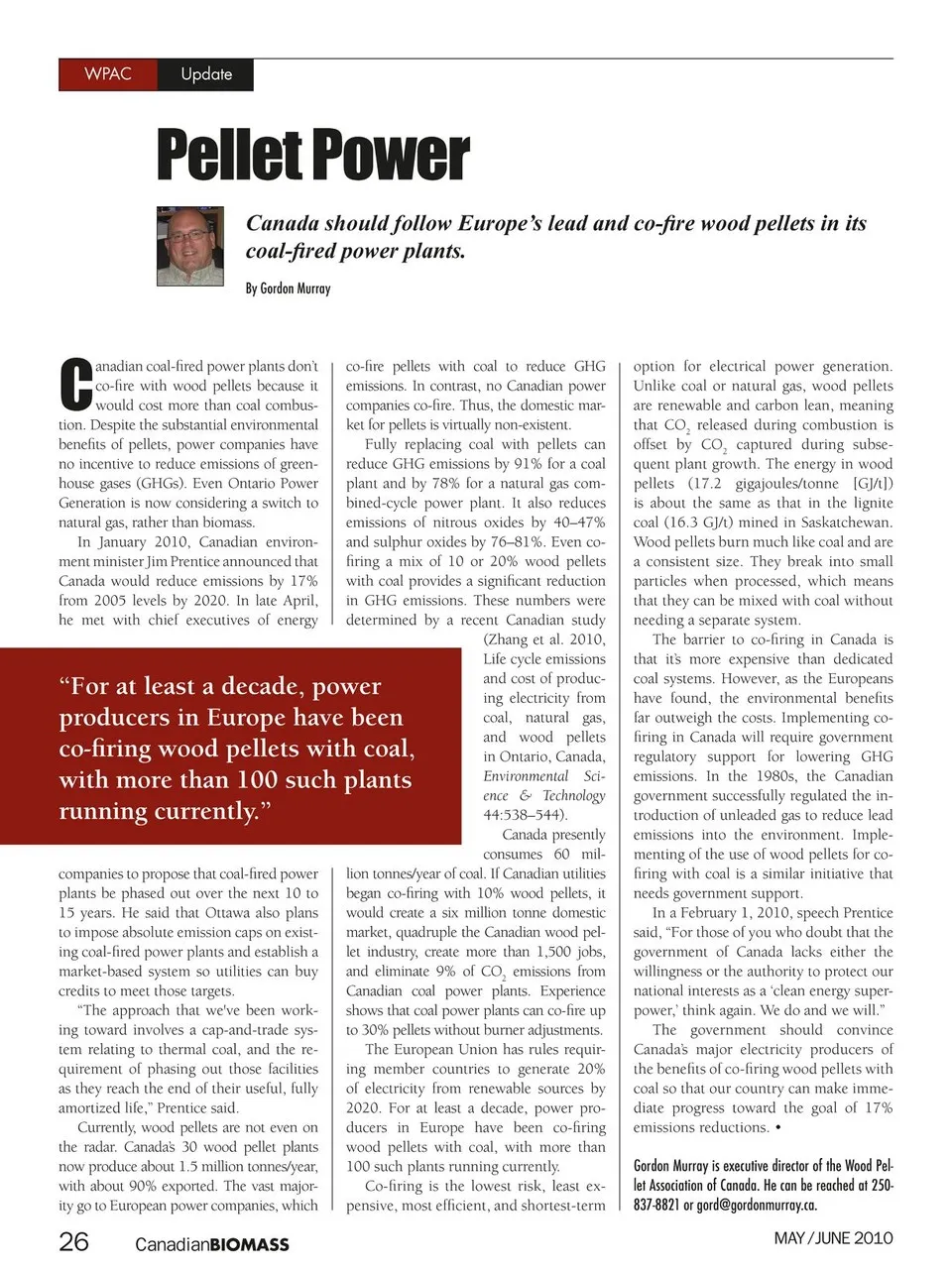
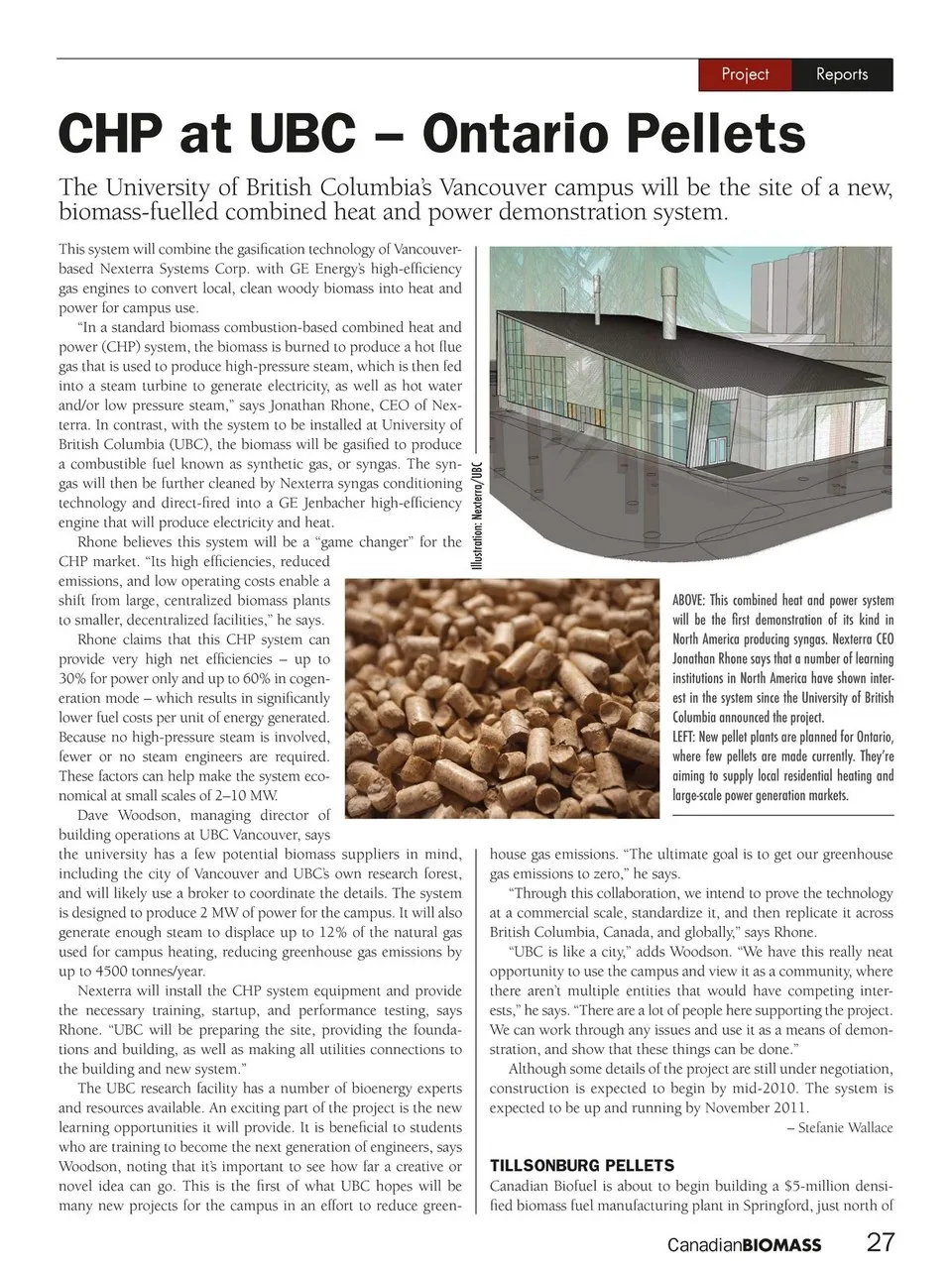
Project Chp at uBC – ontario pellets The University of British Columbia’s Vancouver campus will be the site of a new, biomass-fuelled combined heat and power demonstration system. This system will combine the gasification technology of Vancouver- based Nexterra Systems Corp. with GE Energy’s high-efficiency gas engines to convert local, clean woody biomass into heat and power for campus use. “In a standard biomass combustion-based combined heat and power (CHP) system, the biomass is burned to produce a hot flue gas that is used to produce high-pressure steam, which is then fed into a steam turbine to generate electricity, as well as hot water and/or low pressure steam,” says Jonathan Rhone, CEO of Nex- terra. In contrast, with the system to be installed at University of British Columbia (UBC), the biomass will be gasified to produce a combustible fuel known as synthetic gas, or syngas. The syn- gas will then be further cleaned by Nexterra syngas conditioning technology and direct-fired into a GE Jenbacher high-efficiency engine that will produce electricity and heat. Rhone believes this system will be a “game changer” for the CHP market. “Its high efficiencies, reduced emissions, and low operating costs enable a shift from large, centralized biomass plants to smaller, decentralized facilities,” he says. Rhone claims that this CHP system can provide very high net efficiencies – up to 30% for power only and up to 60% in cogen- eration mode – which results in significantly lower fuel costs per unit of energy generated. Because no high-pressure steam is involved, fewer or no steam engineers are required. These factors can help make the system eco- nomical at small scales of 2–10 MW. Dave Woodson, managing director of building operations at UBC Vancouver, says the university has a few potential biomass suppliers in mind, including the city of Vancouver and UBC’s own research forest, and will likely use a broker to coordinate the details. The system is designed to produce 2 MW of power for the campus. It will also generate enough steam to displace up to 12% of the natural gas used for campus heating, reducing greenhouse gas emissions by up to 4500 tonnes/year. Nexterra will install the CHP system equipment and provide the necessary training, startup, and performance testing, says Rhone. “UBC will be preparing the site, providing the founda- tions and building, as well as making all utilities connections to the building and new system.” The UBC research facility has a number of bioenergy experts and resources available. An exciting part of the project is the new learning opportunities it will provide. It is beneficial to students who are training to become the next generation of engineers, says Woodson, noting that it’s important to see how far a creative or novel idea can go. This is the first of what UBC hopes will be many new projects for the campus in an effort to reduce green- ABOVE: This combined heat and power system will be the first demonstration of its kind in North America producing syngas. Nexterra CEO Jonathan Rhone says that a number of learning institutions in North America have shown inter- est in the system since the University of British Columbia announced the project. LEFT: New pellet plants are planned for Ontario, where few pellets are made currently. They’re aiming to supply local residential heating and large-scale power generation markets. house gas emissions. “The ultimate goal is to get our greenhouse gas emissions to zero,” he says. “Through this collaboration, we intend to prove the technology at a commercial scale, standardize it, and then replicate it across British Columbia, Canada, and globally,” says Rhone. “UBC is like a city,” adds Woodson. “We have this really neat opportunity to use the campus and view it as a community, where there aren’t multiple entities that would have competing inter- ests,” he says. “There are a lot of people here supporting the project. We can work through any issues and use it as a means of demon- stration, and show that these things can be done.” Although some details of the project are still under negotiation, construction is expected to begin by mid-2010. The system is expected to be up and running by November 2011. – Stefanie Wallace tillsonBurg pellets Canadian Biofuel is about to begin building a $5-million densi- fied biomass fuel manufacturing plant in Springford, just north of CanadianBIOMASS 27 Reports Illustration: Nexterra/UBC
Canadian Biomass May/June 2010: Page 27